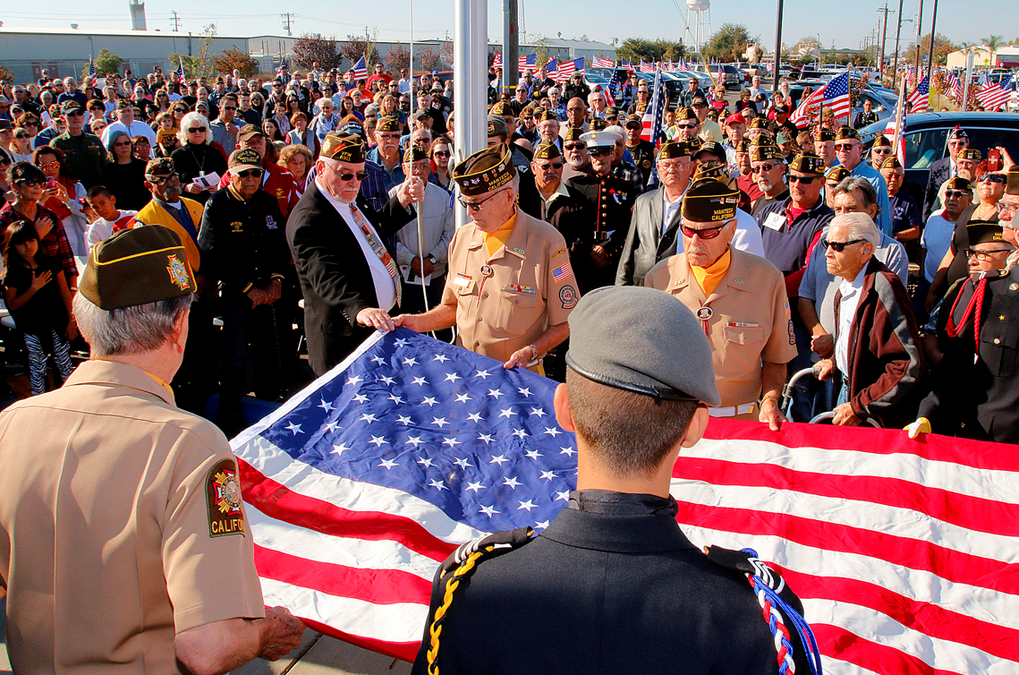
Should military-related flags fly over the Manteca Veterans of Foreign Wars hall on Moffat Boulevard?
That’s one of the questions but not the bottom line Tuesday as the Manteca City Council revisits the municipal policy regarding the display of flags at or on civic facilities or land.
How far the elected city leaders are willing to go when it comes to the categories of flags that can be flown on a city flag pole is the bottom line.
Before deciding what rules should apply to flags being allowed to be flown on property and facilities leased from the city such as the golf clubhouse, the Big League Dreams sports complex, and the Manteca Boys & Girls Club, the Council needs to decide if they want to retain the current flag policy or change it
The current policy is what is called “government speech.”
*City flagpoles are not a forum for the public’s frees expression.
*Commemorative flags may be flown outside City Hall as approved by the city manager as an expression of the city’s speech.
*Flags allowed by default are the American and California flags and a city flag, if and when one is adopted.
*Sister city flags may be flown inside city hall.
There are five options before the council when they meet Tuesday at 6 p.m. at the Civic Center, 1001 W. Center St.
*1) Only government flags such as the federal, state, and city flags at city hall and leased properties.
No additional decisions would be needed.
It is the most restrictive option and poses the least legal risk.
There would be no public participation or recognition of groups or causes.
*2) Government flags at city hall while leased properties could a) have no flags, b) only flags related to the organization, c) or any flag can fly.
The Council, the city manager or tenant would make the decision.
Somewhat problematic for legal exposure.
Decision also needs to be made whether leased properties will abide strictly by government speech or public speech.
*3) A calendar of commemorative flags being established annually for non-government flags to fly over city hall and leased city properties could a) have no flags, b) only flags related to the organization, c) or any flag can fly.
The City Council would make the decision.
Considered the middle ground of options as it accommodate government speech while allowing causes and groups to be recognized.
It is considered somewhat fraught with legal exposure.
*4) Commemorative flags could be allowed at city hall with a public request for a specific flag to fly.
The City Council or city manager would make the decision.
It is the option that is the least restrictive and puts the city at the greatest risk of being sued.
It would create a time consuming process utilizing city resources, opens up a forum for public debate, and is the policy that will create the most legal exposure for the city.
*5) Leave the policy as is regarding commemorative flags but allow no requests from third parties.
The city manager would make the decision.
Considered somewhat restrictive, it opens forum up for debate, and the city is deciding what groups and causes to recognize.
Staff, in a memo, made a number of other points for the council to keep in mind or weigh.
*The First Amendment protects freedom of speech from government restrictions.
*Cities must consider how allowing or denying flag requests interacts with the First Amendment. As an example, the Establishment Clause prohibits a city from favoring one religion over another.
*If the city unintentionally creates a public forum, it may lose the ability to restrict offensive or divisive flags.
*Decisions about the commemorative flag to display may generate strong community reactions and potential division.
*Reviewing applications and managing disputes could consume significant legal and staff resources.
*Without a clear written policy, ad hoc decisions could create legal vulnerability and perceptions of unfair treatment.
To contact Dennis Wyatt, email dwyatt@mantecabulletin.com ‘