A number of residential and commercial concerns are downsizing their Toters and bins in response to the weak economy.
Sometimes they try to cram too much waste into city provided containers resulting in garbage ending up on the ground
But there is good news.
The amount of recycling is up almost 26 percent in year-to-year comparisons.
At the same time in recent months, the city is experiencing a slight increase in contaminated recyclables that have to be buried due to garbage being placed in blue Toters as well as green Toters. The contamination rate is now up to between 7 and 9 percent. That trend- if it continues - could jeopardize Manteca’s seven plus years running of no solid waste fee increases.
“We don’t know if it is the foreclosure crisis or what, but we have noticed an increase in contamination,” noted Rexie LeStrange who coordinates Manteca’s recycling efforts.
Besides garbage, the biggest problem with recyclables is the placement of Styrofoam products in blue Toters.
LeStrange noted that Styrofoam is not recyclable in Manteca.
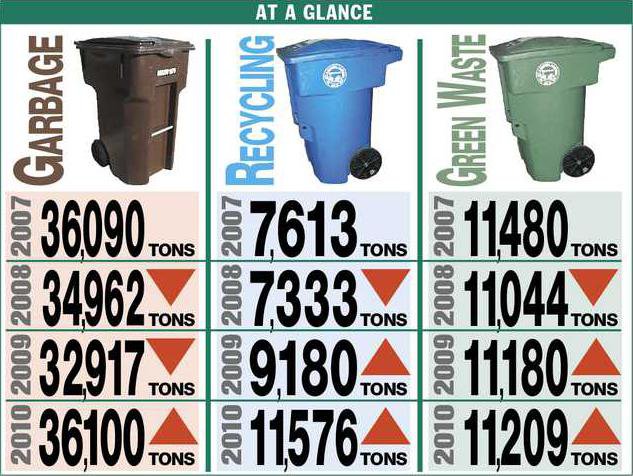
Despite population growth, Manteca had two back-to-back years in 2008 and 2009 when the amount of garbage generated dropped. It shot back up by 10 percent in 2010 to reach 36,100 tons.
Recyclables that aren’t contaminated and are accepted for recycling at Newby Island in San Jose have increased for the past three years including a 26 percent jump between 2009 when it was at 9,180 tons and 2010 when it was pegged at 11,576 tons.
Even with the 10 percent uptick in garbage, Manteca is still light years ahead of where it was at in 1991 when it started working toward a state-imposed 50 percent diversion goal of waste from being buried.
Toters weren’t part of the Manteca vernacular 20 years ago.
Several years earlier Manteca had switched to green bins for newspapers and blue bins for glass and plastic bottles as well as aluminum cans. Garbage wasn’t just collected in old-style cans. The city would pick up as much as you put out. You could even bag additional garbage that didn’t fit into cans into 30-gallon bags – as long as they were tied and place next to garbage cans on collection day – and they would be taken away at no additional charge.
Recycling reduces the amount of garbage that has to be buried at the landfill on Austin Road north of Manteca. That in turn helped the city avoid paying for the burying 22,785 tons of recyclable items in 2010 on top of 36,100 tons of garbage that was buried. While the city still pays to have green waste taken from them, it is over 60 percent per ton less than the cost of burying garbage.
The landfill is expected to run out of capacity by 2053 if not sooner. When that happens, Manteca would be forced to find other alternatives that may even including shipping garbage by rail out of state as some municipalities have done.
City Manager Steve Pinkerton said the city periodically explores options to see if there is a more cost effective way of disposing of garbage. The periodic exercise still has yet to improve on the cost of driving truckloads of garbage to the landfill seven miles north of Manteca and dumping it there for burying.
The city is currently working with a private concern about the possibility of developing a green waste facility. The plan would be to take the 11,209 tons of green waste and 6,078 tons of wastewater treatment plant sludge generated each year in Manteca and running a municipal-owned composting operation south of Manteca. The fertilizer would then be used on 400 acres of city parks and could be possibly sold to help take future pressure off rate increases.
The city in the past few years has worked with the schools to institute recycling at all of the district’s campuses within Manteca. The schools have taken it a step further. Seven schools have purchased machines that take all of their dirty Styrofoam food trays and solidify them into a solid block. The blocks are then recycled into other products. Prior to that about 750 trays per day at each school were tossed into the garbage and buried at the landfill.
There are also 40 apartment complexes now actively involved in the recycling effort.
The city in 2010 collected 36,100 tons of garbage, 6,067 tons of sludge from the wastewater treatment plant, 11,209 tons of green waste, 11,576 tons of standard recyclables in blue Toters, 25,000 pounds of universal electronic waste, 52,000 pounds of computers, 11,525 gallons of used motor oil, and 750 used oil filters, and hundreds of pounds of household batteries as well.
Trash: Going green saves green