What do Ronald Reagan, Star Wars, and Charles Manson have in common?
They are all part of Death Valley folklore.
The television series “Death Valley Days” was the last Hollywood production Reagan was involved in before completing his transition from actor to citizen-politician.
Much of the background for the planet scenes in Star Wars was filmed in the northern part of Death Valley.
And Manson eluded law enforcement for months by holing up in an abandoned cabin in a remote section of the southern part of Death Valley.
Winter is an ideal time to visit the largest national park in the contiguous 48 states, with more than 3.3 million acres making it more than four times the size of Rhode Island.
Temperatures rarely top 80 degrees, with the lows on the valley floor typically staying above 40 degrees.
The real appeal of winter - especially with visits timed after the Thanksgiving weekend and in early January - is the absence of people. It’s never anywhere near the congestion in Yosemite and in terms of sheer solitude it’s virtually unparalleled.
On my ninth and most recent trip to Death Valley, I spent five hours making a 8.4-mile hike with a net gain of 2,200 feet to the 9,064-foot summit of Wildrose Peak, while encountering only four other people. Try doing that on El Capitan. Wildrose - a moderate hike in terms of effort - is quite doable in winter when there is snow on the ground.
Death Valley offers a wide contrast of geological wonders you cannot find anywhere else on the planet packaged together in the same location.
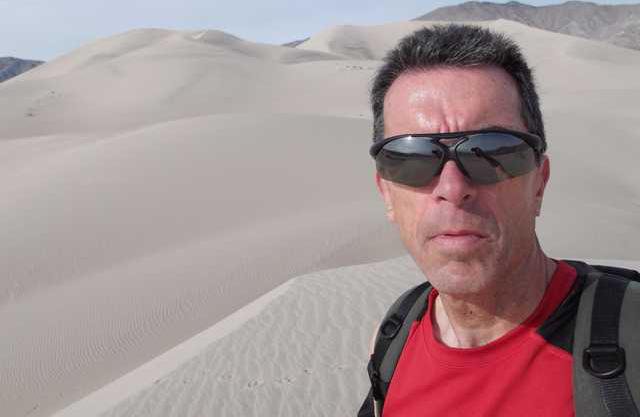
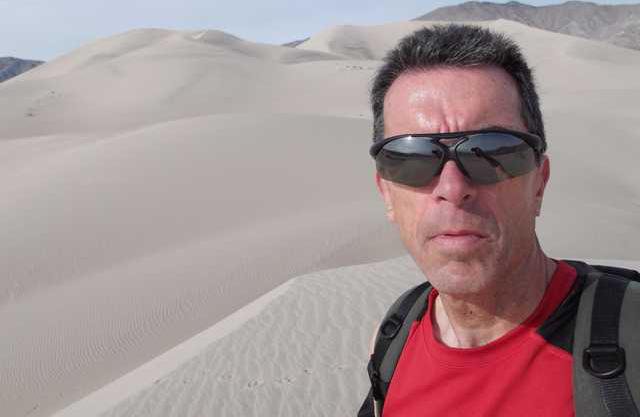
•There are unique sand dunes that range from the easily accessible Mesquite Dunes just off Highway 190 to the isolated Panamint Dunes where you could literally be the only person walking on them in a given day some 15 miles away from the closest human.
•Large segments of the park are below sea level including the lowest point in the United States -Badwater at 282 feet below sea-level.
•There’s a crater carved by a meteor than you can explore.
•Badlands can be hiked.
•There are canyons galore, many with different geological formations.
•If you have four-wheel drive - or care to rent a Jeep in Furnace Creek - you can drive into the Saline Valley and view “The Race Track” where huge rocks moved periodically by wind on a sun-baked former lake floor have created trails.
•There is an endless number of hiking options ranging from making your way up to Telescope Peak at 11,049 feet to exploring the valley floor that changes as you travel north-south as well as east-west.
Ground temperature can reach 200 degrees during summer months
There’s plenty of life in the eco-system that has adapted to the extremities of Death Valley where the ground temperature in August can soar to 200 degrees when the air temperature is at 122 degrees. Among the unique life is the Death Valley Pupfish, which can survive temperatures as high as 130 degrees in the salty and shallow water of Salt Creek. Some prefer the early spring where the alluvial fans and valley floor are bursting with desert wildflowers. In some locations you’ll see kit foxes, bighorn sheep, and even wild burros. If you hike the Panamint Range you’ll come across more hawks and other birds than you’d imagine would populate what seems to be relatively barren when compared to the Sierra.
I fell for Death Valley 25 years ago on a bicycling excursion organized through Backroads Touring.
That trip included staying at several campgrounds as well as the Furnace Creek Ranch.
Furnace Creek is the hub of Death Valley. It is where you will find a landing strip, a golf course, plenty of date trees, the visitors’ center, the Borax Museum, one of three gas stations where the gas last week was $5.25 a gallon, a general store, bicycle shop, and several restaurants. It is also where you will find a 224-room lodge with rates starting at $172 a night double occupancy.
If you want something more uptown and elegant, then try the Furnace Creek Inn. In its heyday in the 1920s it was where Hollywood stars and the rich played. Rooms at the inn start at $335 per night with one bed.
Personally, between the three campgrounds, the lodging, and the inn I find Furnace Creek too congested for my tastes.
I stay at Stovepipe Wells some 26 miles away where rooms start at $92. It’s a bit of heaven. There is no cell service. Most rooms have no TV. There are no in-room phones. If you must access the Internet, you can do so in the lobby where you’ll find a TV as well in the saloon. There is a restaurant, swimming pool, campgrounds and a general store as well plus gas which is about 60 cents a gallon cheaper than Furnace Creek at any given time.
It is also an easy walk - or drive - to locations where you will see the night skies like you’ve never seen before. The depth of the valley, high mountains, lack of nearby civilization creating light pollution, and clean air helps stars you may have never before seen with your naked eye populate the sky. You can check at the front desk and they can give you information needed to find the course that the space lab takes across the sky.
Death Valley is rich in human & mining history
Death Valley and nearby valleys were a hot bed of mining activity and speculation during the 1890s and early 1900s. At one time small towns populated the region, boasting a combined population of 50,000. Water in some spots in the 1890s sold for $50 a drum. Some mining camps had as many as three newspapers including a daily.
About 15 miles outside Death Valley in Nevada is the ghost town of Ryholite, where the bank and what was then the most grand railroad station in all of Nevada were each built for excess of $2 million still partially stand. It is also where you will find the famed glass bottle house. Beatty is a few miles farther, offering more lodging, restaurants, and - since it’s is Nevada - a casino.
It goes without saying that Death Valley’s natural as well as human history is fascinating.
If you’re into bicycling - especially road racing bicycles - you will enjoy 21 percent grade challenges, non-stop climbs out of the valley that are paid back by descents that stretch out as much as 22 miles with grades approaching 9 percent.
The quickest way to reach Death Valley from Manteca during the winter with Tioga Pass closed is by taking Highway 99 to Bakersfield then heading east via Highway 178 through the stunning Kern River Canyon. The route will take you through Ridgecrest and past the China Lake Navy Air Station of Top Gun fame and up into the Panamint Valley through Trona.
Trona, in itself, is an interesting place. They mine sulfur there. Hardly anything grows which explains why the baseball and football fields at Trona High are devoid of grass and are nothing but sand. Hence the de facto mascot assigned the school by opponents - the Trona Sandmen.
In all, it is an eight hour drive.