It was a well-scripted “Night in the 40s” Veterans’ Day salute Friday evening at the Del Webb at Woodbridge recreation center that honored 17 World War II survivors.
It was a celebration with song and dance as well as vivid memories of a time long ago often referred to as “The Greatest Generation” the world has ever known. It was a proud period in American history where so many sacrificed without hesitation for the future freedom of their nation.
The salute to the veterans was organized by the Veterans of Woodbridge Group that originally was to be limited to a memorable USO dance for the community of 600 homes. It evolved, though, into much more including a 30-minute DVD with background music featuring the veterans and the presentation of individual challenge coins to each of them for their honorable service.
Some 250 residents in the age-restricted community on Union Road north of Lathrop Road in northwest Manteca streamed into the wartime USO entry way and into the club house hall. Many were dressed either in uniform or in period attire of the Second World War years.
Woodbridge resident Bob Naquin served as the master of ceremonies in the guise of familiar wartime comedian Bob Hope – but as “Bob Hopeless.” The Woodbridge community choir of some 30 voices opened with a series of patriotic songs including, “This is My Country” ending with a sing-along of “God Bless America.”
Fellow veterans salute those who served in World War II
Bob Hopeless held his audience with his one liners. The event got to a more serious note when the 17 World War II veterans were called up on stage one-by-one following a dramatic DVD tribute individually singling them out. After receiving a challenge coin to commemorate their service, the former GIs in the audience were asked to stand as their service groups were recognized from Army to Navy to Air Force to Marine Corps. The veterans in the audience snapped to a salute further honoring those on stage. The World War II men all responded in kind as they snapped to attention.
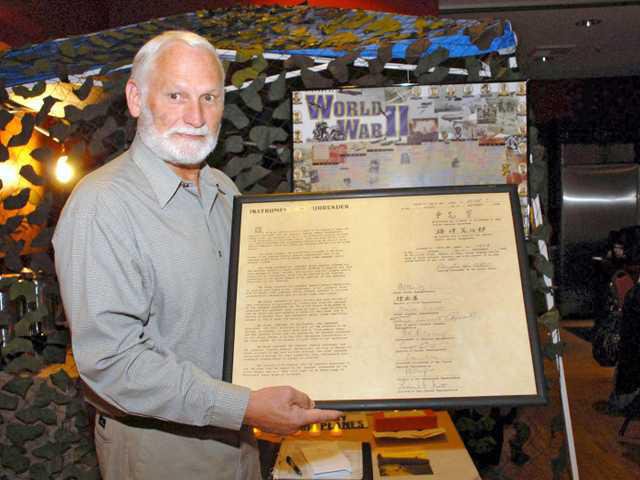
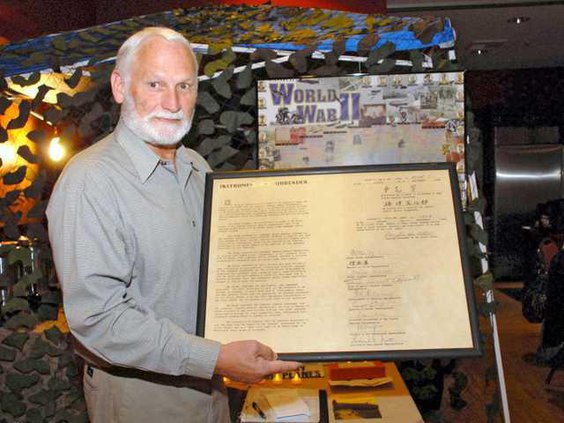
Memorabilia from the war filled two display cases in the Del Webb hallway and President Harry Truman’s copy of the Japanese surrender document was on display just inside the reception hall. The pen General Douglas MacArthur used to sign the document was known as “The Big Red” and had been specially made by Parker Pen Company for the historic signing.
Dr. Bill Egelston, M.D., was at a table near his late father’s framed surrender document and volunteered to detail the background of how Douglas Egelston made his way to Washington, D.C., and to the Oval Office after he was believed to have been killed in action for some four years. His ship had been sunk by enemy forces – with him and many of his comrades ending up in the forced Burma railroad construction by prisoners of war near “The Bridge of the River Kwai.”
The retired Kaiser Hospital orthopedic physician said his dad was aboard the USS Houston – “the Galloping Ghost” – on February 4, 1942 during the Battle of Makassar Strait during the Battle of the Java Sea. The Houston was the flagship of the Asiatic Fleet and had been reportedly sunk on several occasions by Japanese reports – referencing its ghostly reappearances.
On the day of the Pearl Harbor invasion, Egelston was in Iloilo, the Philippines, aboard the heavy cruiser. Egelston said his dad wrote that Admiral Hart had pulled the fleet out of Manila a week before December 7 and as the ship steamed out of Iloilo they could hear the enemy bombing of the city.
The ship then set its course for Balikpapan, Borneo for refueling and eventually joined what was to become the Asiatic Fleet in Java. Over the next three months the fleet suffered great losses in its continuous actions losing all but two of its 26 vessels.
The fleet had been comprised of destroyers, light and heavy cruisers, submarines and numerous support vessels from the U.S., Australia, Holland and Great Britain. Only his father’s ship the USS Houston and a light cruiser, the HMS Perth remained afloat in the fight.
Low on ammunition and needing repairs, the Houston limped into Jakarta. The plan was to move out through the Sundra Straits, down to Surabaya to retrieve their dead and return to Pearl Harbor.
By midnight they had reached the center of the straits and encountered an enemy landing force. Egelston wrote that the Houston was able to sink 11 enemy ships in a fierce battle firing in all directions.
All but 87 of 400 survivors died in Japanese POW camps
The HMS Perch had been sunk within half an hour and the Houston was sinking three hours later. The morning of March 1, 1942 saw the waters filled with survivors from both ships and the remains of the Asiatic Fleet.
Of the 700 crew members of the Houston, some 400 reached the shore to become Japanese prisoners of war. All but 87 would die in the POW camps where they had labored for 42 months in slave labor until they were released just weeks after the dropping of the atom bomb.
The sailors who had survived the sinking and the machine gun strafing in the waters of the straits by the enemy were used to rehabilitate oil refineriess in Java, grubbing out rubber plantations in Singapore, and they endured death marches and the torturous task of building the Burma Railroad, with its many bridges from Bangkok, Thailand to Moulmein Burma.
At the conclusion of the stage presentation honoring the veterans, Lynn Egelston sang two George Gershwin favorites that she related to crooner Bing Crosby. “Someone to Watch Over me,” and “What’ll I do?”