MANTECA DECISION 2010
This is a part of a series of stories on how mayor and council hopefuls would address various municipal issues
Ben Cantu’s vision for strengthening downtown district centers around building a municipal government complex - complete with City Hall, police, courts, library and even a Department of Motor Vehicles office - literally at the heart of Manteca.
Cantu is one of five declared candidates planning to seek election Nov. 2 to the post of Manteca mayor.
Returning city government’s offices downtown to their roots - the original two-story brick City Hall built in 1924 is in the triangle formed by Sycamore, Manteca and Yosemite avenues across from Library Park - is at the heart of Cantu’s strategy to increase foot traffic.
The complex would be development behind Kelley Brothers Brewing Company, Bank of America, Financial Center Credit Union, and the Veteran of Foreign Wars Post Hall that front the 100 and 200 blocks of East Yosemite Avenue. It would entail buying land around the vacant parcel that once was home to the Manteca Bean Co.
It would have access from South Grant Avenue as well as Mikesell Avenue and front South Main Street and Moffat Boulevard. The location is directly across from the $6.6 million transit station scheduled to break ground in the next 12 months along with an adjoining 100-space parking lot.
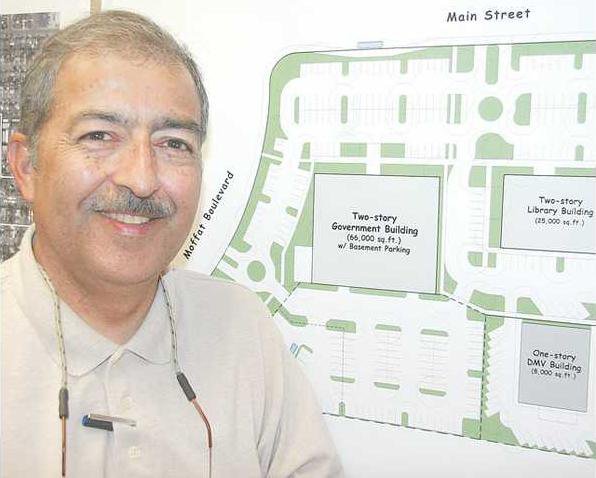
The government complex would include:
•A two-story government building consisting of 66,000 square feet - roughly twice the square footage of the existing Civic Center - along with basement parking.
•A two-story 25,000 square-foot library.
•A one story, 8,000-square-foot DMV building.
•A two-story 20,000-square-foot courts building complete with basement parking.
Tossing the DMV into the mix helps boost the amount of people going downtown significantly as most foot traffic at City Hall centers around those who often wait until the last minute to pay utility bills.
The other key components of Cantu’s vision is making downtown more pedestrian friendly, enhancing traffic flow, and expanding the area defined as downtown or central Manteca.
Cantu’s take on the best solution for downtown traffic is different than what has been proposed.
It involves making Yosemite Avenue between Manteca Avenue and Fremont Avenue one-way going east toward Highway 99. There would be only one-lane of traffic with parking where it is narrower alternating between parallel and diagonal so sidewalk extensions could be put in place where appropriate to allow for restaurants with sidewalk dining and such.
Center Street - which is much wider - would have two lanes of traffic in each direction with parking between Fremont Avenue and possibly Walnut Avenue.
Maple Avenue would remain as a one-way street heading south while the 100 block of North Grant Avenue would become a one-way street heading north. The 100 block of Garfield Avenue would become a one-way street heading south.
Main Street would then become two lanes in each direction through the downtown district.
Such a flow pattern would push more traffic through the Center/Yosemite intersection and reduce traffic and turn movements at Yosemite and Main in a bid to ease peak hour back-ups on Main Street.
Cantu favors an expanded downtown district with special zoning to allow for higher densities and to essentially rewrite parking requirements that currently can kill any effort to develop downtown for retail or other uses due to their small sizes.
Downtown’s expanded boundaries, under Cantu’s plan, would go west to the Fosters Freeze on Yosemite Avenue near Walnut Avenue and east almost to Powers Avenue. It would include the north side of Center Street from a point west of the railroad tracks to Fremont Avenue and north along Main Street to either North Street or Alameda Street.
Cantu said such a district with proper zoning allowances could encourage retail along Center Street and either residential conversions to restaurants and offices or new office uses along Yosemite Avenue west of the tracks.
That includes relaxed parking standards, design standards expanding on the 1910s aesthetics which is when older builders went up so that the same visual feel is carried throughout the district, and type of uses allowed.
“A head shop, smoke store, and tattoo parlors aren’t what you need to get people to come downtown,” Cantu said.
Making the plan work would have the redevelopment agency buy up property as it becomes available. In that way, the RDA can piece together parcels over the years to make larger parcels that developers could then buy to build projects.
As for parking, Cantu makes no bones about it.
“I think we need to create a parking problem,” Cantu said, pointing out central districts that have appealed to consumers don’t have parking standards that match shopping center-style developments. Instead, he believes the city should work as they have in the past to develop parking even if it isn’t directly attached to retail. In many cases, that eventually would involve having mid-block pedestrian access to parking areas at the rear of buildings and off alleys.
“The council, not just this one but previous ones as well, haven’t followed through,” Cantu said.
All of what Cantu proposes is with the goal of making downtown what he calls “a livable community” with additional residents and visitors that entrepreneurs in turn, can open businesses that cater to a different market than shopping centers.
“It is the heart and historic center of the community,” Cantu said of why downtown should be a top council priority.
He added that he has nothing against development on Manteca’s periphery that includes shopping opportunities. But, just like a tree, if the center of Manteca is allowed to die it ultimately will weaken and kill the rest of the community.
As for the existing City Hall complex, Cantu proposes converting it into a community center. That would involve transforming the council chambers into a performing arts center, making rooms available for community uses as well as things such as dance classes, plus expanding senior center.
Cantu is one of five declared candidates planning to seek election Nov. 2 to the post of Manteca mayor.
Returning city government’s offices downtown to their roots - the original two-story brick City Hall built in 1924 is in the triangle formed by Sycamore, Manteca and Yosemite avenues across from Library Park - is at the heart of Cantu’s strategy to increase foot traffic.
The complex would be development behind Kelley Brothers Brewing Company, Bank of America, Financial Center Credit Union, and the Veteran of Foreign Wars Post Hall that front the 100 and 200 blocks of East Yosemite Avenue. It would entail buying land around the vacant parcel that once was home to the Manteca Bean Co.
It would have access from South Grant Avenue as well as Mikesell Avenue and front South Main Street and Moffat Boulevard. The location is directly across from the $6.6 million transit station scheduled to break ground in the next 12 months along with an adjoining 100-space parking lot.
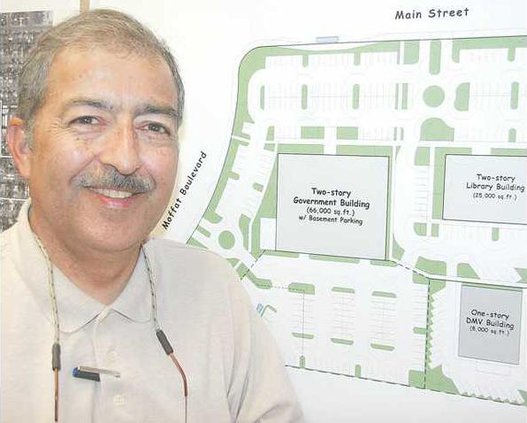
The government complex would include:
•A two-story government building consisting of 66,000 square feet - roughly twice the square footage of the existing Civic Center - along with basement parking.
•A two-story 25,000 square-foot library.
•A one story, 8,000-square-foot DMV building.
•A two-story 20,000-square-foot courts building complete with basement parking.
Tossing the DMV into the mix helps boost the amount of people going downtown significantly as most foot traffic at City Hall centers around those who often wait until the last minute to pay utility bills.
The other key components of Cantu’s vision is making downtown more pedestrian friendly, enhancing traffic flow, and expanding the area defined as downtown or central Manteca.
Cantu’s take on the best solution for downtown traffic is different than what has been proposed.
It involves making Yosemite Avenue between Manteca Avenue and Fremont Avenue one-way going east toward Highway 99. There would be only one-lane of traffic with parking where it is narrower alternating between parallel and diagonal so sidewalk extensions could be put in place where appropriate to allow for restaurants with sidewalk dining and such.
Center Street - which is much wider - would have two lanes of traffic in each direction with parking between Fremont Avenue and possibly Walnut Avenue.
Maple Avenue would remain as a one-way street heading south while the 100 block of North Grant Avenue would become a one-way street heading north. The 100 block of Garfield Avenue would become a one-way street heading south.
Main Street would then become two lanes in each direction through the downtown district.
Such a flow pattern would push more traffic through the Center/Yosemite intersection and reduce traffic and turn movements at Yosemite and Main in a bid to ease peak hour back-ups on Main Street.
Cantu favors an expanded downtown district with special zoning to allow for higher densities and to essentially rewrite parking requirements that currently can kill any effort to develop downtown for retail or other uses due to their small sizes.
Downtown’s expanded boundaries, under Cantu’s plan, would go west to the Fosters Freeze on Yosemite Avenue near Walnut Avenue and east almost to Powers Avenue. It would include the north side of Center Street from a point west of the railroad tracks to Fremont Avenue and north along Main Street to either North Street or Alameda Street.
Cantu said such a district with proper zoning allowances could encourage retail along Center Street and either residential conversions to restaurants and offices or new office uses along Yosemite Avenue west of the tracks.
Cantu wants to create a planning problem
“Zoning changes are the trick,” Cantu emphasized as it would create development standards conducive to higher densities with smaller parcels.That includes relaxed parking standards, design standards expanding on the 1910s aesthetics which is when older builders went up so that the same visual feel is carried throughout the district, and type of uses allowed.
“A head shop, smoke store, and tattoo parlors aren’t what you need to get people to come downtown,” Cantu said.
Making the plan work would have the redevelopment agency buy up property as it becomes available. In that way, the RDA can piece together parcels over the years to make larger parcels that developers could then buy to build projects.
As for parking, Cantu makes no bones about it.
“I think we need to create a parking problem,” Cantu said, pointing out central districts that have appealed to consumers don’t have parking standards that match shopping center-style developments. Instead, he believes the city should work as they have in the past to develop parking even if it isn’t directly attached to retail. In many cases, that eventually would involve having mid-block pedestrian access to parking areas at the rear of buildings and off alleys.
Death of downtown would kill rest of city
Cantu believes the impasses that have riddled efforts over the past 20 years to get downtown moving forward again can be blamed on all parties. That said, he believes the city has an obligation to take the lead role. “The council, not just this one but previous ones as well, haven’t followed through,” Cantu said.
All of what Cantu proposes is with the goal of making downtown what he calls “a livable community” with additional residents and visitors that entrepreneurs in turn, can open businesses that cater to a different market than shopping centers.
“It is the heart and historic center of the community,” Cantu said of why downtown should be a top council priority.
He added that he has nothing against development on Manteca’s periphery that includes shopping opportunities. But, just like a tree, if the center of Manteca is allowed to die it ultimately will weaken and kill the rest of the community.
As for the existing City Hall complex, Cantu proposes converting it into a community center. That would involve transforming the council chambers into a performing arts center, making rooms available for community uses as well as things such as dance classes, plus expanding senior center.


