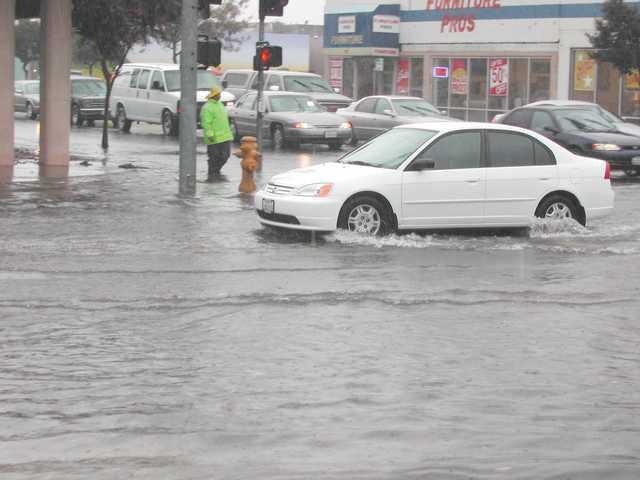
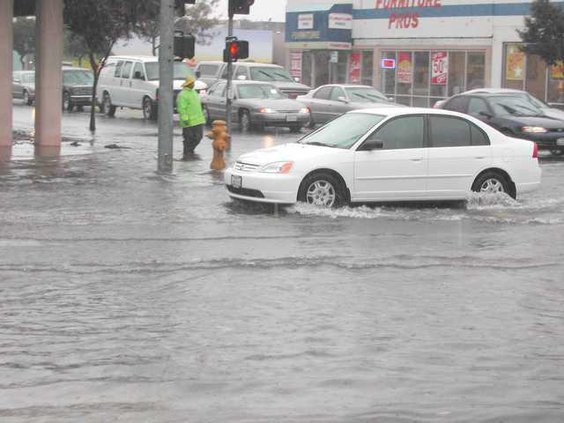
It’s the rainy season and there’s not a drop of the wet stuff expected to fall on Manteca for a week or more.
So why are city leaders tonight looking at investing $218,000 in storm drainage system upgrades? It’s because when steady heavy rain or cloudbursts occur some segments of Manteca are almost assured to have significant street flooding.
And while improvements to the storm system serving Central Manteca were made after a heavy rain event in October 2004 that flooded a dozen intersections and made passage through the Main and Center streets intersection treacherous, it didn’t address all of the needs.
It is why staff is recommending that almost half of the $452,395 in federal Community Development Block Grant funds go to helping improve the storm system in older sections of Manteca. And since the neighborhoods selected meet the federal standard for the funds of serving low- to moderate-income areas the block grant money can be spent on the projects.
The council is being asked to set aside $150,000 of the block grant funds to add to existing money set aside to purchase land and construct a storm surge basin along Moffat Boulevard.
Another $68,000 would go to making additional improvements to prevent flooding at Center and Main streets.
Engineers have noted that it would be cost prohibitive to design and construct a system that would eliminate absolutely all prospects of flooding in the older parts of Manteca. But many of the ways to improve operation of the existing system that has been upgraded several times since the early 1990s in the central district is to make it easier for storm run-off to flow unobstructed into underground pipes.
Manteca has an elaborate storm retention basin system in place that is often incorporated into neighborhood parks. That allows water to run into a central location in various neighborhoods before it is released into the main storm drain system and dumped into the South San Joaquin Irrigation District canals surrounding the city. The canals then ferry the water to various points where it is released into the San Joaquin River.
If the water was not held and released when capacity allowed it, the entire system would be swamped triggering flooding throughout Manteca.
In the case of the older sections of town, the problems of Manteca being relatively flat weren’t addressed for years. As a result storm water often had no place to go.
Improvements in the past decade have substantially reduced flooding potential at historical trouble spots such as Moffat and Main, Center and Main and along other streets between Main Street and Powers Avenue. There can still be flooding simply because the water can’t get into the system.
The surge basin would allow for water to be taken out of the system and stored creating more capacity for run-off. Stored water would then be released back into the system once capacity is freed up.
The improvements - being done with federal dollars - are a band-aid approach at best.
Manteca has unfunded storm system needs
City leadership in 2001 dropped a $2.35 a month utility tax that was raising $690,000 a year to go toward storm system improvements and maintenance. The tax was repealed after the legality of the utility users’ tax was questioned. It was adopted on Nov. 20, 1989 as a way to fund storm drainage system improvements and maintenance to alleviate street flooding, particularly in the downtown district.
The issue of funding storm drain improvements has not been addressed in the last 11 years meaning that the storm maintenance and upgrade of the existing system is a drain on the general fund budget.
Manteca still has four years of payments on the original loan back in 1989 to make that totals more than $1 million. That debt repayment - $223,000 a year – plus ongoing maintenance – takes a $500,000 to $700,000 annual bite out of the general fund. The utility tax – which would have brought in $900,000 this year if it were still in place – would have covered that tab plus have money to go toward over $1 million in upgrades and replacement of aging infrastructure that staff has recommended but hasn’t been funded.
To address some of the issues the city back in 2009 changed its policy of having water discharged from various park storm retention basins within 48 hours. That requires much larger pipes that add to the cost. The newer strategy calls for a water discharge rate of 96 hours from storm retention basins instead of 48 hours. That represents the longest accepted maximum time that water would sit in a retention basin before it is released into a series of underground pipes and eventually into the San Joaquin River.
Currently, it is rare for water to stand in any retention basin more than 24 hours.
In order to meet the 100-year flood protection standard that will remain unchanged, the city may have to alter future retention basins to either make them deeper or larger.
The problem, however, is how to fund improvements that can’t legally be charged off to growth.
Helping Manteca weather storms
$218K may go to upgrade storm system for central city