MHS grad believes in art as a ‘powerful soul medicine’
She goes by the name Amari. She is Alma Marie Alcala Lozano, a graduate of Manteca High and the University of the Pacific where she was accepted under a debate scholarship that she won in high school.
She is a performing artist, a poet and writer, and a member of the Actors’ Equity Association. She is the author of “Barangay USA: Tribute to the Elders – a Poetic Narrative of the History, Character & Courage of the First Wave of Filipinos to Come to America – The Manong Generation,” an unpublished work.
She is also one of the main resources for the book, “Little Manila is in the Heart: The Making of the Filipina/o American Community in Stockton, California” by San Francisco State University associate professor of history, Dawn Bohulano Mabalon.
But these days, the artist Amari is focusing “the healing and empowerment of the individual through sacred adventures that inspire spiritual growth and personal transformation.”
This is based on her belief that “art is a powerful form of soul medicine” and is “dedicated to the development of communication art forms into spiritual technology for the 21st century.”
A lifelong student of metaphysics, Amari has practiced meditation as a spiritual discipline for more than 30 years.
At the University of the Pacific, Amari pioneered community and jazz programming for KUOP-FM the educational radio station serving northern and central California. She developed workshops in creative drama, dance and music for the ethnic neighborhoods with the Parks and Recreation Departments of Stockton and New York. As a poet, she taught “Poetry in the Schools” through the National Endowment for the Arts.
She was also an actress, writer, musician, singer and lyricist with the Twelfth Night Repertory Company, a professional educational theater company which created and performed original stage shows throughout California. Additionally, she was a featured cast member in the award-winning mini-series developed for PBS stations KCET Los Angeles & KQED San Francisco.
Alma Marie Alcala Lozano of Manteca has nurtured a cherished dream since childhood – to write a book. Not just any tome but a book about her beloved late father, Atanasio, his life and times, and the many people whose lives he touched.
Life, though, has a way of throwing detours along the way. Alcala Lozano was no exception to that bane of everyone’s existence. But her project continues to be a work in progress and may soon become a reality.
In the meantime, some glimpses of the kind of biographical sketch that she is working on appear in an epic-length book that was recently published by Duke University Press (www.dukeupress.edu). The book is “Little Manila is in the Heart: The Making of the Filipina/o American Community in Stockton, California.” The author is Dawn Bohulano Mabalon, a Stockton native who is currently an associate professor of history at San Francisco State University.
Alcala Lozano was one of the scores of people interviewed by the author for this book which touches on the history of the Filipino culture and experience throughout most of the 20th century in Stockton. The stories are told against the backdrop of racial, agricultural, and economic upheavals during that period of time.
Alcala Lozano was fully qualified as a resource for the book. Not only did she have plenty of information to share about the Filipinos in Stockton; her late father’s activities and involvements in the community was part of that ethnic group’s fabric of life in a historical sense.
Atanasio Alcala was part of the first wave of Filipinos who came to America in the 1920s, also known as “the Manong Generation.” His experiences as a seasonal farm worker in the fields up and down the San Joaquin Valley, his struggle for education while working as a “houseboy” for a wealthy family in Stockton, and his decision at the ripe age of 80 to go back to school at the urging of his wife, Maria, and enroll in English and journalism classes at Delta College are all preserved in his many articles that were published in “Showboat,” the campus magazine.
Even after the family moved to Manteca in 1961, Atanasio Alcala remained an active member of the Filipino community in Stockton. He was part of the community effort that brought about the building of the $2.8 million Filipino Center in the heart of Stockton – a project that consisted of a 10-story housing unit and a two-story commercial building that is still a familiar part of Stockton’s downtown landscape today.
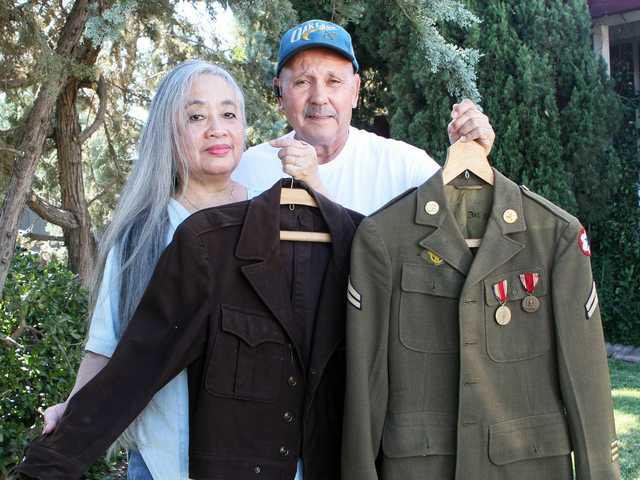
During World War II, he joined the U.S. Army and saw action in the Philippines. Alcala Lozano said her father served in the 978th Signal Company as one of General Douglas MacArthur’s radio and teletype operators. Among her treasured mementoes of her father are his war uniforms and medals.
When he came back to the United States after the war, Atanasio Alcala founded and, later, became a life member of the American Legion, Manuel A. Roxas Post 798 in Stockton named after the first president of the Philippine Republic. He served as a post commander, adjutant, historian for the organization, as well as state convention delegate. He also worked at the Sharpe Army Depot in Lathrop as a clerk-typist and warehouseman until he retired after working there 20 years.
In the “Little Manila” book, Alcala Lozano recalled going to Stockton as a young girl with her father to visit Filipino old-timers he knew. Those visits also provided nostalgic opportunities for her father to have conversations with his fellow Ilocanos in their native tongue.
“Every time my dad would get a paycheck, we would go to downtown Stockton, go to Gan Chy on El Dorado, and we’d eat Chinese food, and we’d pass the old-timers and my dad would talk to them in Ilocano. It was so much fun to hear them talk, and they would be so animated, and then afterwards their eyes would get so sad, and I would see them standing on the street, always so sad and lonely. I could feel their pain,” Alcala quotes in the book.
Even after so many years, she still has tears in her eyes as she recalled those scenes of the old “manongs” and her father reminiscing life in their old country.
Photographs of her father as a young man are also included in “Little Manila.” One photograph was taken in 1929 and shows Atanasio Alcala and the other officers of the Filipino Club at Stockton High School where they attended. He was the club’s secretary-treasurer. Another group picture in the book shows Atanasio Alcala and three of his four young children. Besides Alcala Lozano, Atanasio and wife Maria had two daughters – Nora Alicia, the oldest; Rory who was in the U.S. Army, and son Ala Simeon, a civil engineer. Alicia was a former chief of staff for B.T. Collins, the late 5th district California Assemblyman. Alcala Lozano also worked as a campaign fund-raiser and assistant to B.T. Collins, among many other jobs she held. All four siblings are graduates of Manteca High School.
Atanasio Alcala died on Ash Wednesday in 1997. He was just two months shy of his 94th birthday. His wife passed away in 2002. Both were active members of St. Anthony of Padua Catholic Church in Manteca.
Alcala Lozano said she was interviewed for the book by Bohulano Mabalon because “she knew the work that I did” with the Filipino community in Stockton.
“She was interested in everything that I had to say,” said Alcala Lozano, a graduate of the University of the Pacific and former director of the Central Stockton Community Center.
She described Bohulano Mabalon’s book as “incredible in terms of the work that she did.
“It’s so in-depth. Not only did she chronicle but she did an analysis” of the Filipino experience in Stockton, “with the crosstown freeway, the political things happening, and the intra-cultural intricacies” of the times.