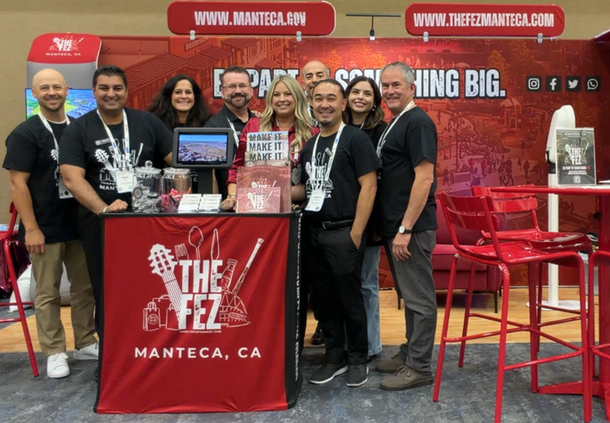
Manteca had a story to tell of economic and housing growth and wasn’t shy about sharing it at the International Council of Shopping Center gathering in Palm Springs.
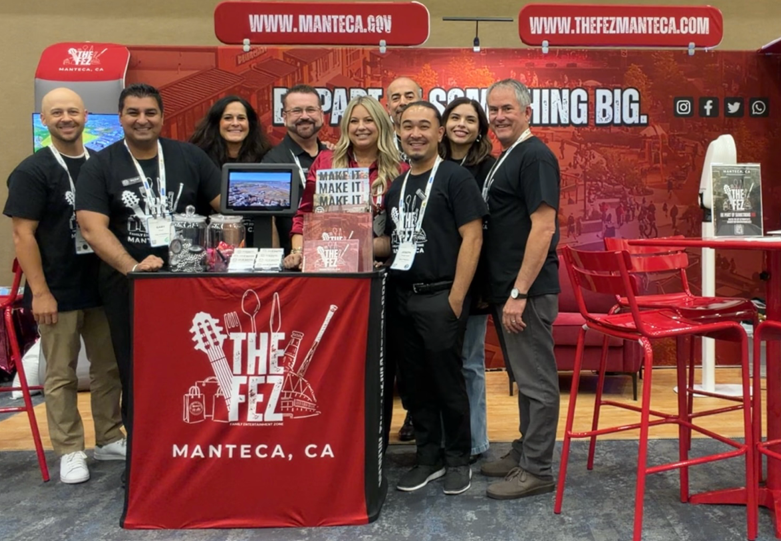
Not only was Manteca one of only five booths dedicated to cities pitching themselves — the others where shopping centers and developers — but they chose vibrant red colors in a sea of white booths to further attract attention.
Apparently it worked.
While such gatherings never lead to a retailer or a restaurant opening overnight, they are key to lining up follow up conversations as the first step in a lengthy process of concerns deciding where to expand to next.
Manteca, in the past has snared a handful of leads at such gatherings that have paid off with the city snaring new businesses to fill the Manteca Crossing now under construction at Atherton Drive and Airport Way as well as a phase breaking ground in the future east of Airport Way.
This time Manteca leaders returned home with 20 leads for follow up conversations including some that have already scheduled physical visits to Manteca to tour available space.
And the city also did not just tell the success story of Manteca growth while pushing the 150 acres of municipal land anchored by Great Wolf and Big League Dreams known as the family entertainment zone (FEZ).
They provided a large visual aerial photo of the city listing 20 various locations where private sector firms are building retail and dining space or have recently had projects approved to do so.
“It was FEZ all the way,” Singh said at what seemed to grab the most attention.
The city made it clear — as land owner — they were open to any size subdivided parcel and land acquisition strategy whether it was an outright sale, land lease, or other avenue.
“It is more flexibility than they likely would get with a private developer,” the mayor sad.
Manteca is working to secure a master development for the FEZ endeavor that would include commercial closest to the 120 Bypass and a strong mixture, of restaurants, entertainment, hotels, and residential include projects with commercial on the bottom floor and housing above.
“That was a big difference for Manteca,” Mayor Gary Singh said. “Most other cities had older spaces that were vacant they were trying to fill.”
All but four attending cities from throughout California relied on a fold up table, a few chairs, and brochures to pitch their community in a communal booth opting to let developers hawk shopping centers in their respective towns.
The Manteca booth boldly displayed the city’s stats that are critical to attracting new stores and dining.
*The fact it is the second fastest growing city in San Joaquin County.
Although Lathrop is growing at a faster rate, Manteca due to its size is adding significantly more housing units with more than 2,400 built in the last two years.
*Manteca grew by 24.4 percent from 2010 through 2020.
*The city is on pace to reach 100,000 residents in 2026.
Manteca is at the epicenter of 800,000 consumers within a 20 mile radius.
*31,000 plus rooftops.
Rooftops, or the number of households, are one of the key factors retailers considering when they site new locations.
*An average household income of $125,000.
*11,000 plus housing units in the development pipeline.
“Retailers (and restaurants) like growing cities,” Singh said. “And with 11,000 or so housing units in the entitlement process we’re going to be growing for a while.”
Also in attendance was Councilman Mike Morowit, City Manager Toni Lungren, two economic development specialists, and a city engineering department representative.
The entourage gave Manteca the advantage of answering specific infrastructure and development questions on the spot.
“It also showed that we mean business,” Singh said.
To contact Dennis Wyatt, email dwyatt@mantecabulletin.com