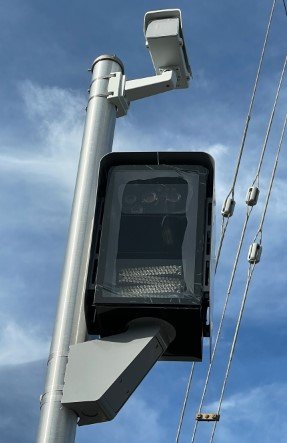
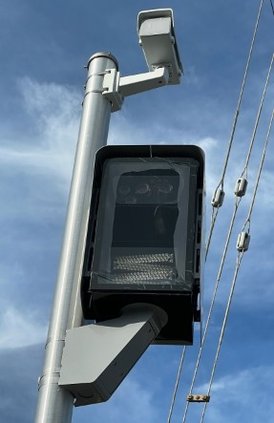
Manteca Police issued 933 red light camera citations in February.
That translates into someone running a red light at one of the five intersections equipped with cameras and radar every 43 minutes last month.
Since all cameras became operational in May-June of last year, there have been averaging at least 900 tickets a month.
Police Chief Schluer said Tuesday there are no plans to relocate the cameras to other intersections.
American Traffic Safety — the firm that installed and monitors the cameras and forwards possible red light infractions to the Manteca Police Department for review — has a three year contract with the city.
Manteca issued 9,824 red light tickets in 2025.
That said, how the red light violations are determined, their classification in the Vehicle Code, and cost changed on Jan. 1.
Changes in red light camera
law, fine lowered to $100
Given changes in the state law that went into effect this year, automated red light enforcement violations are no longer treated as criminal penalties that can cost more than $500.
The new law shifts them to civil penalties capped at $100.
It also moves responsibility from the driver to the vehicle’s registered owner, and directs the revenue back to local communities for street safety improvements.
Based on the $490 fine, the tickets Manteca issued in 2025 collectively cost motorists $4,813,760 before the law changed.
Just over 80 percent goes to the court system and the state.
The balance of almost $900,000, if it is all collected, will go to the city.
At the new $100 rate, 9,824 red light tickets represent $982,400 in penalties.
The new law, though, sends any appeal to the local jurisdiction for an administrative hearing.
That would send 100 percent of the fine to the city without it being split with the court system or the state.
Over the course of 12 months, the ATS contract has a maximum cost to the city of $873,600.
That means if Senate Bill 720 was in place last year, the city still would have been able to make ATS whole and have money left over to divert to other traffic safety concerns.
The city’s contract with ATS complies to a state mandate that cities that employ the technology cannot lose money on the proposition.
As a result, ATS — if the city doesn’t collect enough in fines during billing periods to cover the monthly contract costs — dismisses the balance.
It should be noted the 2025 ticket numbers reflected seven months of all five red light camera intersections being up and running and not in a 30-day grace period when only warnings were issued.
Two months there were only some active and three months where there were no tickets per se issued.
To contact Dennis Wyatt, email dwyatt@mantecabulletin.com