The weakest link in the South San Joaquin Irrigation’s delivery system that brings water to farmland and 230,000 city residents will be among its strongest by the end of 2028.
That’s when work is expected to be completed on the $94.3 million project to construct a two-mile plus tunnel to replace the main supply canal that now carries irrigation water from Goodwin Dam through the steep and treacherous Lower Stanislaus River Canyon.
“This tunnel is a lifeline for our communities,” said Glenn Spyksma, SSJID Board President. “We’re building a future where water keeps flowing no matter what nature throws our way.”
The tunnel project is a joint endeavor of SSJID and Oakdale Irrigation District.
It also is being done without a cent of federal or state funding.
“The Canyon Tunnel Project will ensure a safe work environment for District personnel as they complete the critical work of getting water to local farmers and families,” noted SSJID Director David Roos.
Roos was referencing the treacherous work that is now involved in removing massive debris that occurs when a rockslide inundates a century-old canal clinging to the side of an unstable steep canyon wall high above the Stanislaus River.
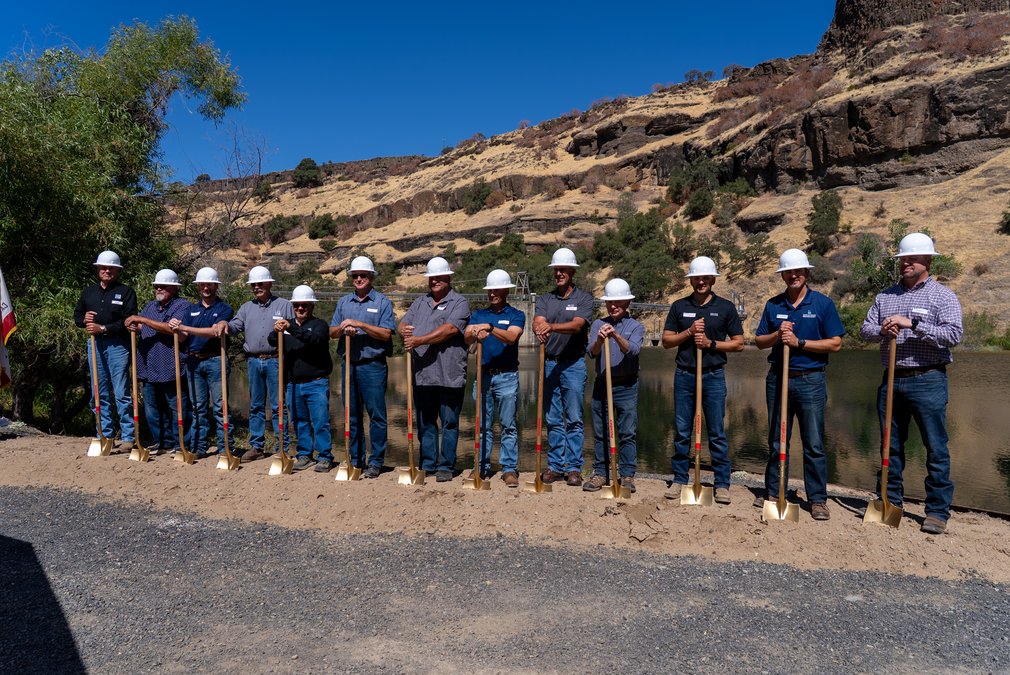
Dozens gathered along Tulloch Dam Road at Goodwin Dam on Monday to witness the momentous launch of the major infrastructure upgrade.
The Canyon Tunnel is designed to eliminate risks from landslides that have threatened the century-old canal, including a 2013 rockfall that nearly crippled early-season water deliveries.
The new tunnel will ensure a safe, uninterrupted water supply to SSJID’s constituents representing 50,000 acres of farmland and the cities of Escalon, Manteca, Lathrop, and Tracy.
Likewise, the tunnel will also protect OID’s ability to serve approximately 26,000 acres of irrigated farmland and raw water for domestic purposes to the community of Knights Ferry.
“We are grateful to the team tunneling through more than two miles of rock to a more reliable, resilient, and safer water future,” SSJID Director Billy Van Ryn said. “Their work is not easy, but a testament to the dedicated service that defines SSJID.”
The project is jointly funded by SSJID and OID, with cost shares based on historic water use from the Joint Supply Canal, a shared facility delivering water from the diversion at Goodwin Dam to OID and SSJID facilities and customers.
SSJID is contributing 72% of the total project cost, while OID is funding the remaining 28%.
Thes collaborative investment reflects the shared commitment of both districts to securing a safe, reliable water future for their communities.
Construction is now underway and expected to wrap up in 2028. Operating with minimal maintenance, the tunnel offers modern reliability from a century-old canal system originally built in the early 1900s. It will also reduce costly maintenance and minimize potential risks during the irrigation season.
“The Canyon Tunnel Project serves local agriculture and cities alike,” noted SSJID Director Mike Weststeyn. “This is part of a comprehensive plan to prevent disruptions during the irrigation season, coupled with our water master plan initiatives to bring better service to our farmers and a more resilient supply for our city treated-water customers.”
The canal being replaced is shared by SSJID and OID to draw water from Goodwin. OID has its own canal as well.
It will drastically reduce maintenance costs of $300,000 SSJID incurs on an annual basis, improve employee safety, and advance regional water quality for years to come.
Landslides and rockslides of various degrees happen annually.
Large ones are less frequent but still occur.
The timing so far has been in the district’s favor.
The last one in early January of 2013 was cleared and the canal fixed with barely a week to spare before the start of irrigation in March of that year.
The canal supplies 100 percent of SSJID’s water.
The new tunnel will be 18 to 20 feet in diameter to allow access for crews to do maintenance work when water diversions are taking place.
It will allow a maximum flow of 1,263 cubic feet per second — the equivalent volume 1,263 basketballs would hold if they were filled with water..
The 12,106-foot long tunnel would start in a gate system behind Goodwin Dam built into the canyon’s wall to protect it from future rockslides.
The water will flow into a tunnel buried 200 to 300 feet below the surface.
The tunnel’s end, where it will flow back into a canal, is 1.25 miles from the nearest home and 1.5 miles from Knights Ferry.
To give you an idea of the rugged terrain, this is a section of the canyon you will find the Class V rapid dubbed Mr. Toad’s Wild Ride that drops 40 feet over 100 yards.
The inaccessibility is requiring a temporary bridge to be placed across the reservoir behind Goodwin Dam in order to work on the start of upper end of the tunnel and the intake area.
To contact Dennis Wyatt, email dwyatt@mantecabulletin.com