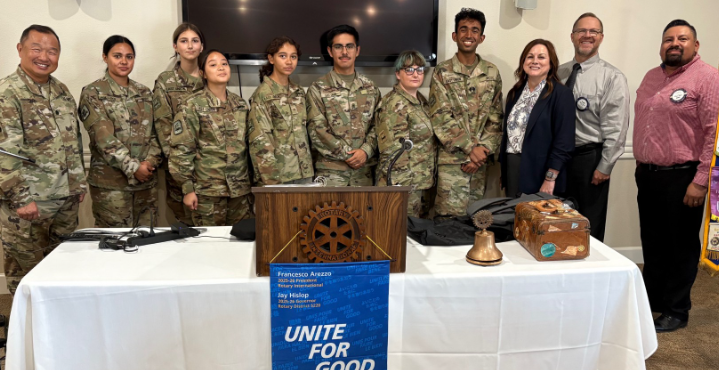
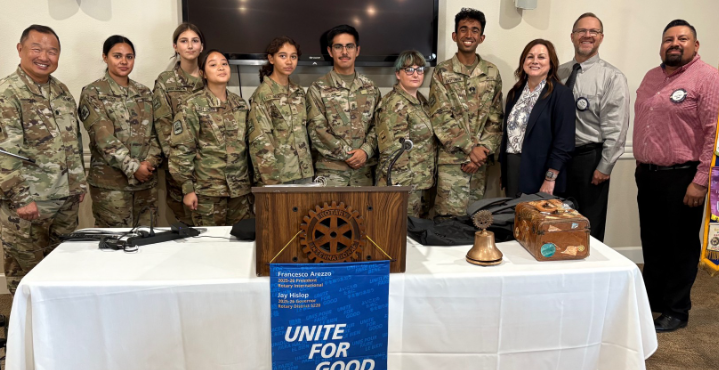
Nahir Jain thought joining the JRTOC program as a freshman was a great way to get out of taking PE.
Four years later, Jain is leading the 98-member strong JROTC unit at East Union High.
And while there is clearly a physical education component — the Lancer Battalion has won the Fresno Raider Challenger that serves as a statewide JROTC competition that focuses on endurance events for the past nine consecutive years — there is much more to JROTC as Jain points out.
There is everything from robotics to academic teams.
But it is not just physical and mental skills that the JROTC cadets numbering more than 300 at the five Manteca Unified high school campuses are learning.
“You learn to lead and you learn to follow,” said cadet Antonio Rocha who is also part of the East Union JROTC command structure.
The bottom line for individual growth encompasses learning to work as a team and understanding and embracing the importance of discipline, commitment, and civic responsibility among other traits.
“They’re part of our future,” MUSD Superintendent Clark Burke said Thursday during a presentation about JROTC at the Manteca Rotary meeting.
Burke noted what students learn through JROTC are building blocks they can use to build a future for their selves through a career/job and being actively involved in civic and community endeavors.
Despite its military appearance, JROTC has nothing to do with recruiting future soldiers.
The JROTC program — one of the nation’s largest youth groups with more than 500,000 students at 3,500 high schools — has a clear mission under federal law.
*Teaching citizenship values.
*Promoting service to the United States.
*Building personal responsibility.
All JROTC program have foundations established in four areas.
*Leadership and education.
*Health and wellness.
*Citizenship and government.
*Life skills.
There is also a modern technology focus on area such as robotics, aerospace technology, rocketry, and cyber technology.
It’s re-enforcement of soft skills such as team work, delayed gratification, promptness, discipline and such puts it in the same category in that aspect as with Interscholastic sports and school band programs.
“It serves students that aren’t into sports or music,” said MUSD Assistant Superintendent Clara Schmiedt.
Schmiedt was a teacher back in the early 1990s when JROTC was first introduced into Manteca schools.
She remembered initially thinking that it “seemed to be a military organization” but soon came to realize it wasn’t.
“It’s like what (the cadet) said,” Schmiedt said, “they learn to lead and learn to follow.”
It is exactly what the modern-day version of the program instituted as part of the 1916 National Defense Act does.
Back in the early days when some questioned MUSD having JROTC program after the Modesto City Schools board rejected authorizing a JROTC unit on their high school by declaring it would be “militarizing students,” a survey was conducted of Manteca High graduates who had joined the military since the program started on campus.
There were less graduates that had been involved with JROTC enlist in the military than from the Manteca High football team.
To contact Dennis Wyatt, email dwyatt@mantecabulletin.com