The last time Manteca went to create a gathering place downtown it didn’t go so well.
It was 15 years ago.
The city had swapped land with Verizon and ripped out a section of Poplar Avenue to expand Library Park.
They then expanded Library Park’s footprint and poured $1.6 million in improvements and new amenities to complete the vision for a community gathering place — a town square, if you will, — to fulfill an objective of the 2001 downtown specific plan.
For a while, it seemed to work.
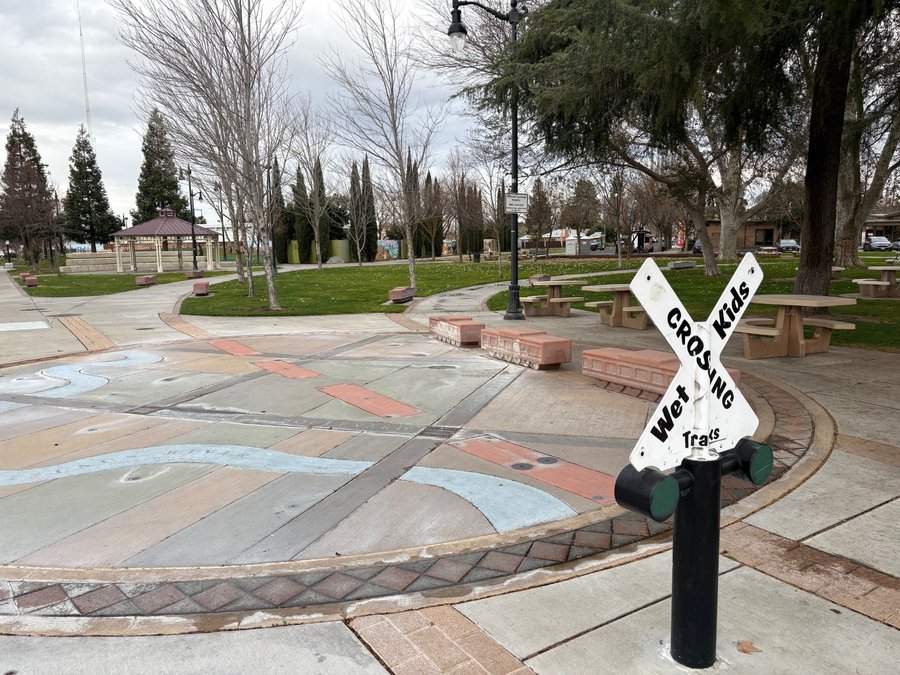
Kids and families made a beeline on hot summer days to frolic in the $460,000 water interactive play feature customized by weaving in elements reflecting Manteca’s culture, geography, and railroad history.
When kids weren’t giggling when the pseudo train whistle blew to warn that that water would soon be popping up from the ground, they were amusing themselves on the two new playground areas.
The Manteca Chamber brought back the mid-week evening farmers market complete with live music beneath the shade of the stately sycamore trees after a two-year stint on Maple Avenue during the construction at Library Park.
But within a year, the homeless started popping up in Manteca in greater numbers and would hang out at Library Park as well as Wilson Park across the streets with piles of their belongings and sleeping bags. Occasionally, they would pitch a tent.
That led to a growing number of people being uncomfortable with attending the market at Library Park even though they were never any reported incidents between the homeless and attendees.
Meanwhile, the fairly robust use of Library Park by community groups to stage events such as Cinco de Mayo celebrations, car shows, Art-in-the-Park for kids, low-key concerts, and such that populated the park prior to its expansion never returned.
The replacement gazebo never got any use outside of the Pumpkin Fair and the street fair.
And the 75-seat amphitheater adjacent to the gazebo has been rarely used over the years although it has been popular with the homeless to kill time.
The addition of the “mini” food truck venue — a single truck and once in a while two vendors — hasn’t helped Library Park develop into the promised gathering place it was envisioned to be back in 2001.
Other elements of the 2001 downtown specific plan did make it to fruition and stick — the iconic transit center that was built, the stylist street lights, a mini-plaza on Maple Avenue, murals, and paver crosswalks.
The biggest pitfall was the execution of the gathering place concept.
It was a “build it and they will come” approach.
There was no deliberate continuous programming by the city or any organization.
The assumption was the community organized celebrations there before the park’s expansion and they would continue to do so after the project was completed.
Hanging the fact Library Park for not turning into the promised community gathering spot that would give new life on the homeless is borderline looking for a scapegoat.
Ascent’s project manager for the upcoming downtown specific plan work, Chelsey Norton Payne, has started out the process this time around noting the city needs to “activate” the vacant lot at Yosemite Avenue and Main Street to make it a gathering place.
It implies more than just physical improvements. It includes ongoing programming.
And that was what the city did not have back in 2011 after making their $1.6 million in a new, larger Library Park into their vision of a gathering place.
How is this go around
going to be different
The fact there is now a Downtown Business Association funded by property owners means the downtown businesses and landlords are collectively putting money on the line to bring people downtown.
Arguably, the corner of Yosemite and Main could be programmed to much more effectively serve that purpose to its high exposure that clearly doesn’t fall into the put of sight, out of mind category that Library Park does sometimes.
The current municipal leadership led by City Manager Toni Lundgren has stopped waiting on the sidelines for stuff to happen as witnessed by programming community activities in the 100 block of North Maple Avenue.
And now, Lundgren apparently is ready to up the city’s game to further engage residents in community activities by actually elevating Manteca Recreation & Community Services to a department head level.
The passage of the 20-year Measure Q sales tax is giving the city the ability to make moves that would allow the city overall to not just survive, but to thrive.
The fact Manteca is pumping $1.2 million to buy the IOOF building and corner lot in a bid to partner with the private sector to make a transformation building helps.
So does the fact this current downtown specific plan is different from the 2001 version as it is “holistic.”
In other words, unless city leaders chicken out when it comes to execution, it will be more than just words on paper.
The 2001 plan referred to the need to develop downtown design standards. This time around the check the city is writing includes creating such standards.
It also will address a major road block that could impede private sector investments into bringing improvements and businesses the city wants to see downtown.
It will do so by putting in place an overlay environment impact study that can be used to reduce the time required for development to take place and make it clear what will be accommodated.
What to do with
Library Park
The just adopted parks and recreation master plan never addressed repurposing Library Park for being under-utilized as it did with the baseball field at Marion Elliott Park to meet what the consultant determined was a severe shortage of pickleball courts in Manteca.
What makes it odd that it wasn’t addressed was the city’s own action in the past two years seeking requests for proposals to basically repurpose it.
That is what led to the proposal to create a repurposed container food park via a private investor that never got off the ground.
The question now is whether the city will be addressing “repurposing” Library Park to some degree in the new downtown specific plan.
One might be whether the city can find a way to build on it as a way to lure younger families with kids to down given its proximity to the library.
The water play feature — that could be retrofitted to meet new state standard so it can again be used — is likely to cost a lot less than the $3 million being poured into the waterplay feature at Woodward Park.
That said, it stands as a $460,000 monument to what can happen when city leaders — like they did when deciding to go forward with the waterplay feature — decide to do something on the cheap.
Back in 2009, the council at the time shaved just under $90,000 off the price tag by not recirculating the water. But in doing so, it would eventually render a $460,000 investment useless.
Even at the time it wasn’t a brilliant move in drought prone California. The state banned such water wasting amenities just four years after it was turned on.
And even if that hadn’t of happened, the city was already restricting the use of the interactive play feature within the first year because of the cost of the water they were sending into the wastewater treatment plant that then also cost more money to treat.
To contact Dennis Wyatt, email dwyatt@mantecabulletin.com