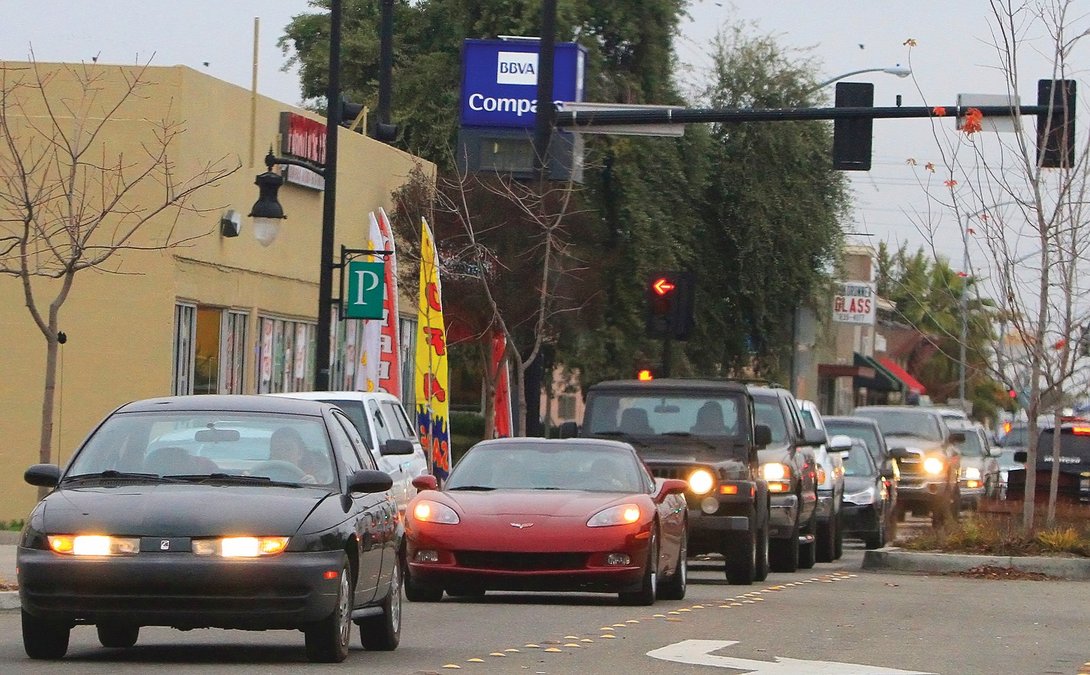
The majority of elected city leaders for 25 years have embraced the need to widen Main Street through downtown to four lanes.
But every downtown study commissioned by the council from the 1980s decreed Main Street needed to stay two lanes to help improve downtown’s fortunes.
And every time the consulting firm insisted changes needed to be made to the corridor to “calm traffic” and discourage through traffic passing through downtown.
Three times previous councils — conceding there is a pressing need for the community that Main Street function as an arterial — eventually voted to start the process to convert the corridor to four lanes.
And each time the council ended up reversing itself due to cost or merchants along the Main Street corridor — including a now long-gone termite company that claimed the loss of street parking would kill “drop in” business — pushing back.
Manteca has now commissioned Ascend consulting to develop a downtown specific plan complete with yet another traffic circulation element at a cost of $980,000.
And while they are at least 18 months away from completing the proposed plan, the conceptual use they submitted for the property the city is buying for $1.2 million on the northwest corner of Yosemite and Main — the IOOF Hall and adjoining parking lot — doesn’t signal they’d likely recommend making Main Street four lanes.
That’s because the consultants envision making the corner parking lot — combined with a partial alley closure and an adjoining city parking lot — an outdoor community gathering place for events.
Even now with two lanes when events have occurred at the corner — such as mural dedications — the traffic on Main Street has been a significant distraction.
Making Main Street four lanes would likely make the corner’s ambiance as a gathering place worse from the perspective of a planner.
All of that questions the wisdom of commissioning a downtown plan without the council making it clear there may be a traffic circulation pattern they have no political stomach or will to pursue or retain
That’s because traffic circulation is a critical element for the plan that is being developed.
The last attempt to
widen Main to 4 lanes
Mayor Gary Singh was a council member in 2021 when the last serious attempt was made to convert Main Street through downtown to two lanes in each direction.
It was his idea and he almost succeeded.
Except the city staff generated idea to essentially appease the council after four lanes on Main Street met pushback from the city senior management team effectively defeated the move for the third time in 25 years.
It was an elaborate paver project that would have required partial curb setbacks and eliminated gutters to allow the use of French drains to remove storm runoff to retain a middle lane direction while accommodating two travel lanes in each direction.
It avoided using an option that would have had Main Street traffic clear signals one direction at a time at the Center and Yosemite intersections. The option would have allowed the center lane in each direction to go straight or turn left while the curbside lane could turn right or go straight.
That option, which would have had minimal costs and was keyed on changing the sequence of traffic signals, was disliked by the public works director at the time.
Staff pushed a holistic approach in 2019 that Ben Cantu, who was mayor at the time, praised as “out of the box thinking”.
It was the replacement of asphalt with pavers that staff said would cost $1.3 million when it was proposed initially in 2019.
But by the time the project — that was given low priority by the staff — was designed and went out to bid, it came back at more than $1 million over budget.
The council rejected the bids and eventually diverted the money to repaving work on the Airport Way corridor.
Staff did come back with a proposal to help ease congestion by synchronizing signals and delaying cross traffic movements at Center Street and Yosemite Avenue for less than $120,000 that the council approved.
Main Street — without a doubt — is the Achilles Heel for the City of Manteca when it comes to what to do with downtown.
Bulbs short-circuited first
bid to make Main 4 lanes
The three-block section of Main Street has been a thorn in the city’s side since the early 1990s.
That’s when traffic started increasing on it from Manteca north of the railroad to reach what was then the city’s largest shopping center anchored by Walmart Pak-N-Sav (now Safeway), and what was Mervyn’s at the time.
The solution to the initial surge in traffic passing thru downtown was instituting no left turns — on the advice of a traffic consultant — for Main Street at Yosemite Avenue.
That proved wildly unpopular as well as widely ignored. The ability to make legal left turns was restored within three years.
The bulbs were put in place during 2005 after a group of downtown merchants during the development of the last downtown plan convinced the council at the time parking was needed on Main Street.
The council had been considering eliminating parking in the 100, 200, and 300 blocks of North Main Street to allow four lanes of traffic to flow through the central district to ease backups on Main Street.
Leading the charge was the owner of a pest control company in the 200 block of North Main who worried that eliminating parking would kill any drop-in business he might get. The pest control firm moved several years later.
The bulb-outs were part of an overall downtown design plan to beautify the city’s core. Their use on Yosemite and Maple was to enhance landscaping and make it easier to park.
On Main Street aesthetics were a goal but the main reason they were put in place was to deliberately slow down traffic passing through downtown to encourage motorists to look at options for shopping as they drove by. That was a key element of the city’s plan at the time to pump new life into downtown Manteca. All it ended up doing was backing up traffic on Main Street.
Consultant offered ‘proof’ 90%
of motorists used Main Street
to access downtown locations
A traffic consultant at the time claimed his firm surveyed Manteca residents and found almost 9 out of 10 residents contacted said they used Main Street to access downtown.
A flaw in the survey question — not asking what the respondent’s perception of downtown was — surfaced in a follow-up by the Bulletin where 10 people contacted at random gave wildly different versions of what they believed downtown to include.
Several included Walmart and the former K-Mart as well as the Save-Mart shopping center as being part of downtown.
The skewed consultant survey prompted one council member — who was unaware at time of the shaky premise of the question asked of respondents — to change his planned vote allowing the bulb plan to go forward on a 3-2 vote with then Mayor Willie Weatherford and then Councilman Jack Snyder voting no.
The vote effectively kept Main Street two lanes through downtown.
Within a year, one of the bulbs in the 100 block was moved after repeatedly being struck by vehicles. Then two others were taken out that severely impeded traffic flow by making it impossible to make a right turn until drivers were on top of the cross street.
Rumblings against the bulbs grew as did complaints about traffic on Main Street.
Council member started push
to take bulbs out in 2009
In 2009, Debby Moorhead became the first council member to push for all of the bulbs’ removal. She was the lone voice until 2016. That’s when traffic on southbound Main started backing up on a routine basis during certain points in the day almost to Alameda Street.
In April 2016, the Manteca council instructed staff to proceed that year to take out the bulbs and reconfigure the 100 block with two southbound lanes and one northbound lane. The 200 and 300 blocks were not included.
Two months later, staff convinced the council that their No.1 citywide street priority to revamp the 100 block of Main Street should be tied into work being done from Yosemite Avenue to Atherton Drive in a bid to save money.
Then in 2017, Singh — frustrated at the cost for the 100 block of Main that was pegged at $1.3 million but would not address the overall congestion through downtown — convinced his council colleagues to address Main from Yosemite to Alameda so that in 10 years when traffic got even heavier the city staff would not come back with a plan to spend more money.
“Let’s do it right the first time and not come back in 10 years to tear it up again and spend even more money,” Singh said at the time.
The council agreed although public works staff at the time was doubtful a design would work that would get four lanes on traffic through the central district.
Paver plan comes in
at $1M plus over bid
Staff came back in June of 2020 with a plan the council embraced.
The plan was a solution to what amounts to three basic problems — improving traffic flow on Main Street through the current two-lane bottleneck, street flooding during downpours, and jump starting efforts to pump new life into downtown .
Yet another plan originally advanced two years prior would have cost more than $4 million as the street would need to be widened by four feet and eat into sidewalks. It would also have required all street lights and traffic signals to be relocated.
In addition, an underlying 6-inch thick slab of concrete that was the original Highway 99 would have needed to have been cracked or completely removed to prevent the asphalt pavement put in place from having a shortened life.
The plan addressed lingering flooding problems that have persisted after two significant storm drain system improvements since 1989 failed to completely compensate for the flatness of the area in sudden downpours.
That is where pavers entered the picture.
The paver solution addressed a multitude of problems.
They include the desire to retain 10-foot wide travel lanes, avoid costly relocation of street lights and traffic signals that would be subject to notorious PG&E delays that drive the cost of projects up, eliminated the need to replace 4,000 plus feet of curb and gutter, addressed perennial flooding during heavy or sustained downpours at the Main and Center intersection, recharged the groundwater, and did not require taking out sidewalk and making them narrower or having store doors replaced so they opened inward.
It also eliminated the need to paint traffic lanes, sidewalks, and turn lane arrows as those are put in place with colored pavers.
There is also the low maintenance cost. Pavers have a lifespan of 65 years versus asphalt at 17 years.
Also, if utility work is done, pavers are removed to get into trenches and then replaced without unsightly and often uneven pavement patching. If by chance several pavers “settle” they can easily be taken out and repacked using sand.
The original cost for the project was pegged at $3.9 million with PG&E relocation work that would be required costing another $500,000 to $1 million and possibly delaying the project even longer.
Using pavers the project was estimated to cost $1 million to $2 million for the 2,600-foot long stretch and roadway that averages 50 feet in width depending upon the condition of the existing 6-inch thick concrete. The concrete is a required base for pavers. The initial savings were estimated at $2 million by from going with pavers.
But when bids came in, they were in excess of $1 million of what the city anticipated.
Why Main Street needs to
function as a key arterial
At the heart of the dilemma is the failure by downtown proponents opposing a four-lane Main Street through downtown to grasp the fact it is a heavily traveled arterial and likely always will be.
There are no “bypass” streets to get around downtown for a mile in each direction thanks to the railroad tracks and how neighborhoods in the central district are configured.
Creating a bypass of downtown would require plowing through a hundred or more homes and/or constructing an underpass or overpass of the tracks as Union Pacific aggressively resists adding at-grade crossings for obvious reasons.
Linking Industrial Park Drive to Spreckels Avenue in 2006 was heralded as a downtown bypass as that was what it functional primarily as for a number of years.
It prevented the need for residents south of the railroad tracks to use Main Street to turn right on Yosemite Avenue to reach the massive commercial area that replaced Spreckels Sugar that included Home Depot, Target, Staples, and Food-4-Less.
North Main Street is — and likely always will be — the arterial that is lined with the most commercial in Manteca.
To contact Dennis Wyatt, email dwyatt@mantecabulletin.com