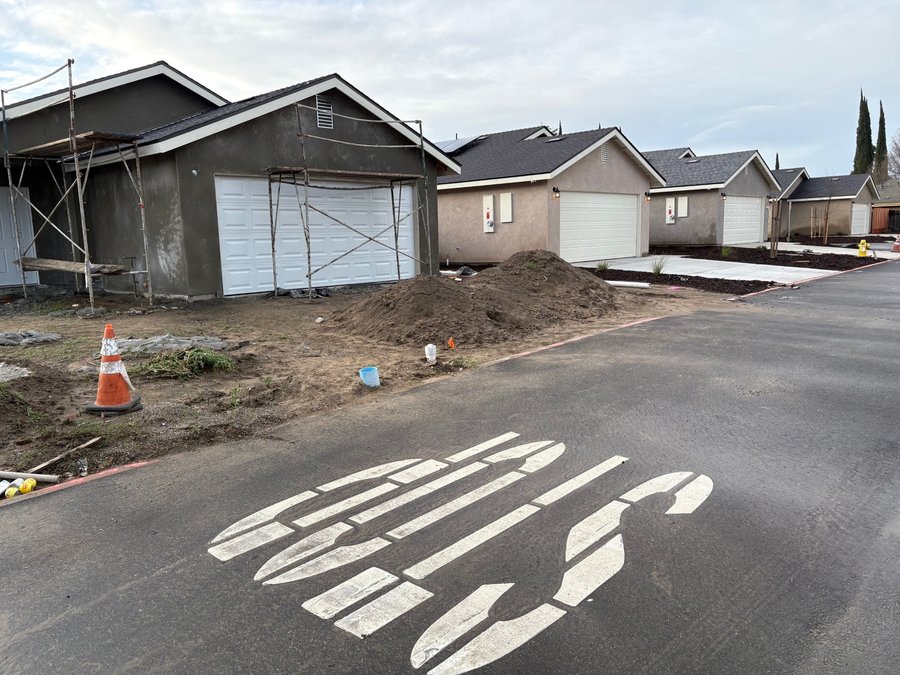
New housing starts in established neighborhoods in Manteca hit a record 143 housing units in 2025.
The infill housing included:
*33 auxiliary dwellings units, sometimes referred to as granny flats.
*10 single family home starts either on what were vacant parcels or replacing aging houses.
*100 affordable apartment units in the Los Robles complex being built behind commercial development at North Main Street and Lancaster Drive.
Manteca, between all types of housing, had 973 units that were started last year. That included 840 single family homes.
Of the 10 infill homes, four are being built on a private street off of Alameda Street west of Fremont Street where a single house once stood on a large parcel.
Another four were built in the 300 block of Maple Avenue, also replacing an existing home.
Infill and ADU housing are the somewhat abstract result of municipal policies for smart growth.
Smart growth basically means making the community more livable while encouraging development that slows down the conversion of farmland.
They are “abstract” in the sense it does not involve a large swath of basically undeveloped land where cookie-cutter-style projects can take place.
Infill projects are also somewhat elusive because of their scale.
Due to involving significantly smaller parcels that need projects that work in concert with existing development that surrounds it, they do not attract larger development concerns.
As such, they do not have a large enough potential “payday” to get a lot of attention from bigger players.
That said, they can work for what might be called “mom and pop” developers who may build a single house, a duplex, a small apartment complex, and similar endeavors.
Infill doesn’t simply refer
to just using vacant parcels
Manteca is doing what it can to encourage infill.
The reason is simple.
It helps compete and/or improve urbanization of older segments of the community.
And when it does, it helps maximize the use of expensive infrastructure and services that helps lower long-term city costs, strengthens economic opportunities for nearby businesses, and adds to the tax base.
When you say “infill”, many people assume it is a reference to vacant lots or parcels.
But in the world of California planning, it also means redeveloping property by replacing existing uses with high density uses.
Manteca leaders added
enticement to encourage
more infill endeavors
Forty-five months ago, the Manteca City Council reduced five growth-related fees through June 30, 2026 to make it more economical to pursue infill development in the central city.
It involves a:
*50 percent reduction for government building facilities fees.
*75 percent reduction for Public Facilities Implementation Plan transportation fee, park acquisition fee, and park in-lieu fee.
*100 percent reduction in the long range planning fee.
The fee reduction applies to sites less than 5 acres.
And if there are non-residential uses, they must be less than 50,000 square feet.
Combined together, the temporary incentive can reduce the cost of required city fees by 25 percent.
Given they can easily be in excess of $40,000 for a single housing unit, it is a significant reduction.
The so-called “infill opportunity zone” generally is bordered by Louise Avenue on the north, Union Road on the west, Wawona Street with a jog at Main to Industrial Park Drive on the south, and Garfield Avenue with a jog to North Fremont with a jog from Edison to Garden Gate Drive on the east.
It is as an area that is generally developed but still contains some areas of vacant or underutilized parcels that could be redeveloped and benefit the city and residents.
The age of most structures within this area is over 50 years old, with many not seeing significant rehabilitation during that time.
City staff notes vacant parcels often depress surrounding property values and often attract crime, homeless camps, and other social issues.
ADU construction
breaks will remain
In the past six years, Manteca has recorded 118 ADU permits, including a record 33 in 2025.
The incentives for ADUs are not expiring, unlike with infill single family homes.
There are a number of advantages when it comes to ADU housing.
*There is no need of major infrastructure investment such as streets and sewer/water lines that are already in place.
*Infill projects such as ADUs not only piggyback on existing amenities and infrastructure, but they also tend to be closer to shopping, dining, services, transit, and schools.
* The smaller ADUs, by virtue of their size, stay at the lower end of the rental market.
*Manteca has encouraged ADUs with lower growth fees and even has basic plan sets available.
*There are several impact fees that are not collected in Manteca on auxiliary dwelling units 750 square feet or less in a bid to encourage more ADUs.
*And if the ADU is 500 square feet or less, the builder is also exempted by the State of California from paying school impact fees to further reduce development costs.
*City rules are also lifted in terms of off-street parking spaces.
*Couple that with the fact “off-property” infrastructure is already in place such as streets, sidewalks, sewer and water lines, storm drains, and even the backbone for PG&E utilities.
To contact Dennis Wyatt, email dwyatt@mantecabulletin.com