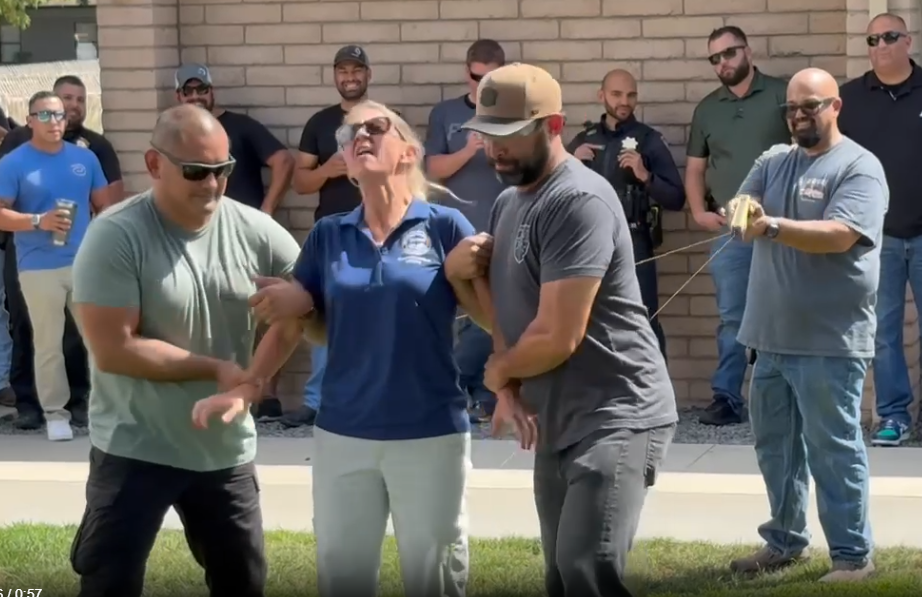
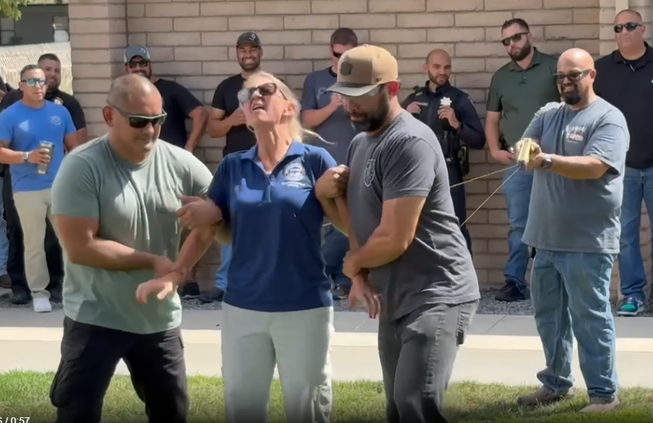
Manteca Councilwoman Regina Lackey is nursing a massive bruise on her thigh and dealing with a big knot on her back.
And that’s OK with her.
It’s because she was able to experience firsthand how the police protect Manteca and constantly train to have the best and safest outcomes possible while serving the community.
“I don’t know what she was thinking,” her husband Steve said when Lackey decided to volunteer to serve as a target along with three animal control service officers during police training on Thursday.
He shared that he got shocked with a dog collar as a teen to see what it was like and had no desire to repeat the experience.
Neither does the councilwoman.
“It was one and done,” she said.
That said, she was glad she did get tased once.
Lackey said she was thinking of several things when she volunteered to be a training target for police.
She wanted to know firsthand how police train.
She also wanted to share with constituents how police use tasers.
And she wanted to show she supported the effort of the men and women of the Manteca Police Department.
“People want to know (about how the police protect them),” Lackey, who posted the video of the tasing on social media.
The training event was witnessed by 60 or so municipal employees who took a break from leadership training to see the taser training.
Lackey was asked before being tased whether she wanted half strength or full strength.
“Just do it,” was her reply after mulling it over for a second or two.
She stood with her back to Sgt. Danipour with two officers holding her so they could lower her safety to the ground after being tased.
Lackey was tased with 1,000 volts from two prongs.
One was in the upper body and the other to the leg.
She was shot and on the ground in under 5 seconds.
Onlookers erupted in polite applause with some cheers.
What did it feel like?
Lackey compared it to when your foot locks up and you can’t move it.
But instead of just the foot, it’s your entire body.
“I had no control,” she said.
The video shows her arms flailing.
“I don’t remember that,” Lackey said, noting all of the responses her body made were reflexive.
Lackey said the 5 second was more intense than six weeks of basic training she went through so she could serve in the Air Force from 1998 to 2003.
The officers were using new Taser 10s that were purchased using Measure Q sales tax receipts.
They replace tasers that are seven years older and not as technologically advanced.
The new tasers can be fired from 40 feet instead of having to be within 25 feet. That allows for safer outcomes for both the suspect and officers.
They also are not a one shot and done.
Instead, officers deploy two shots. One on the upper body and then one on the lower body.
The old tasers fired both shots at once.
In addition, the new tasers allow for five separate sets of shots instead of one double shot without having to replace the cartridge.
They also deliver a maximum of 1,000 volts per shot and not 7,000 volts.
As such, the less than lethal option that new tasers provide are now less likely to cause targets serious permanent harm or death.
Police Chief Steve Schluer noted officers first try to de-escalate serious situations verbally. The taser is used when that fails and the situation becomes dicey.
Schluer said the officers simply warning they are going to use the taser — much like with a warning they are going to release a police dog — gets suspects to comply.
The police chief said officers once or twice a month on average actually have to fire tasers.
They unholster them a lot more but the simply act of doing so and stating they are ready to use them avoids the situation to go farther.
“They help keep the suspect, the public, and the officer safe,” Schluer said.
Police are required to do taser training once a year.
Most training is on a dummy like device test emulates the human body. There is also virtual training.
There are some officers who volunteer to be tased during training but it is not a requirement.
The new Taser 10 is expected to help reduce potential taser deaths by 50 percent.
This was the department’s second training session with the new tasers.
The first was two weeks earlier.
One of the volunteers then was Schluer’s 18 year-old son Collins.
Schuler said Collins had been asking him since he was 8 years old if he could be tased.
The answer was always no, because volunteers had to be 18 years or older.
Collins, after he turned 18, again asked his dad to allow him to be tased.
Following his tasing, that has been posted online to the theme song “Bad Boys” used by the TV “Cops” series, Collins was asked if he wanted to be tased again.
His answer?
An emphatic no.
To contact Dennis Wyatt, email dwyatt@mantecabulletin.com