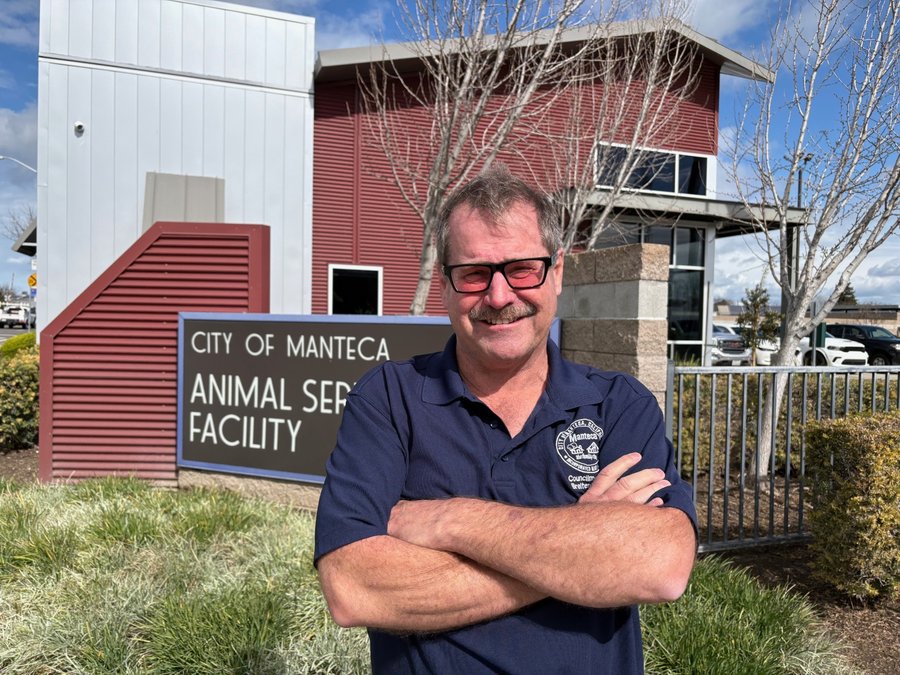
Manteca has secured $850,000 in federal funding to expand the animal shelter.
It is part of the city delivering on a promise made four years ago not to let animal services be treated as if it was an afterthought.
One of the latest stepped up animal services was the installation last month of a microchip scanner near the front entrance of the shelter at Wetmore Street and Main Street.
It allows someone that might pick up a stray dog or cat to scan it in a bid to return it to their owner.
Not only does it allow for a quicker resolution of helping lost pets find their way home faster given it can be accessed 24/7 whenever animal services is not staffed, but it also can make staff more efficient by freeing them for other needs.
The city is continuing to meet standards to be recognized nationally as a no-kill shelter.
That means 90 percent of the animals that end up at the animal shelter have a “live outcome.” It includes pets being reunited with their owners, pets being adopted, or pets being transferred to rescue organizations.
Manteca is also currently working with the Animal Protection League to provide low cost spay and neuter services to city residents. It will also include wellness care.
The city last year conducted two free vaccine and microchip clinics in partnership with the Animal Protection League.
During 2025, the city launched Friends of Manteca Animal Shelters. It is a 501(c)(3) nonprofit designed to grow support and expand lifesaving programs.
The Doggie Day Out where volunteers take shelter dogs out for walks that help to calm them down by reducing kennel anxiety and such.
There were 853 walkers during 2025, including 217 new walkers.
Altogether, there were 1,653 program walks during 525 walks in 2025.
Animal shelter expansion
will soon move forward
The process of securing the $850,000 in federal funds for the animal shelter started more than four years ago when Mayor Gary Singh first approached Congressman Josh Harder.
Passage of Measure Q means the expansion - that is now at capacity — is a do-able project.
The city had adequate land at the shelter for expansion.
The current city approach is in stark contrast with the city in the past.
The previous animal shelter on Wetmore Street where the solid waste division offices are now located was built in 1978.
It was designed simply as a space for cages and an office in the smallest footprint possible.
Within years, it was clearly inadequate.
That lead to the city having a high kill rate.
The current shelter has:
*Two separate dog rooms. Each has 13 individual kennels designed with a door that slides up in the middle of each run. That allows doubling the available space for up to 52 dogs if needed. The kennels have a system where urine and smaller fecal matter can be hosed into using the wand system after larger droppings are collected.
*There is a separate room where animals — when needed — can be put to sleep.
*There is an examine room for treating animals.
*There are two cat rooms of which one is for the isolation of sick cats.
*There is an outside holding pen for larger animals.
*There is an extensive exercise area outside for dogs.
The design employed all of the latest standards adopted by the Society for the Prevention of Cruelty to Animals when the animal shelter opened in 2011 at a cost of $2.1 million.
To contact Dennis Wyatt, email dwyatt@mantecabulletin.com