There’s a new thrift store in Manteca.
And if Monday’s grand opening is any indication, it is going to be a runaway success.
*Well over 600 customers went through the doors in a little more than six hours.
*Shelves and racks had to be replenished repeatedly.
*Roughly 40 percent of its opening day inventory of 1,000 items — ranging from shirts, jackets, blouses, pants, prom dresses, shoes, backpacks and more — were snapped off of shelves and racks.
*The decor made the presentation in other Manteca thrift stores seem sterile in comparison.
There are two catches, however.
They don’t take cash. Or any payment, for that matter.
And to shop there, you need to have membership in an exclusive “club”, the Manteca High student body.
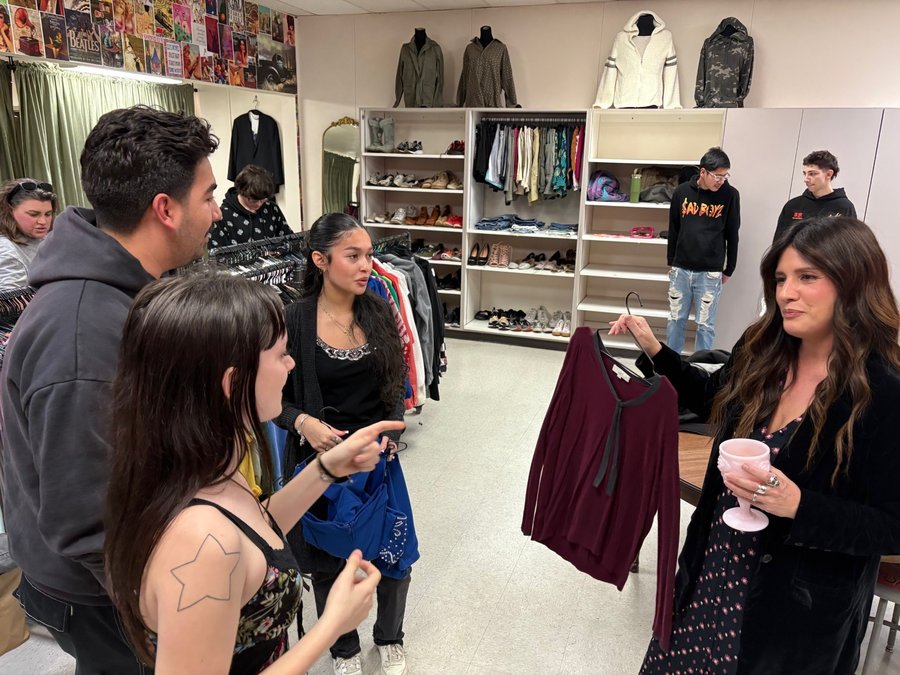
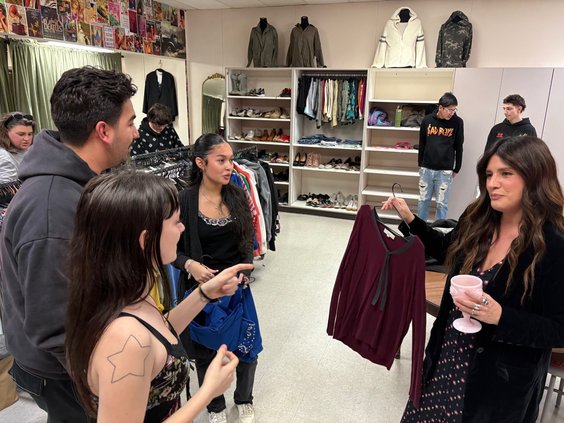
The place is the Vintage Vignette, aptly named as it is a thrift store in re-imaged space that once housed the Manteca High student photo lab.
It is the brainchild of interior design instructor Angie Anaya and executed flawlessly by her 18 advanced class students.
The primary objectives were to:
*Create a space that was inviting and not embarrassing, if you will, for students whose families struggle to make ends meet by removing the stigma of student clothes closets.
*Encourage all students to “recycle” clothes instead of tossing those that have been gently used that often end up in landfills long before their useful life has expired.
That led to the unique concept of Vintage Vignette.
It is free to all students, regardless of need.
It will be open for that purpose every Thursday during student lunches.
The staff will be students in Anaya’s fashion merchandising class.
Anaya noted the interior design class created the space just as they would in an interior design job, and hand it ready-to-move-in to a client.
However, for Monday’s grand opening, the 18 interior design students had the honors of helping customers as they made their selections.
In doing so, they learned soft skills that some employers contend are in short supply among high school graduates such as effective communication.
The definitely were kept busy.
The store had 1,000 clothing items that had been washed and prepared for the racks.
By day’s end, they had replenished the shelves and multiple times as they “moved” roughly 400 clothing items and every backpack they had on hand.
“We wanted to create a special and very welcoming space,” noted senior Katelyn Metzger.
Career Technical Education funds were used to covert the space with students collaborating.
In the process, they learned that everyone had a somewhat different take on what a modern vintage shop space should look like.
But if you think this was just picking out paint and such, you’d be off the mark. It was a hands-on learning process that put basic skills learned in the classroom — from math to effective communication — to work.
Although the consensus was to use wallpaper, it was quickly determined to be problematic and not within the budget.
They decided on what was the next best thing — but in execution was arguably a lot better — by creating a collage of photographs students collected and then selected.
The goal was to not have an inkling of the student clothes closet of yesteryear where those from struggling families were able to access to select needed apparel from among hand-me-down clothes on racks, in boxes, and from mismatched tables with those clothes requiring hangers hung from seemingly 1,001 versions.
The interior design students were charged with shattering the student clothes closet stigma of yesteryear with its dingy vibe, cold feel, limited lighting, and musty smell.
That meant the tiniest detail mattered.
It is why all hangers are not only new, but they were selected to be in one style instead of a chaotic looking mismatch.
The two dark rooms were converted into dressing rooms.
The display shelves and racks flow seamless into the store’s feel.
But at the end of the day, the goal is to get students into recycling clothes.
“Reduce, reuse, restyle,” said senior Olivia Mulzet who noted she learned patience through the collaboration process.
Anaya compared the coloration experience of people being in their own “bubble” of reality.
She noted it was a process of bringing together numerous people in similar but slightly different “bubbles” to agree on how to move forward.
“I had my ideas of vintage,” Mulzet said, noting it didn’t align exactly with classmates.
But in the end, she believes the end result was better thanks to collaboration.
Mulzet, who likes math, also re-enforced the ability of such a hands on project to make what students learn in the classroom work in life.
They took all the measurements of the room and used math in other ways such as determining the amount of paint needed.
The collaboration for the thrift store went way beyond Anaya’s interior design and fashion merchandising classes.
Special education students on campus learning life skills laundry the donated clothes.
The Sierra High culinary class produced treats that each student was presented with as they exited the store on Monday.
One teacher, Anna Wooten, who brought several classes throughout the day to the store, noted student feedback had been extremely positive.
Many teens were already talking about how they would be “cleaning out their closets” of items they no longer use to donate them to The Vintage Vignette so they could be recycled to schoolmates.
One of her students found a dress that meet the requirements needed for an upcoming JROTC military ball. That dress, once the event is over, is likely to be returned as are prom dresses the store has on hand.
Wooten also relayed how one of her students asked if it was OK for him to take a sweater for his mother to lift her spirits. as she had been struggling lately as she worked to support her children at a retail job. He also found several items for himself.
Anaya said the class is working with stores to secure new underwear and such for Vintage Vignette as well as adding hygiene products.
Those that would like to donate items can do so at Mrs. Vanwarmerdam’s office in the administration building or emailing Anaya at aanaya@musd.net.
The interior design students also would like to see the effort to recycle, reuse, and repurpose clothing at no-charge to all students grow.
“We hope other schools (East Union, Sierra, Lathrop, and Weston Ranch) add similar stores,” added junior Davin Halla.
To contact Dennis Wyatt, email dwyattmantecabulletin.com