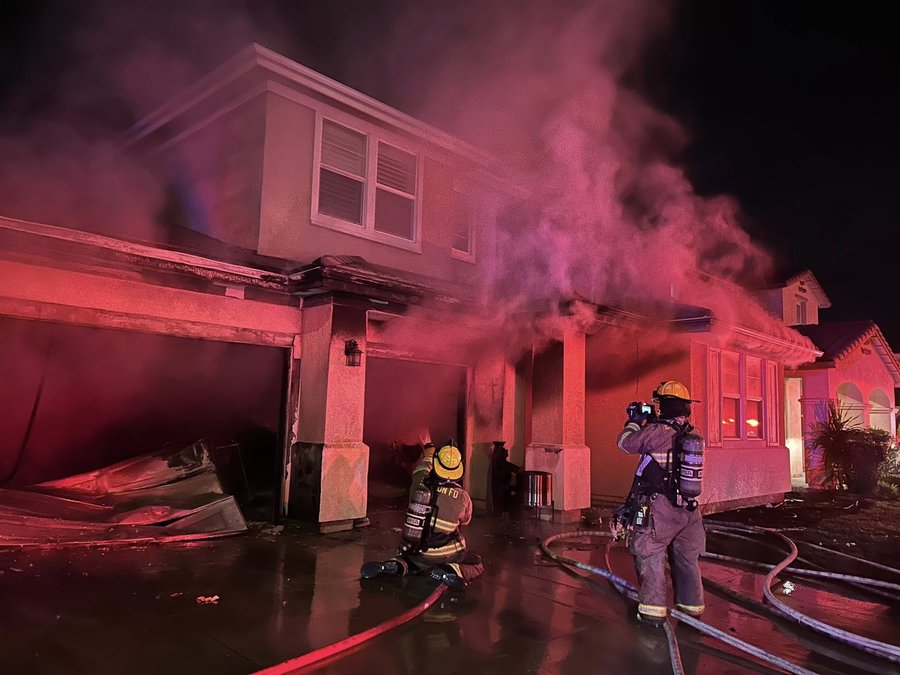
It’s a race against the clock when it comes to fire suppression.
Fire science has established every 30 seconds a fire can double in size.
In medical emergencies — strokes, cardiac events, major trauma, and such — the longer initial in-field medical care takes to start, the lower the odds for a good outcome.
Those two factors are what set the stage for the predicament the Ripon Consolidated Fire District finds itself in today protecting the lives and property of 22,000 people spread across 56 square miles with only one staffed station.
The district has one engine with two firefighters staffed 24/7 along with a two-man ambulance crew the is cross-trained in firefighting.
The RCFD is in the process of gearing up for a parcel tax vote in August designed to allow the placement of a second two-man fire engine at the shuttered fire station at River Road and Murphy Road.
It would significantly reduce response time to the northern parts of the City of Ripon as well as the northern and eastern parts of the rural area.
Equally important, is having additional firefighters ready to answer a 9-1-1 call for a medical or fire emergency when the current engine and ambulance are still handling another emergency call.
That situation, known as concurrent calls, happened 986 times in 2025. The district handled 2,881 calls overall last year.
Arguments that the district can rely 100 percent on mutual aid when a second call happens concurrently or could rely on volunteer firefighters to respond both gloss over one thing — response time.
The longer it takes for an engine company to arrive at an emergency, the less of a chance for the best outcome.
That can translate into the difference between minimum fire damage or significant damage or even 100 percent loss.
Optimum outcomes in medical emergencies are even more dicey as the longer a person is not breathing or is severely bleeding the lower the changes of an optimum out outcome and the greater the odds of death.
A yardstick provided by the National Fire Protection Association that staffed departments need to aim for includes:
*Call processing — from the initial 9-1-1 call to dispatching — should take no more than 65 seconds.
*Firefighters should be suited and in their apparatus within 80 seconds or fire calls and 60 seconds medical emergencies.
*Travel time from pulling out of the station to arriving on scene should be no more than 240 seconds.
Automatic aid dispatches the closest available engine from a nearby department or by requested mutual aid can add 10 to 14 minutes in travel time.
“Most of our aid comes from Escalon Fire,” noted Ripon Consolidated Fire Chief Eric DeHart.
If not Escalon, engines will respond from either Manteca, Modesto, or Salida.
That puts responding engines on the Highway 99 corridor where traffic during the morning and afternoon commutes often slows below 30 mph.
Suggestions from some that the department could simply rely on volunteers on concurrent ignores today’s realities.
“You’d be asking someone to leave their job and respond 8 times a day, assuming there are in Ripon at the time,” DeHart said.
And if you’re only talking about concurrent calls that would reduce the need, on average, to 2.5 times a day. It is still is a massive time commitment.
Then there is also the need for volunteers to stay on top of training.
The department does use volunteers.
As an example, when the water truck is needed for a rural fire, a volunteer will go to the station and respond with it so the two-man engine is fully staffed.
As it stands based on last year’s call statistics, there is a 34 percent chance — or roughly a 1-in-3 odds — when you call 9-1-1 within the Ripon Consolidated Fire District you’re going to have to wait 10 to 14 minutes longer for help to arrive on top of the district’s average response time.
What the parcel tax
will generate a year
The district is still ironing out exact wording, but the bottom line of the upcoming ask of parcel owners is to generate $1.8 million a year.
To man a second fire engine to address the issue of more than one emergency happening at any given time, it will cost $900,000 in salaries and overall benefits such as health insurance, workmen’s compensation, and retirement.
The $900,000 figure covers six firefighters at $150,000 with two a shift for 24/7 coverage.
To contact Dennis Wyatt, email dwyatt@mantecabulletin