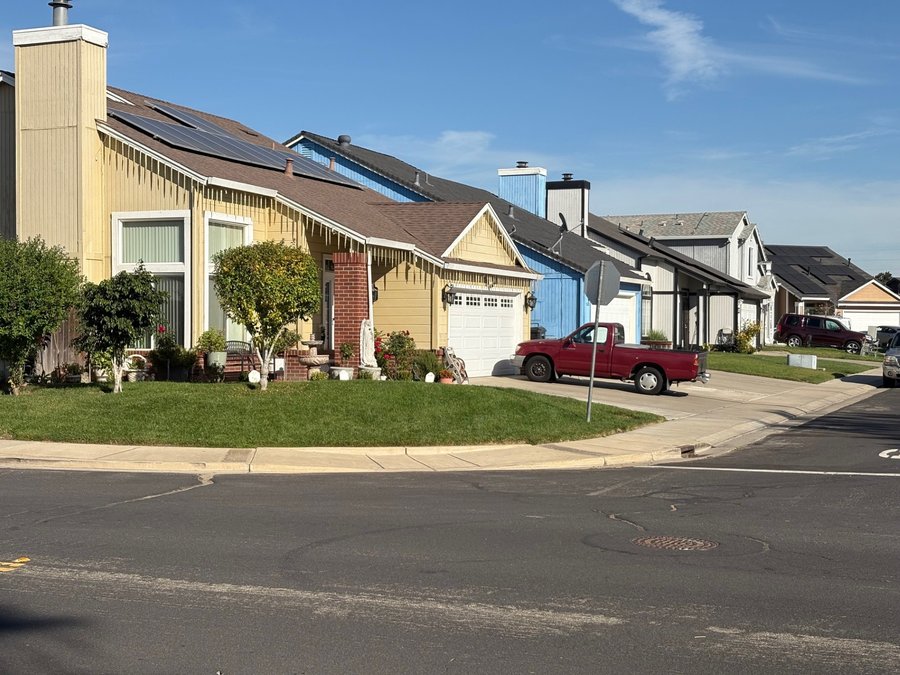
The days of Cedar Glen — a mid-1990s affordable housing project having the smallest lots with a free standing home in a tract-style development in Manteca — are numbered.
In the coming few years, the 3,301 square-foot lots of Cedar Glen off of Vasconcellos Avenue in Manteca east of Highway 99 where 66 homes were built, will no longer be the smallest.
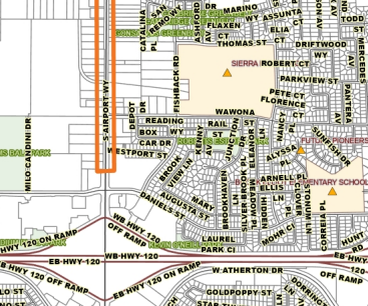
That designation will go to 77 “motor court” lots that will be as small as 2,746 square feet in the 827-home Lumina at Machado Ranch now under construction of the southwest corner of Woodward Avenue and Airport Way.
Both Cedar Glen and the Lumina motor court homes are based on the working theory that smaller lots with smaller homes are more affordable when it comes to new homes.
But there is a big difference.
Lumina at Machado Ranch is a product designed and funded by the developer as an “at-market” affordability housing endeavor.
Cedar Glen was a partnership with the City of Manteca’s now defunct redevelopment agency.
The RDA — that took its funding form the city’s share of increased Proposition 13 property taxes on existing land and improvements within its identified project boundaries as well as the city’s share of taxes assessed on new development — participated via silent down payments.
As such, buyers had to qualify for a mortgage but they also had to not make more than a certain percentage of the region’s annual household income.
The RDA participation that put up a $15,000 downpayment for each home allowed what were at the time 66 long-term renter households in Manteca to be able to buy their own homes.
The silent loan was forgiven after a set number of years of the buyer living in the home. If they sold before then, the RDA retrieved a pro-rated balance of the silent mortgage and a pro-rated share of the increased equity.
Cedar Glen project effectively
increased affordable at-market
Cedar Glen was the first new “affordable” housing project in Manteca that did not serve low-income seniors.
The homes that sold new for $97,000 in 1994 when the median sale price of all homes in Manteca was $125,900 are not affordable to households that can qualify for their estimated values today but lack funds to make a downpayment.
That said, they are affordable for those with decent “local” salaries that can’t afford the current Manteca median encompassing new homes and resales closing escrow that is now at $575,000 if they can make the downpayment.
Cedar Glen homes, in terms of their pricing in relation to the median home price on the market in Manteca, is still roughly what it was in 1994 when they were first sold, which is 30 percent.
That means they are still addressing an affordable housing need today.
As such, the endeavor increased the number of at-market homes available for people with household incomes south of the city’s median income levels.
The new subsidized
North Main apartments
The 100-unit, three-story Los Robles Apartments now being built behind commercial development on the west side of the 1100 and 1200 blocks of North Main Street where it T-intersects with Lancaster Drive is niche affordable housing.
It serves those working households defined as low-income in the region. Rents are subsidized to varying degrees based on the household’s size and income.
The city has no local tax investment in the project although they did have to indicate their support of the $40 million in revenue bonds Bold Communities needed to secure to complete financing of the project.
Such revenue bonds typically have tax breaks for the investors. As such, the housing they create for subsidized rents must stay that way for periods typically of 40 years or more.
It is similar to the 147-unit Juniper Apartments on Atherton Drive next to the at-market Tesoro Apartments.
The big difference between Los Robles and Juniper is the Juniper complex involved RDA funding in the mix that is still being using local tax revenue diverted from the city to pay off bonds.
The motor court homes
are 100% market funded
The motor court homes on the 157 acres on the southwest corner of Airport and Woodward is 100 percent market driven.
While those needing subsidies of some type won’t qualify to buy them new or down the road on the resale market, they will definitely increase the lower-end stock of at-market housing.
For comparison to the 2,746 square-foot motor court homes being built at Lumina at Machado Ranch, in Manteca tract home neighborhoods built in the late 1960s and 1970s such as Shasta Park, the average residential lot is 6,000 square feet.
That’s more than twice the size of the motor court lots.
They can be that small because four homes share a common area.
The common area is a 20-foot-wide driveway from the street serving four homes that have driveways 18 feet deep that split off the motor court driveway.
Guest parking is allowed on driveway aprons as well as on the street.
All landscaped areas in front of the two homes facing the motor court as well as the two homes facing the street are maintained by a homeowners’ association.
The individual lots have minimum widths of 40 feet and minimum depths of 45 feet.
California Rooms — indoor-outdoor living spaces designed as a seamless extension of a great room — are included in the motor court homes and may encroach up to 3 feet into the backyards.
The overall 827-home new neighborhood will also have “big lots” numbering 37 and come in at 8,000 square feet.
There are 120 lots of 6,000 square feet — the default standard of tract lots in Manteca in the 1960s and 1970s.
The rest of the lots approach the size of many in older sections of central Manteca where homes were built in the 1930s, 1940s, and 1950s. There are 202 lots of 5,000 square feet, 207 lots of 4,000 square feet, and 109 lots of 3,375 square feet.
Duplex project
is now underway
A 114-unit duplex neighborhood that also includes two single family homes is also now under construction on Airport Way just south of the golf course.
Installing infrastructure and such for the project is why Airport Way was closed for months until several weeks ago.
The project is the largest duplex endeavor ever undertaken in Manteca.
Plans are for each unit to be sold separately.
To contact Dennis Wyatt, email dwyatt@mantecabulletin.com