April showers bring May flowers.
That’s true to a degree.
The rain during the transition from March to April this year is extending bloom windows that were starting to look short-lived with the record end-of-winter heat.
Even so, if you want to enjoy wildflowers and low key hikes in the Sierra foothills and mountains, then this month is going to be the best.
Keep in mind the wildflowers roll out at the lower elevations first.
As those blooms fade away as the calendar marches into May, the mid-elevations still offer wildflowers.
The higher elevations — just below the tree line and in the area where granite rock dominates along the Sierra crest — typically start blooming in earnest after mid-May or early June on the tail end of the snowmelt.
However, with what is left of this year’s snowpack, the ultimate wildflower viewing time may start in early May.
The nice thing about living in the Northern San Joaquin Valley is that there are endless day hikes to enjoy the return of spring from low-key affairs of two or so miles with little elevation gain to those that are moderate and even strenuous.
The varied terrain from 20 feet about sea level to 13.000 plus feet also offers a smorgasbord of visual and photogenic delights.
Here are four easy to moderate springtime hikes that won’t disappoint.
*THE UPPER NATURAL BRIDGE OF CALAVERAS COUNTY: This 2 mile round-trip hike features a wide well marked trail, a natural bridge, plenty of wildflowers and a series of caves — limestone grottos — with water trickling from a flow stone ceiling into a cool pool of dark water.
Hiking time is about an hour but you will need to allow for additional time to explore the cave that requires wading and scrambling. Those wishing to go the length and reach the upper entrance 250 feet upstream will need to do some swimming, wading, or floating.
But if all you do is dally just inside the entrance from the trail and along Coyote Creek, the trip is worth it.
The natural bridge is part of the area the Bureau of Reclamation manages around New Melones Reservoir. Take Highway 4 out of Angels Camp to Vallecito where you will turn on Parrotts Ferry Road and drive over four miles to Natural Bridges sign pointing you to the trailhead at 1,500 feet.
*MERCED RIVER TRAIL: This is a moderate 6 mile round-trip excursion that’s mostly flat with some rocky portions that takes you down the Merced River’s lower gorge from the Railroad Flat Campground at the 1,050-foot level north of Mariposa reached by taking Highway 140 to Briceburg.
Much of the hike is along the long abandoned Yosemite Valley Railroad that assures a gentle grade for walking.
In the spring this stretch of the Merced River is first with ablaze with thousands of California Golden Poppies clinging to rocky bluffs going from water level at 1,300 feet up to the 2,000-foot level above.
That is mixed in with — and followed by — a repertoire of other wildflowers as spring inches toward summer.
The river below the trail often echoes off the walls of the canyon providing a gentle roar punctured occasionally by the chirping of birds.
The hike should take between two to three hours.
*CALAVERAS BIG TREES SOUTH GROVE: Another moderate hike, the 5.3-mile round trip to the imposing Louis Agassiz Tree in the South Grove of the Calaveras Big Trees State Park offers yet another take on spring time in the 209.
The hike covers terrain that is relatively flat for the Sierra. A round trip takes about three hours.
Budding shrubs and a sprinkling of wildflowers can be found in April. But what makes this hike a treat in spring is the smell and the fact you won’t work up a sweat. It’s hard to describe, but the scent of giant sequoias shaking off yet another winter under warming skies is a pleasure onto itself.
The goal is to reach the Agassiz Tree. At 250 feet, is the tallest Giant Sequoia in Big Trees and ranks among the tallest 10 trees in the Sierra. It’s 2,000 plus years old. What will really grab your attention is its girth. It has a 25-foot diameter some six feet off the ground.
There is a $10 per vehicle entrance fee to the state park for miles east of Arnold on Highway 4 above the 4,000-foot level.
*HETCH HETCHY WAPAMA FALLS: Hetch Hetchy is one of those hikes that never disappoints no matter how many times you do it or what time of the year.
It is also a moderate hike that is 5.5 miles round trip with a net elevation gain of 200 feet. It starts at 3,728 feet at the edge of O’Shaughnessy Dam in Yosemite National Park.
This hike has a lot going for it, especially in the spring. A walk across the dam and then through a tunnel bored during the dam’s construction.
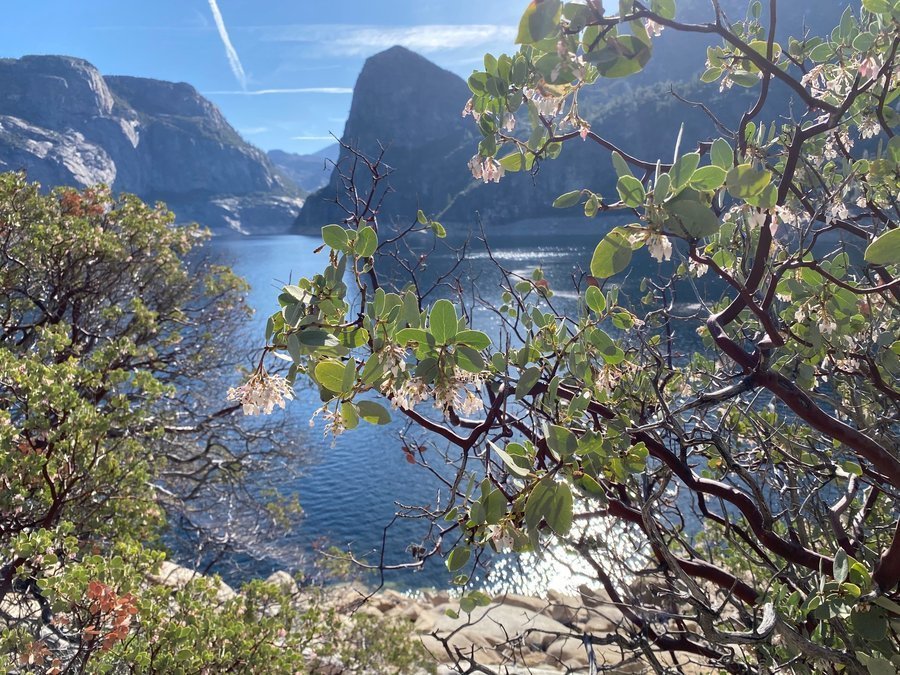
The trail is along the edge of Hetch Hetchy Reservoir with stunning granite walls rising from its blue waters with plenty of small seasonal waterfalls and a sprinkling of spring flora coloring on the way to the main event — Wapama Falls.
Of all the water falls in Yosemite National Park, this is the best in terms of relative accessibility without a hoarde of people.
You will likely get a bit of spray once you start descending the stone steps that take you to a series of short bridges running past the falls. Even though the flooding of Hetch Hetchy Valley to provide drinking water for the City of San Francisco effectively buried the last 400 feet of Wapama Falls, the remaining 1,400 foot drop is still impressive.
If you want to make the hike a bit harder and move the dial toward the strenuous side you can continue to Rancheria Falls, a classic cascading ribbon-style fall. It stretched the trip to12.7 miles round trip.
To reach Hetch Hetchy, take Highway 120 to Evergreen Road just outside the entrance to Yosemite National Park. It’s a 7.5 mile drive after turning off Highway 120 to the reservoir.
There is a $30 entrance fee per vehicle good for seven days.
To contact Dennis Wyatt, email dwyatt@mantecabulletin.com