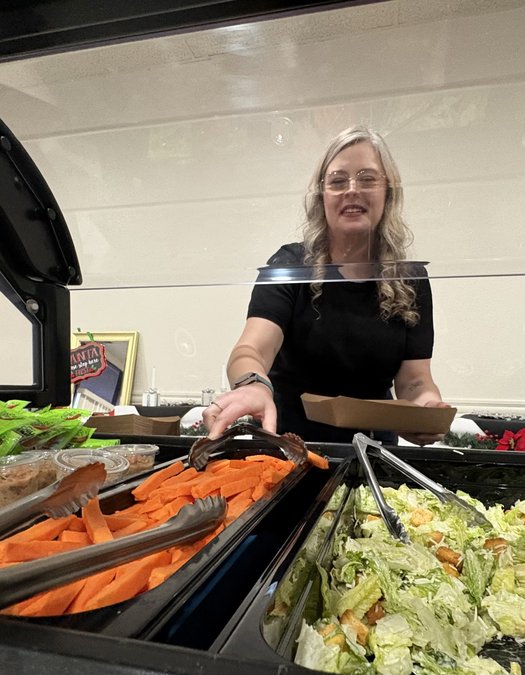
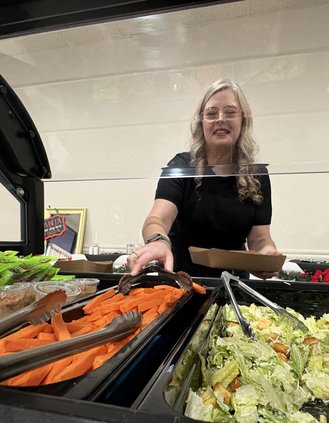
Tracee Franks oversees the largest kitchen operation in Manteca bar none.
And unlike much smaller dining concerns, in order to be successful, she needs to do more than just tailor menus to pass muster with diners.
She also needs to follow fairly rigid nutritional mandates handled down by Sacramento and Washington, D.C.
Franks oversees the Manteca Unified Nutritional Education Services for the school district that has nearly 26,000 students.
Nutritional Education just don’t “whip up” a new recipe when they add something to the menu.
The process is methodical while also relying on some of the world’s finickiest eaters as taste testers — kids.
“At school, everything has to be tasteful and not just nutritious,” noted Tracee Franks who oversees the Manteca Unified School District Nutritional Education Services.
It is no easy task.
Besides having to follow state and federal nutrition guidelines that the district meets or exceed, they have to satisfy young tastebuds, and stay within budget.
Directives include 30 percent of what they serve must be 100 percent from scratch. MUSD regularly exceeds the 40 percent threshold.
If they come up with a new entree, they must follow rigid guidelines.
For example, at the elementary level it must by 600 to 650 calories based on serving proportions.
The recipe is analyzed by a computer program. If it exceeds or falls below the range, they can’t add it to the menu.
The same goes for other nutritional components regarding sugar, fats, and salt. What entrees, sides and desserts they craft have to fall in preordained parameters and check every box. If it doesn’t, they can’ serve it to students.
The process requires a lot of tweaking.
But that is the easy test.
It also has to taste good.
Next, they take what the entree that passed nutritional muster and tasted good to adults devising the recipe and make sure it passes the ultimate taste test.
“Adult palates are different that students,” Franks said. “If it is nutritious but it doesn’t taste good to them, they won’t eat it”
The taste test is conducted in select classrooms.
Nutritional services bring samples for each student to try.
The students then essentially give it a thumbs up or thumbs down.
The bottom line is Nutritional Education needs to do their part in making sure the district’s nearly 26,000 students are ready to learn when the bell rings.
Being hungry and/or not eating healthy makes it difficult for youth to stay focused on learning.
Franks shared with the Manteca Rotary on Thursday that the district has 250 nutrition services workers handling everything from warehouse and delivery duties as well as serving and preparing food to devising new offerings.
And it is more than just lunch.
They serve breakfast as well as — in the case of students that go from the last bell into an after-school tutoring or education-based program until 6 p.m. — snacks and supper.
Given the commuter nature of the Manteca-Lathrop community, there are a large number of students who are at campuses up to 10½ hours a day.
It is the responsibility of nutritional services not simply to keep them fed, but also make sure they are “fueled” properly.
An example is the approach to breakfast.
Every elementary student is served breakfast after they enter the classroom. High school students have access to breakfast before class from various carts on campus.
Franks noted the big focus at breakfast is grain.
In terms of nutrition for growing bodies and brains, it is much more conducive to learning than protein for breakfast.
What is served in the classroom needs to be done in a fashion that minimizes creating a mess as well.
Breakfast, like all student food service, is free regardless of income.
That is the result of a state decision in 2020. The district for day-to-day nutritional services is funded 50-50 by the state and federal governments. None of the nutritional funding can go to anything else including classroom instruction.
Before the directive from Sacramento, the district was trying to figure a way to accomplish that goal on their own.
That’s because 70 percent of the district’s students are social-economic disadvantage under state law.
That basically means their families are struggling to provide basic needs.
One of the things that tips the scale is the high cost of housing — renting and buying in Manteca, Lathrop, and southwest Stockton.
The district also serves free meals weekdays in the summer at various locations in the community.
They also conduct a summer camp for students dealing with Type 1 diabetes.
District remodel will save
costs and allow for growth
Long-range cost savings, streamlined operations, and ample room for growth is also on the menu for the Manteca Unified School District Nutritional Services.
And it is all being made possible due to a mantra at the school board and district levels to spend money wisely and to squeeze the most benefits for students out of every tax dollar spent.
It is what led the district to buy a 58,000-square-foot building in the heart of the Manteca Industrial Park at 550 Carnegie Street for $6.4 million and then move forward with a $9.9 million remodeling project that started in October.
The drive for a new central warehouse that will also encompass offices started with two major needs.
*The district lacked adequate warehouse space for nutritional services and is paying $500,000 annually to rent space.
*What warehousing they do have at the district office site was in need of repairs with expensive refrigeration storage essentially be operational only because of the proverbial “baling wire” effort.
*The needed new space pegged at 19,000 square feet would cost $14 million to build assuming land wasn’t needed.
By buying the former home to Ecologic, the district has a space three times of what they currently need.
Not only does that mean roughly triple the space allowing plenty of room for growth, but the district can also house all of the Nutritional Education Services in one location.
It also will have elements such as a test/training kitchen as well as existing office space that is being remodeled.
Down the road, there is room for an additional central kitchen.
The district is currently moving forward with two new elementary schools south of the 120 Bypass and one in Lathrop.
Typically, a central kitchen can handle four to six schools.
Each high school has a central kitchen as do two elementary school sites.
The test kitchen/training kitchen could possibly be used one day to program career technical education programs such as the culinary arts to help educate high school students.
Manteca Unified Chief Financial Officer Victoria Brunn said training kitchens are rare for school districts.
The district is using non-general fund money for the remodel that includes new walk-in freezers and refrigeration as well as racking for dry goods.
By eliminating leasing and getting three times the space for $2.3 million more than the $14 million to build a new 19,000 square-foot structure.
The goal is to have the new location up and running before the start of the 2026-2027 school year.
To contact Dennis Wyatt, email dwyatt@mantecabulletin.com