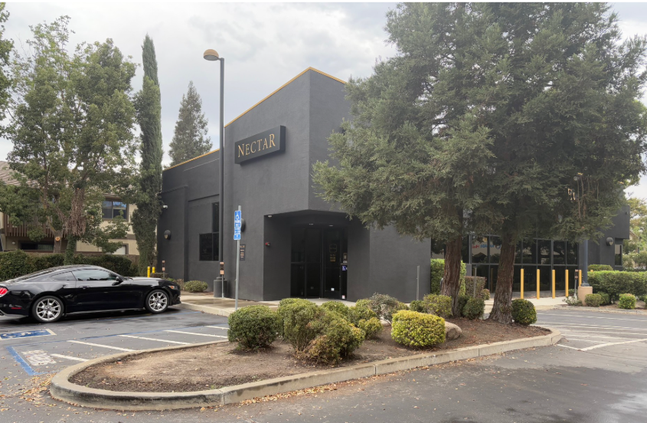
Tucked into the back corner of a West Yosemite Avenue business-professional center and next door to an apartment complex you will find a subtle charcoal stand-alone building with dark glass windows.
Equally subdued signage identified the concern as Nectar, the second cannabis storefront to open in Manteca,
There was just one car in the parking lot following Wednesday’s mid-afternoon drizzle.
Down the road where West Yosemite Avenue approaches the ACE station, there were 11 cars in the parking lot of another marijuana dispensary, Off the Charts.
It serves to underscore a point made a few minutes earlier by Jacob Naven.
Naven, who is running for the Manteca mayor’s post in the November 2026 election, is against a third dispensary opening.
And one of many reasons to justify his position is Gov. Gavin Newsom this week signing into law the suspension of 19 percent excise tax on cannabis until 2028 to help the legal cannabis market that contends it is struggling to keep customers in their competition with the black market.
The argument that the California Legislature and Newsom bought into was the reason that was happening was high taxes. Thus, the rollback to the 15 percent excise tax that was in effect before July 1.
“I’m only one vote, but (if I am elected) I would vote against it,” Naven said.
The ship may have sailed when the city issues three permits for cannabis stores, but one of three chosen applicants has yet to launch.
That third store is Embarc.
Embarc was approved to locate in a business plaza directly behind Dairy Queen on South Main Street across the street from Walmart.
For whatever reason, the deal for leasing the space fell through.
A new location, once Embarc secures it, means the City Council has to approve it.
And even if Embarc hadn’t lost its location, the operating permits are subject to annual renewal by city officials.
That means the council can yank the permit, if they chose to do so, for various reasons.
“I personally do not use marijuana,” Naven said. “If it’s allowed under California law and a benefit to users then it (should be allowed in Manteca).
As such, he agrees with the council majority that made Manteca cannabis sales made possible by the city opting to exercise its ability to issue storefront permits under California law.
But he parts ways with the number of permits the council decided to issue and the perimeters they established that restricted where cannabis dispensaries would be allowed to open.
Naven believes Manteca made two mistakes.
The first was allowing three permits instead of just two.
The second was putting rules in place that made it possible for Nectar to open within a half mile of Sierra High in an area that sees a good number of students walking to and from school.
Naven’s insurance office happens to be in the same business-office park as Nectar, but closer to West Yosemite Avenue near Valley Oak Dental.
Since the opening of Nectar, Naven said there has been an uptick in homeless in the parking lot.
One homeless individual actually brought a lounge chair on the first day Nectar was opening and sat in it for hours waiting for the dispensary to open.
There have also been encounters between clients, customers, and staff of concerns with homeless in the same complex that Nectar is located that have been less than stellar.
“Homeless is not a crime,” Naven said.
He also added the homeless that are adults have the right just like anyone else to purchase and use legal cannabis.
That said, homeless survey after survey, shows the majority of homeless have addiction problems and a large number also have mental issues.
The Nectar location happens to be close to a well-known area for illegal homeless encampments.
When the city was discussing locations for the three permits, those who work with the homeless were concerned about the ease the homeless could access the proposed site behind Dairy Queen given its close proximity to the city’s emergency homeless shelter and service center.
Naven lauded the Off the Charts location away from pedestrian traffic of all kinds, open exposure to a major arterial and not tucked away in a proverbial nook and cranny, and it being in an industrial park and not a professional and office park as being much better.
Having one less cannabis dispensary would also mean one less storefront the police department has to monitor whether it is through surveillance feeds monitored in the dispatch center or during patrols.
As for the number of permits, he said Manteca risks making it financially dicey for the private sector to be able to offer legal buyers an extensively tested product grown without endangering the environment with toxic chemicals as is often the case with black market grows, and sold in a fairly safe and secure retail setting.
He noted State Farm, the insurance company he is an agent for, is careful not to over saturate their markets.
Naven noted when Manteca reaches 50,000 people, State Farm determined the community could support a third agent in addition to Crystal Downs and Nancy Ashment. That allowed him to open a Manteca office.
He said if State Farm didn’t cap the number and allows say 15 agents, all of them would likely struggle to make ends meet and provide less than qualify service.
Manteca — like other local jurisdictions — has no legal ability to restrict the number of most specific types of businesses that open such as gas stations, fast food places and such beyond whether they’re doing so in the proper zone and complying with regulations.
But given the state legally empowered cities to limit, if they preferred, the number of cannabis retail storefronts that opt to allow cannabis dispensaries, changes the equation.
Financially viable dispensaries are critical for the private concerns to maintain security commitments plus keep a steady flow of revenue flowing to municipal coffers as outlined in community benefit agreements.
To contact Dennis Wyatt, email dwyatt@mantecabulletin.com