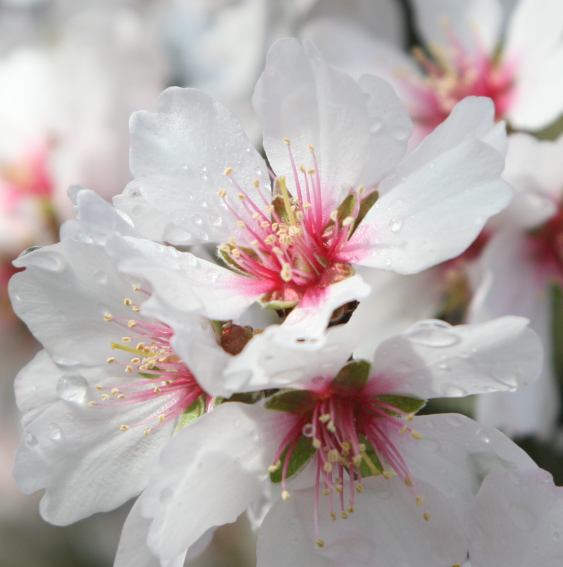
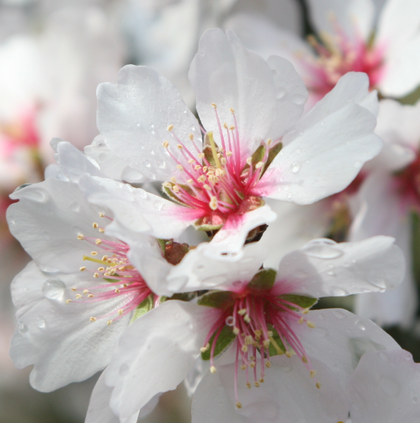
Continued rain with wind almost daily through March 2 with only a handful of days where the highs will get past the mid-60s could dampen prospects for the 2026 almond crop.
When bad weather coincides with full bloom, it can severely reduce the yield.
There has already been 2.5 inches of rain recorded as of Wednesday at noon across the Soutth San Joaquin Irrigation District with more to come.
Growers in the SSJID territory — that includes orchards around Manteca, Ripon, and Escalon — have a combined 33,000 acres of almonds. It accounts for 30 percent of San Joaquin County’s overall 111,900 acres planted in almonds.
To put that in perspective, almond orchards in the county cover 174.8 square miles or 3.5 times the land area of the City San Francisco, which is 46.9 square miles.
The rain is likely to set back the start of the SSJID irrigation season to mid or late March.
Each almond blossom only remains receptive for pollination for three to four days.
A good crop occurs when at least 25 percent of the blooms survive.
Growers indicated sustained intense, or cold rainy/windy periods during the bloom window can lead to little or no nut set.
Issues growers are now dealing with are as follows:
*Bees will not fly in the rain, high winds, or when temperatures are below 50 degrees. Cross-pollination is essential for almonds.
*Even without train, temperatures have to reach the mid-60s for optimum bee activity.
*Rain causes pollen grains to absorb water, burst, and lose viability.
*Constant moisture creates the perfect environment for diseases such as brown rot, green fruit rot, and shot hole, which can infect the flowers.
*Prolonged rain can cause premature bloom drop and a significantly lower crop yield.
*Strong winds can blow blossoms off the trees.
Almonds are the biggest irrigated crop in the SSJID service territory with 33,000 acres followed by alfalfa at 6,000, grapes at 6,000, pasture at 5,200, walnuts at 2,400 and peaches at 1,800. The rest is split between a diversity of crops ranging from corn to melons.
The nuts also the second largest California farm commodity, generating a crop valued at $5.7 billion in 2024.
California is the nation’s largest farm producing state at $61 billion, eclipsing No. 2 Iowa by $14.4 billion.
Milk is No. 1 in California at $8.6 billion followed by almonds at $5.7 billion, grapes at $5.64 billion, cattle and calves at $4.97 billion, and lettuce at $3.67 billion.
To contact Dennis Wyatt, email dwyatt@mantecabulletin.com