Yosemite Avenue and Main Street is still “the corner” in Manteca after 154 years.
On the southeast side where Bank of America stands today, is where Joshua Cowell settled in 1872, built a home, and started farming.
The north-south beaten path turned into a dirt road named Hogan Road before becoming Main Street 106 years ago.
It is where the state a little over a century ago intersected two highways in its fledgling highway system — Highway 99 and Highway 120.
And it is was the corner that got Manteca’s first traffic signals.
Now it is about to become the focal point of what is promised to be an all-encompassing $930,000 downtown specific plan touching on things such as strict design standards, traffic flow enhancements, creating more gathering places to lure people, as well as enhancing walkability and sustainability.
It even has a component to cut the red tape by creating and adopting a master environment impact document.
In doing so, it will save the private sector from having to invest more time and more money to keep re-inventing the proverbial wheel whenever they pursue a desired project that doesn’t fit perfectly into existing zoning rules.
Along the 18-month or so journey needed to gain robust input and shape a vision with what is in place as well as what could be encouraged to be built, “the corner” looms as a Rorschach test for city leaders and the community.
The reason is simple.
How traffic that flows through the intersection was treated one way by traffic engineers putting together citywide traffic circulation plans over the years.
It was treated a different way by previous consultant/community endeavors to create a new road map to make downtown a vibrant destination.
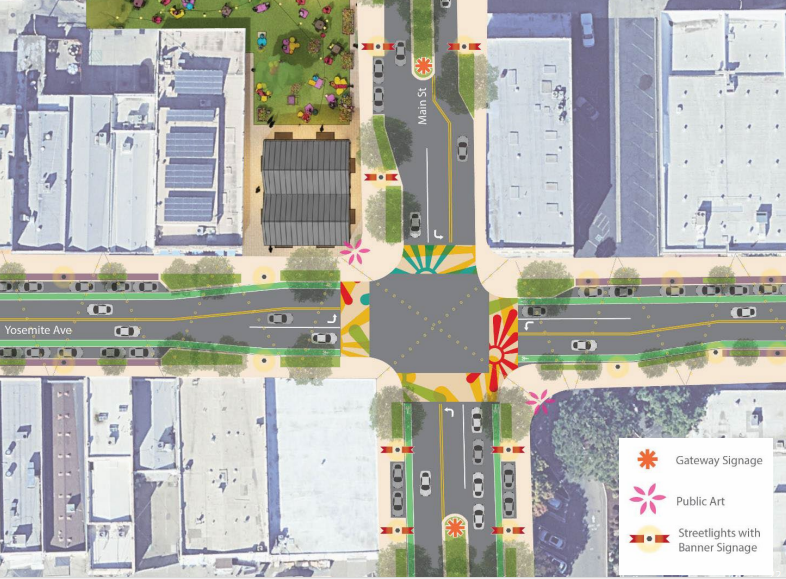
The conceptual plan offered by Ascent Environmental — the city’s just hired consulting firm for the downtown specific plan — at Tuesday’s council meeting offered an inkling of how critical the corner can be in Manteca’s future.
Keep in mind, what Ascent offered was meant to be illustrative of approaches that it will explore with the community when it comes to streetscape and mobility.
It was meant not as a recommended course, but to understand the explorative process the community is about to embark on when it comes to transforming downtown.
And what that illustration lacked was any reference to what has been a problem with Manteca’s approach to downtown over the years — developing and adopting a plan and going with it.
In the past traffic circulation plans and downtown plans have been reversed, dropped, massively changed and such when opposition, regardless of how small, surfaced or the city failed to identify how it would get the money needed to execute the plan.
The specific plan, this time around, will not gloss over the financing aspect.
But what it can’t address is the political will to not just to take off form the starting line but to make it across an actual finish line.
Conceptual vision for
Main/Yosemite corner
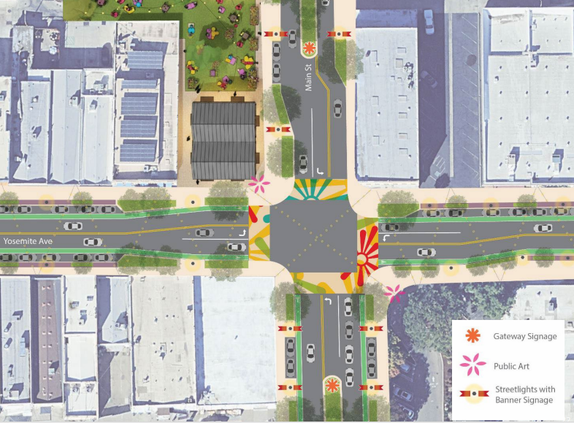
Again, the overview of Yosemite and Main offered Tuesday in Ascent’s Power Point presentation was simply an illustrative concept.
But it did show where it could go.
First and foremost, Main Street through downtown will never be two travel lanes in each direction if the goal is optimum walk ability — an essential element to getting people to park in one spot and walk up to five minutes in a bid to reach attractions while perhaps exploring what is along the way.
To de-emphasize a car dominated downtown that was driven by the perception parking 50 feet from the front door is the key to the success of a boutique retailer or a restaurant, the mobility and streetscape for pedestrians needs to be friendly, inviting, and safe.
That is why Ascent notes the importance of aligning the Yosemite and Main intersection with curb extensions.
At the same time, sidewalks need to be expanded with robust landscaping, lighting, and signage.
Main Street would benefit from landscaped medians including in the block between Yosemite and Moffat.
On-street parking should be included, where possible, even in the 100 block of South Main.
Painted bike lanes are needed along Yosemite Avenue.
Public art should be incorporated in the intersection and corners at Yosemite and Main.
In the bigger picture, a Main Street downtown “bypass” clearly has to be declared once and for off the table for ever. And in doing so, the level of traffic movement on Main Street through downtown has to be accepted as it.
That flow has, in recent years, been improved by better traffic light synchronization and deliberating prolonging wait time for east-west traffic on Yosemite, Main, and Moffat.
And to prevent de facto work arounds from degrading the quality of central Manteca neighborhoods near downtown, the city may need to take more aggressive traffic calming measures.
The Yosemite “bypass’ of extending Moffat westward to flow into West Yosemite Avenue, favored by Mayor Gary Singh and Mayor Ben Cantu before him, needs to be considered in long-range thinking of a specific plan.
Such a bypass not only would reduce traffic congestion along Yosemite through downtown Nd reduce the impacts on the Main-Yosemite intersection, but it would impact overall specific planning in terms of businesses along Yosemite — especially on the south side in the 100 and 200 blocks west of Main — and development patterns along Moffat.
To contact Dennis Wyatt, email dwyatt@mantecabulletin.com