Addressing uplifted sidewalks — or more precisely who gets stuck with the bill to fix them — has been a political Achilles heel for elected Manteca leaders for at least four decades.
And now the question is coming back into play.
Updating the sidewalk ordinance was identified as one of the top priorities and needs the city attorney’s office will address in the fiscal year starting July 1 as outlined at last month’s City Council goals setting workshop.
Uplifted sidewalks have been an issue that has plagued Manteca — and every other city — since the days when concrete sidewalks were first poured and trees planted nearby.
The city, in at least 40 years, has not had a concrete and consistent plan to deal with trees pushing up public sidewalks in residential neighborhoods.
That doesn’t mean they’ve been ignoring the most egregious tripping hazards on sidewalks.
When a city street tree uplifts the sidewalk, the city will ultimately rip out the concrete, often remove the offending tree, and plant a new one in a manner to avoid a repeat. It is done 100 percent on the taxpayer’s dime.
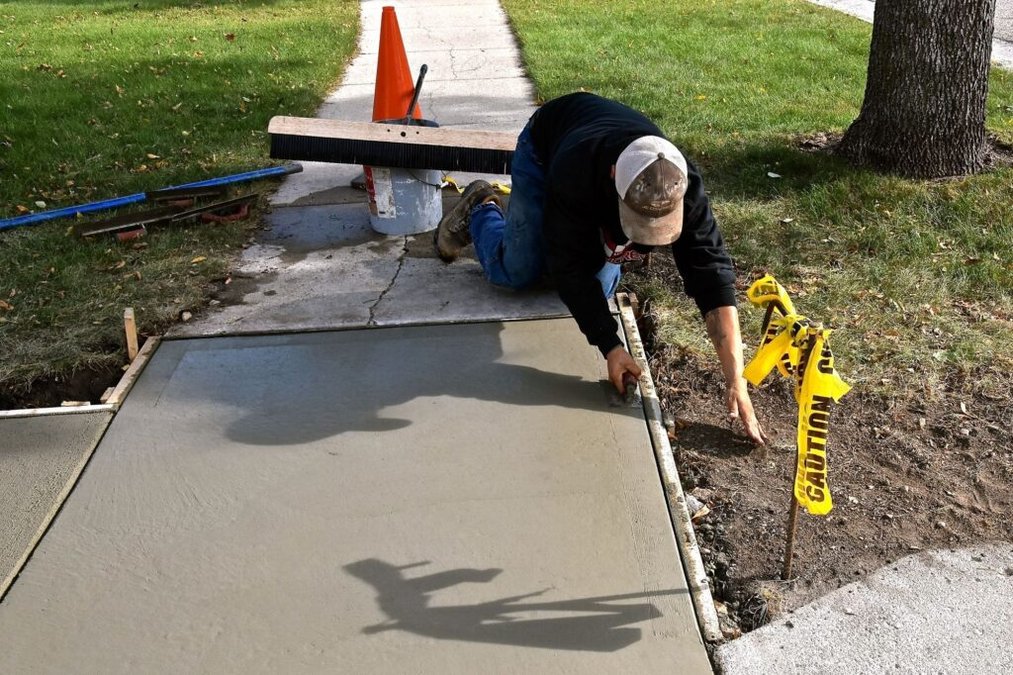
Street crews, when tripping hazards are reported or spotted, will do “bridge fixes” such as grinding down uplifts or using asphalt to create a slope.
But for the most part, holistic solutions to sidewalk uplifts haven’t effectively been approached when it comes to those on public sidewalks in front of homes.
That is about to change for two reasons.
*A majority of the current council have telegraphed they have the political will to do so.
*Passage of the Measure Q temporary sales tax for 20 years opened up a possible funding source to step up the city’s efforts.
That doesn’t mean the city is in a position to fund 100 percent of the cost.
Municipal needs may be too pressing for the three-quarter sales tax revenue to allow more general revenue funds to fully address sidewalks in residential areas where they are owned by the homeowner but are a public easement for pedestrians to use.
Regardless of the extent of Measure Q funding that may go to sidewalk repairs, it will likely mean property owners — either when work is done or property sold — might foot part or all of the bill.
The city over the last three decades has tried to tackle fashioning a set policy regarding who pays for residential sidewalk replacement needed primarily due to tree roots uplifting concrete on at least six occasions after being pressured by residents to address the issue.
Each time, the pushback was significant when the city started hammering together a game plan. It was because in every instance, municipal leaders indicated property owners would have to be part of the solution given the city wasn’t flush with cash.
It is why a few years back when council members were asked to earmark a proportion of the unspent federal COVID relief funds to address community needs and amenities, Councilman Morowit was the first to set aside $50,000 for sidewalk repairs in addition to what the city already does for sidewalks along arterial and elsewhere on municipal property.
There was a brief discussion at one point about budgeting a set amount each year for each council district to address the residential sidewalk problems.
But given the cost to address issues in just front of one home can easily exceed $10,000, that discussion was short lived.
“Whatever we do, has to be citywide,” Morowit said Wednesday. “I’m in favor of a 50-50 split (between the city and property owner). I think it’s fair.”
Morowit noted it is clear the city can’t do the actual work.
“We don’t have the manpower,” the councilman said.
The options staff is expected to analyze include:
*The city funding all sidewalk repairs.
*Homeowners funding all sidewalk repairs.
*A 50-50 split between the city and homeowner using contractors from an approved city list.
Given the size of the city and the fact it is literally a growing problem as trees grow, it is likely splitting the costs would emerge as the answer to how the needed work will be covered.
There are other options that could make a 50-50 split more palatable to homeowners.
*Having no cost building permits requiring a one page application to obtain.
*Offering an option that defers the homeowners’ share of the repair bill until such time the property changes ownership.
*Developing a list of qualified contractors with contact information. Given no city funds would be involved that could be co-mingled with state or federal funds, the prevailing wage law that adds to construction costs wouldn’t kick in.
The permit and contactor list proposals would address convenience concerns.
The deferral of the homeowners’ half until the next time the property enters escrow, eases financial concerns for the homeowner who might otherwise be forced to seek a loan, assuming they can qualify or afford one.
Some cities in the past have used the deferral until escrow even when they require property owners to pay for 100 percent of the work if the city goes ahead and does it.
Other cities in the past have been known to allow the work to be paid off in monthly installments as part of utility bills over a period of three to five years.
Back in the 1970s, some California cities used that approach without charging interest. That said, such an option may not be legal under current state law.
Trees & sidewalks:
Conflicting objectives
Sidewalks — as well as so-called street trees — serve two conflicting objectives as outlined in Manteca’s general plan.
They also exist in every over California city’s general plan given they address state mandates.
The sidewalks provide safe passage for pedestrians.
The trees meet a multitude of environmental goals.
They:
*reduce urban heat islands.
*absorb carbon monoxide, now lumped together with greenhouse gases, and produce oxygen.
*can reduce urban energy demands by helping lower ground temperatures.
Trees are also an element of making neighborhoods more livable and communities more walkable.
They offer shade and soften what otherwise be would an asphalt jungle of sorts.
One might think the older sections of town where just about any tree was allowed to be planted near sidewalks or in parking strips — areas between the sidewalk and curb and gutter — would be the largest area of concern.
After all, trees that grow in diameter as wide as the parking strip itself or those with roots that naturally travel near the surface even with adequate watering have damaged many sections of neighborhood sidewalk, especially where homes predate the early 1960s.
That has changed in recent years.
The design Pulte Homes adopted for Del Webb at Woodbridge incorporated parking strips with trees in the 1,425-home age-restricted neighborhood in north Manteca. The goal was to create a throwback feel to the pre-1960s where that was the norm in California cities.
There have been several instances of pedestrian being injured from tripping over uplifted sidewalks in the Del Webb development.
That’s the case even though the first home was built only 20 years ago and the trees chosen aren’t the type that grow big enough to serve as shave trees.
Morowit noted the Del Webb homeowners’ association, that collects fees from all homeowners within the neighborhood, is addressing the issue of sidewalk hazards in common areas
The city, for at least 30 years, has had a list of approved street trees that can be planted that are considered compatible with sidewalks.
Even when they are used in newer neighborhoods, sometimes they can create sidewalk issues.
Manteca has approximately 16,000 plus trees maintained by the city.
These trees are found in city parks, along streets, in municipal right-of-way, and at the municipal golf course.
To contact Dennis Wyatt, email dwyatt@mantecabulletin.com