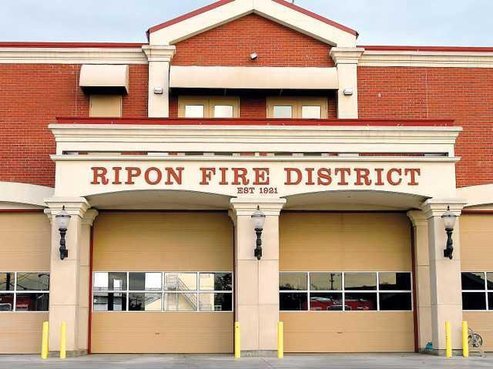
The recently approved 88-home Meadowood neighborhood in north Ripon near Fulton Avenue illustrates how things aren’t what they appear to be when it comes to the Ripon Consolidated Fire District’s finances.
Those less than thrilled about a proposed parcel tax election the district is moving toward see the subdivision as adding to the need for fire services, and therefore overtaxing the two-man engine company and two-man ambulance unit that responded to an average of eight emergency calls each day during 2025.
Those homes also represent funding needed to pay off the outstanding balance of the frontline fire engine that responded to most of those calls in 2025.
That annual fire engine payment of $115,000 will be covered for about 2.5 years with the roughly $4,000 per home fire facilities fee the City of Ripon imposes on new construction.
Those $4,000 fees are collapsed into the price the buyer will pay for a new home in addition to the annual parcel fee they will pay.
It is essentially a “buy in” to the district, if you will.
“The City of Ripon are strong partners with the fire district,” noted Fire Chief Eric DeHart.
DeHart indicated the city charges the maximum fire facility fee on growth allowed under state law.
Fire engines — that typically need to be placed into backup service after 10 years as aging equipment plus wear and tear start to create reliability issues — now cost $1.2 million to replace.
Ladder trucks cost $2 million and counting.
To put that in perspective, the general operating budget for the fire district is $4.3 million.
The district has no control over growth.
And given recent changes in state law aimed at expanding California’s housing inventory to address affordability means the City of Ripon has limited ability to stop housing growth.
That said Ripon, unlike Manteca, hasn’t positioned itself nowhere as nearly aggressive at expanding water and water treatment.
It is a reason why housing growth has been a trickle compared to the torrent in Manteca.
Manteca’s default strategy has been to overcome funding pressures for municipal services, including fire protection, by relying on tax revenue from growth.
Even that strategy has a limitation given the need for the city to secure a temporary 20-year three quarter cent sales tax to help it recently hire nine firefighters to cover what has been a manpower deficit in terms of city fire protection.
The fire district operates on a flat parcel tax established in 1985.
The only way it gets an increase in parcel tax revenues is when a large parcel such as the one where the 88 homes are being built is broken down into smaller parcels.
Assuming there was only one parcel to begin with, the subdivision would create 87 additional tax paying parcels.
The best way to assure not needing growth to cover costs is for taxation for basic services not to stay stagnant.
If that 88-home project isn’t built, the district would eventually need a source to cover the nearly $300,000 in fire truck payments it would help pay.
In other words, what little growth compared to Manteca that Ripon has had, is paying for fire engines that have a set useful life that serves the existing 22,000 residents within the 56 square-mile district.
That would mean the more self-sufficient the district is in terms of having adequate local funding, the less reliant it would be on growth to help cover fire engine payments.
As a side note, cities such as Manteca when they can, strive to pay cash up front for fire engines to avoid the cost of interest.
What the parcel tax
will generate a year
The district is still ironing out exact wording, but the bottom line of the upcoming ask of parcel owners is to generate $1.8 million a year.
To man a second fire engine to address the issue of more than one emergency happening at any given time — there were 986 concurrent calls for service in 2025, it will cost $900,000 in salaries and overall benefits such as health insurance, workmen’s compensation, and retirement.
Given the Ripon Fire has a 401k and is not a part of the California Public Employees Retirement System that is more expensive and struggling with unfunded liabilities, the benefit package is costing taxpayers much less than in many other districts.
The $900,000 figure covers six firefighters at $150,000 with two a shift for 24/7 coverage.
To contact Dennis Wyatt, email dwyatt@mantecabulletin.com