By EVELYN PROUTY
The Bulletin
Editor’s note: The following was part of a series that appeared in the Manteca Bulletin that the late Evelyn Prouty incorporated into her book “Manteca: Selected Chapters from its History.” She was a reporter for the Bulletin at the time.
From the pioneer days when nothing was here but a few widespread ranches, to the incorporation of Manteca as a city, Joshua Cowell was busy building a city.
He was also known as “Uncle Josh” and as the “Father of Manteca.”
Tinkham’s History of San Joaquin County, 1923, tells us Joshua Cowell was born in Tioga, New York, on January 2, 1842, the son of Henry and Elida McMaster Cowell. His grandfather, Joshua, served in the War of 1812. In 1845 the Cowell family moved to Grant County, Wisconsin.
If we look back to the pioneers of the sandy plains, we will find that many of these early-travelers came from Grant County, Wisconsin. A few which come to mind are the Salmon, Reynolds, Graves, Castle, Harelson, and Oliver families.
In 1861, young Joshua came west with his brothers but Joshua did not come on to California as they did; he stayed in the Carson Valley of Nevada, remaining there two years.
He walked over the Sierra to San Joaquin County, arriving here in January of 1863, and immediately purchased the ranch he continued to live on until his death, which included most of the present City of Manteca.
Cowell married Vienetta R. Graves, born in Grant County, Wisconsin, and the daughter of another early pioneer. They were the parents of six children; Elida, married James Salmon, Mary E. married Charles Salmon, Clara C. wed Clifford Wiggin, Otis, and two children who died in childhood.
Pen Pictures from the Garden of the World, 1890, tells us his first home was moved to the ranch and it was in this home that all of his children were born.
In September 1884, after the death of his first wife he married Emily Sanders and they had one daughter, Hattie.
Bank refused to
take his land back
Joshua and his two brothers, H.W. and Marion, farmed together for some time.
The Manteca Story, by Alice Coon, relates how during the 1870s, he tried to turn back to the bank 640 acres for a mortgage of $4 per acre. His granddaughter remembers that some years he had to borrow money from the bank to pay his taxes.
He later owned 1,000 acres in Manteca and rented another 1,000.
An article in the Manteca Bulletin on his 83rd birthday says Cowell was still farming what is now part of downtown Manteca.
Cowell was one of the first advocates of an irrigation system and many in the community agreed with him. But most just laughed at the idea and Cowell, along with others involved in the project lost fortunes that they had invested.
Cowell had tried to dig a ditch from Knight’s Ferry to the center of Manteca, a distance of 45 miles. After farmers refused to cooperate, Charles T. Tulloch took over the project and Cowell contracted to just build the ditches. Hence, Tulloch was given the credit for the early system and the new dam was named in his honor.
Branches out
into business
As Manteca began to grow, Cowell hired Dan Baysinger to construct some of his buildings. Cowell built the building which housed the first Central Drug on the southwest corner of Yosemite Avenue and Main Street, and the building across the street on the northeast corner. He also built a building which was torn down on the northwest corner of that intersection.
Cowell became director of a number of establishments in the new city. He took over the Manteca Rochdale store when it was about to go under and for a while it also served as the post office. For five years he was president of the Cowell Station Creamery, Manteca’s first enterprise. He was director of the First National Bank of Manteca.
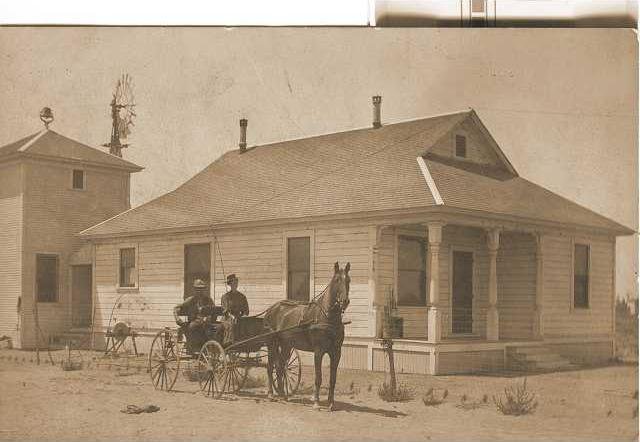
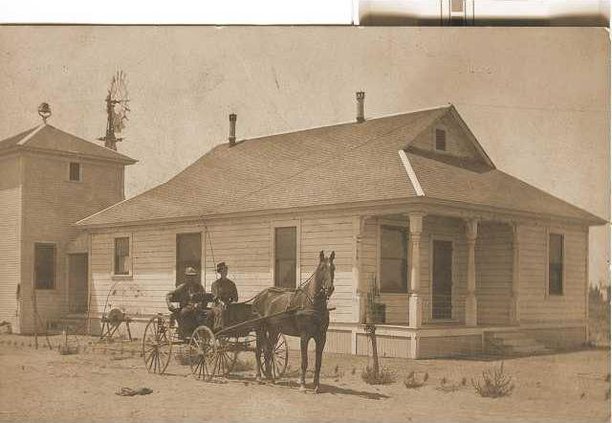
In 1904 the old home was torn down and a new one was constructed. His granddaughter, Norma Hodson, remembers the home as having six bedrooms, a dining room, living room, two baths, one upstairs, and a parlor. The parlor was sometimes used for funerals as at that time Manteca did not have a funeral parlor.
Mrs. Hodson also remembers that in the back yard up on a pole was the fire bell. When a fire was reported the bell would ring, bringing residents from the community to the Cowell home to get the pumper.
They would then pull the pumper to the fire and all hands would pump for all they were worth until either the fire was extinguished or had burned itself out. With the wooden buildings and the lack of communication it is a miracle they ever saved anything.
Cowell elected
first mayor in 1918
In 1918 when Manteca was incorporated as a city Joshua Cowell was elected as its first mayor, and he was the honored guest at the laying of the cornerstone for the new City Hall in 1923.
Two years later Joshua Cowell died at home in his eighty-fourth year. The Manteca Bulletin, May 29, 1925 tells us he died the 20th and the funeral was held at the Brethren Church on the corner of Veach and Highway 120. The “Father of Manteca” was laid to rest at East Union Cemetery 52 years after coming to the South County.
Few people in Manteca today would know that three-block Cowell Street in Powers Tract was named for one of its most industrious and respected citizens.