Manteca — in a four day period last week — received 3.29 inches of rain.
And that rain in the form of runoff had to go somewhere.
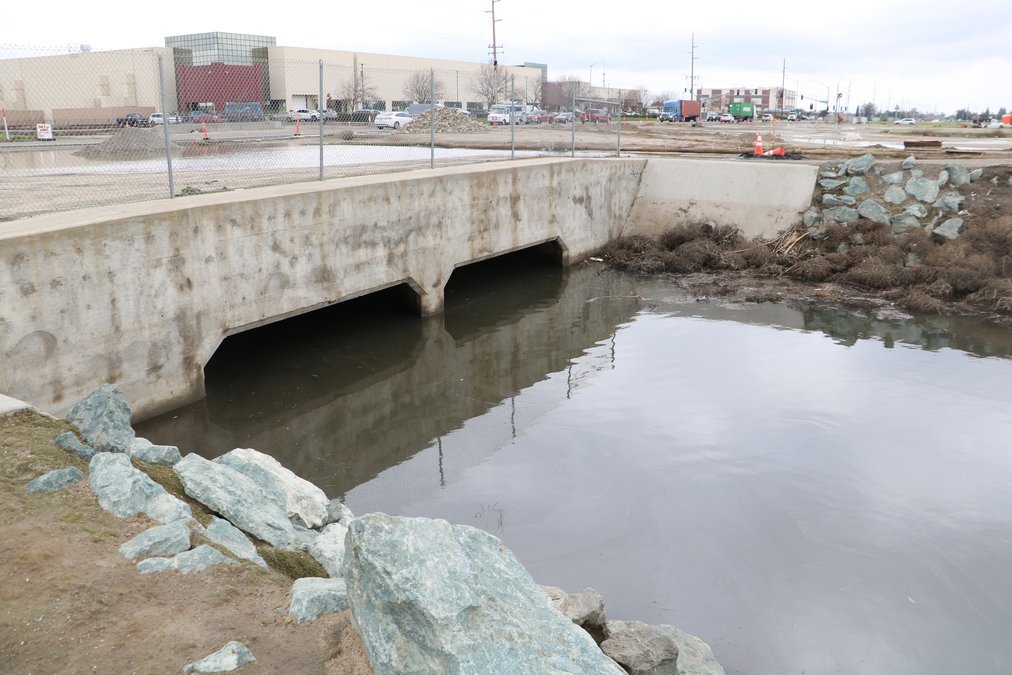
That “somewhere” for most of Manteca except the southwest portion of the city is the South San Joaquin Irrigation District’s French Camp Outlet that drains into the San Joaquin River and the Delta.
The open outlet canal runs along the east side of the Union Pacific Railroad’s Altamont line tracks that serve as the common border for the cities of Manteca and Lathrop.
Receiving 3.29 inches of rain in 96 hours is a lot of rain for Manteca considering the annual average based on National Weather Service data collected at Stockton Metro Airport, is 17.29 inches.
The city’s elaborate system of storm retention basins — most of which have been put in place since 1989 in conjunction with neighborhood parks in new development — serve as temporary holding ponds.
How the system work is simple.
Telemetry systems sense when water levels are getting too high in the outlet.
It sends messages to divert runoff from rooftops, streets, sidewalks, driveways, parking lot, and other impervious surfaces into the closest storm retention basin.
The water is held in the storm basin until capacity opens up in the outlet canal.
The system worked as planned last weekend yet streets in some new neighborhoods, such as Yosemite Greens along Airport Way that backs up to the golf course, had flooding.
The South San Joaquin Irrigation District — that owns and maintains the outlet canal that they have allowed much of the city to drain into — more than six years ago noted a need to address outlet capacity based on Manteca’s continued growth.
The city agreed and a hydrology study was done to determine what improvements were needed.
The study was completed in 2021. The SSJID accepted the study but the city wanted to relook at the conclusions. That is as far as the outlet study apparently got in terms of devising a game plan and then implementing it.
It is important to remember the French Camp outlet was designed and built to address agricultural needs only when Manteca had less than 2,000 residents.
That means it was designed only to handle any excessive flows from canals during the irrigation as well as runoff in the wet season that makes its way into the canals when there are no irrigation water deliveries.
The French Camp outlet is one of three outlets the SSJID operates.
It is also the lowest elevation outlet and the one that essentially drains the most land in the district including its biggest urbanized area — Manteca except for the southwest portion of the city.
The city is currently working on an effort to send runoff water from southwest Manteca to the San Joaquin River at a point to the west of the Oakwood Shores gated community. That outlet project, when it first surfaced more than eight years ago and before southwest Manteca development took off, carried a $14 million price tag.
Until the outlet is in place, excessive water from the storm basins in southwest Manteca flows into a temporary retention basin developers put in place.
Compounding the problem in southwest Manteca is the water table in various locations is as high as three feet.
Issues with culverts
built decades ago
The limited capacity of the French Camp outlet is not a new issue.
It was created for irrigation runoff purposes roughly a century ago.
Add to that every time an acre or farmland with either row crops, orchards, or vineyards is developed it is almost all covered with impervious surfaces as well as areas such as grass that reduces the amount of water that can drain “on site.”
The first stage of the San Joaquin Rail Commission’s project that started in June 2024 to double track the railroad tracks from the Lathrop Wye to a point near Manteca High to accommodate expanded ACE passenger service involved the outlet.
The existing box culvert was made larger and and wider.
SSJID crews last weekend did what they always do during storms — monitor the outlet and canals throughout the district to make sure culverts are kept free of debris so the flow of storm water isn’t impeded.
Water flows even after smaller storms have been getting dicer in terms of the outlet canal with each passing year due to growth.
The location of the Yosemite Greens neighborhood also didn’t help.
It is near a chokepoint along the outlet — the culvert under Louise Avenue.
Water from the neighborhood was having to merge with flows from further up the outlet.
High tides can undermine
ability of outlet to move water
While the city has been able to make sure developers put in place storm retention basins in addition to storm drains on their dime, the lack of an adopted project for either the proposed Oakwood Lake outlet or improving the French Camp Outlet means growth likely isn’t covering the financial impact of infrastructure costs that will be needed to move storm runoff from neighborhoods they build to the San Joaquin River.
There is also another limiting factor that comes with the city’s storm runoff basically joining the San Joaquin River to a point northwest of the community of French Camp.
High tide can push up water levels in the Delta.
The is what happened when high tide occurred during a substantial period of rainfall in January of 2023.
Water lingered in some retention basins close to a week following the last rain drop.
Keep in mind, Manteca represents only a small sliver of the San Joaquin and Sacramento River basins that drain into the Delta.
It also needs to account for its geographic location as being at the river’s lowest point of elevation when it reaches the Delta after collecting runoff in the 1,195 square miles of the San Joaquin River basin.
To contact Dennis Wyatt, email dwyatt@mantecabulletin.com