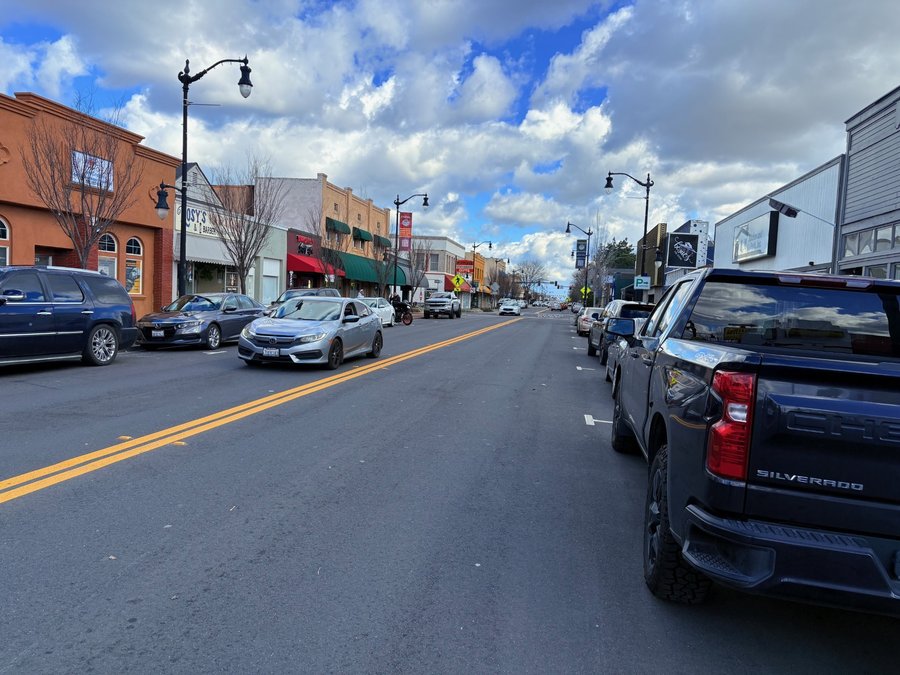
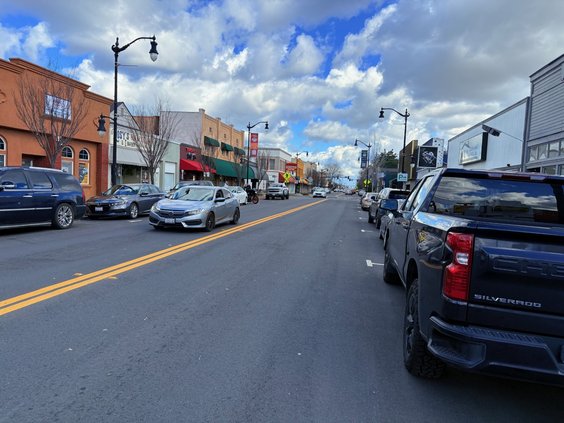
Yosemite Avenue is the problem — and represents the greatest potential — for any plan to set the stage for transforming downtown Manteca.
That’s been clear since the first effort to rethink downtown in 1964 when a crowd of business owners and merchants met in the small MRPS Hall to devise a way to get more people to shop and dine there.
The effort 62 years ago was led by the late Ted Poulus, who at the time was a young pharmacist eager to grow his business with Manteca.
The primary target was the need to create municipal parking lots given new shopping centers on the city’s edges were catering to the undisputed driving force of life and developing communities in the 1960s — the automobile.
Think El Rancho Supermarket anchoring the Low family center at North and Alameda and the Big Boy Market center on East Yosemite where Grocery Outlet is today.
Even New Deal Market (where the Hope Chest Thrift Store and an ethnic grocery store are today) as a new store in the 1960s just a half block from Yosemite and Main, had its own parking lot in front of it.
Now 62 years and five concerted efforts later to intentionally direct downtown’s future, Ascent Environmental, a consulting firm hired by the City Council will lead an effort to devise a complete downtown specific plan including a master environmental impact document.
The intent is to nail down everything needed to serve as a blueprint for downtown’s transformation into a more robust community gathering area which, by extension, would booster commerce.
And nothing is more key than developing a game plan for Yosemite Avenue from the railroad tracks to Fremont Street.
That’s because in order to make downtown more walkable and appealing the canvas needed to accommodate everything from al fresco dining to an appealing “beautified” corridor needs to be larger.
Some cities such as Tracy have allowed “temporary dining space” created during the pandemic to stay in place. It takes advance of large shade trees — as opposed to the ornamental trees along Yosemite — and uses bright range K-rail to divert parking spaces into a dining patio.
And it’s more than just “activating” what is now limited outdoor space in the form of sidewalks in front of stores.
The steady stream of through traffic that reflects the fact Yosemite Avenue still functions as a major east-west arterial can be, for want of a better term, a “mood killer.”
The last consultant in 2002 that the city had do a “partial” specific plan — given elected leaders never pursued key elements due to pushback including adopting universal architectural guidelines due to pushback — zeroed in on deliberately making Main Street more congested through downtown.
Not only did the plan trash more than just one travel lane in each direction, but they added what turned out to be the notorious landscaped bulb-outs that removed parking spaces and impeded right turns.
The most enduring off-the-cuff remarks from a member of the consulting team at the time indicated if people had to come to a stop on Main Street, they might kill time looking in a store window at a display and say to themselves “I need to go there.”
Given the dearth of window displays then and now in the 100 block of North Main, it was clear the consulting firm was leaning heavily into boilerplate concepts to hammer into the specific plan with complete disregard for the reality on the ground.
In the 1960s up to the early 1990s, the solution for Yosemite that trigged the most talk was making it one-way heading east from Manteca Avenue to Fremont Street.
West bound traffic, in such a scenario, turned north on Fremont Street and then west on Center Street.
At Manteca Avenue/Sycamore Avenue, it either turned southwest and passed Library Park to rejoin Yosemite Avenue or continue heading west on Center Street to Union Road.
That vision was rooted in a 1960s proposal by Caltrans to address the nightmare that Highway 120 traffic was — especially on Friday nights, Saturday mornings, and Sunday afternoons — of Bay Area traffic going to and from the Sierra.
Their plan was to turn Highway 120 through Manteca into two parallel one-way streets.
The westbound lanes would curve to the northwest to a point on Powers Avenue where they would be tied into an eastern extension of Center Street from Fremont.
Once westbound Highway 120 cleared Union Road, it would curve to the southwest and rejoin the eastbound lanes.
The Manteca Marketplace anchored by Save Mart was a vacant parcel at the time.
The eastern end of such a realignment would have taken out more than 30 homes that existed at the time.
The opening of the 120 Bypass in the 1970s effectively addressed the congestion the highway being routed through downtown caused.
The Yosemite Avenue
solution that has surfaced
In recent years, a number of elected officials including former Mayor Ben Cantu and current Mayor Gary Singh, have advanced a different “bypass” for Yosemite Avenue traffic that passes through and does not stop in downtown.
That would involve swinging Yosemite Avenue traffic to the southeast once it crosses the tracks and continue as two lanes behind the 100-200 blocks of West Yosemite on city right-of-way along the Tidewater Bikeway.
It would then tie into Moffat at its intersection with South Main.
Traffic would continue on Moffat to Spreckels Avenue to turn back to the East Yosemite retail corridor west of Highway 99.
It dovetails into Moffat’s emergence as the best access to downtown from growing southeast Manteca.
Moffat from Main to a point just east of Cowell Avenue is wide enough of accommodate four lanes.
The city has property from Cowell to Spreckels Avenue to eventually widen Moffat.
That would allow the downtown specific plan to use municipal parking behind the 100 and 200 blocks of West Yosemite and the ability to access downtown from the 100 block of South Maple into its overall approach.
That could include encouraging dual-entrance businesses in the 100 and 200 blocks with direct access to currently underused parking lot.
To contact Dennis Wyatt, email dwyatt@mantecabulletin.com