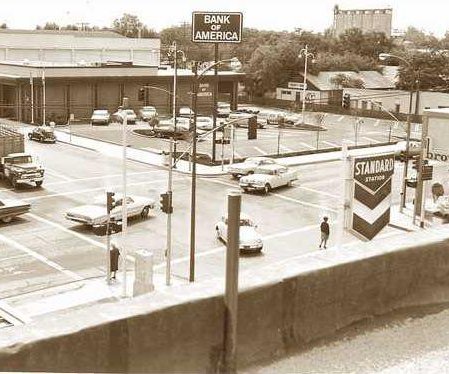
I started driving in 1973 when the average gas price was 55 cents a gallon in the Sacramento area.
But I paid more.
I either bought gas at Bob Lyda’s Chevron or George Prescott’s Shell.
They were a block away from each other on Lincoln’s main drag, Highway 65.
The pump prices were in the low 60s at both stations.
It’s not that there wasn’t cheaper gas in Lincoln. There were two other stations.
One was two blocks away — a Flying A Station that morphed into a Gulf before closing in 1980 — and was a nickel cheaper.
The other was at an independent at a self-serve car wash with a convenience store. It was even cheaper than the Flying A.
Keep in mind a gas station/car wash/convenience store was an aberration in 1973.
Most gas stations actually repaired cars with some even doing partial engine overhauls.
You could also buy tires and items such as fan belts at gas stations.
If you wanted something to drink at the same time you got gas, you had to have some nickels and dimes to retrieve from the old-school slider box soda machines.
You’d open the lid, put your coins in, pick from an extensive option of four flavors in 16-ounce glass bottles, and slide it to where your change had temporarily unlocked a locking mechanism.
This was what about the time that some gas stations added a singular glass-door refrigerator and maybe a couple of racks of gum and candy when you went into the office.
You usually paid at the pump by handing your card or cash to the attendant.
Self-serve wasn’t yet the norm and it was still the same cost as if the attendant pumped it for you.
The gas jockey would wash your windshield and ask if you wanted your oil checked.
They’d also fill your tires, if needed, was between the pumps and not relegated to the far corner of the gas station.
Prescott’s Shell gave you Green Stamps with each gas purchase.
He also had promotions such as a free 8-ounce drinking glass when you bought 8 gallons of gas or more.
The business plan was simple. They wanted to be the go to place for most of your automobile repairs besides just gas.
It was about building customer loyalty.
That said, the promotions were often dictated by the company a station owner had bought a franchise with.
And that company — whether it was Shell, Chevron, Gulf, Texaco, et al — would spend a ton on advertising to convince you their gas was better for your engine.
The reality that what big oil companies were hawking was hogwash given, at the time, California has established minimum standards for refining, came up one day when Prescott was complaining about his contract with Shell.
Actually, it came up when I asked him why the Shell tanker that a few minutes earlier had pulled out of his station and was getting ready to deliver gas to the gas station/car wash/convenience store combo down the street.
That’s when he shared how he was locked into a contract that required him to pay more wholesale for the same gas his competition was selling for less retail. It was the same gasoline, refined at the same Shell refinery.
To be honest I stuck with Shell and Chevron for years, still convinced based on my parents’ gas buying habits that those two brands were better for engines than discount brands.
Part of it had to be the convenience of a credit card before MasterCard and Visa muscled their way into the gas pumps.
It’s been years since I’ve bought from either a Shell or a Chevron unless I was traveling and they are my only options to buy gas.
I get there are reasons why gasoline prices can very form one location to another.
Stations have different lease terms that — surprise, surprise — reflects the value of the property where they are built on.
It should be no surprise that the Chevron station located near Chinatown across from the Union Station in Los Angeles is plastered all over the media, social and otherwise, whenever gas prices surge significantly.
The gas at the LA Chevron was $8.71 a gallon on Monday, compared to the AAA reported average of $5.72 a gallon in Los Angeles.
Some might think they are gouging customers because the competition is miles and not blocks away. But that is not the case.
Many such urban gas station locations near city centers in large metro areas have a diminishing market.
As gas mileage improves— plus a shift toward EVs with 24 percent of all new cars sold in California last year — they have a smaller volume while the cost of doing business keeps going up.
And in the case of the specific LA Chevron that apparently is perpetually the highest priced gas in the City of Angels, it has a minuscule convenience store.
Given the more robust margin on soda, bottled water, candy, and such that most stations today rake in the money with, the station is caught between a rock and a hard place.
They need to stay in business and the people that buy gas at almost $3 more than average in the nation’s second largest city need to buy it.
It is disingenuous for wannabe economists in Texas, or elsewhere, on social media to claim it is “typical California price gouging” in LA as it is to contend California is somehow more car crazy than they are.
We’re talking about Texas where the world’s largest gas station/convenience store and world’s longest car wash opened last year .
The Buc-ee’s in Luling, Texas, has a 75,593 square-foot convenience store that is more than half the size of the Manteca Costco, a 255-foot long wash, and 120 fuel pumps.
The gas price on Monday at that Buc-ee’s location was $3.48.
The bottom line is location.
Clearly, Texas is much more oil refinery friendly than California.
And in California — just like in Manteca — you have multiple options when it comes to where you can buy gas.
You can drive a quarter of a mile from the Chevron station mentioned above in Los Angeles and you can get gasoline for almost $1.50 a gallon less.
A shorter drive from the East Yosemite Avenue Chevron in Manteca can save 80 cents or so a gallon.
That isn’t price gouging.
It’s called choices.
This column is the opinion of editor, Dennis Wyatt, and does not necessarily represent the opinions of The Bulletin or 209 Multimedia. He can be reached at dwyatt@mantecabulletin.com