
The homeless proofing of Manteca continues.
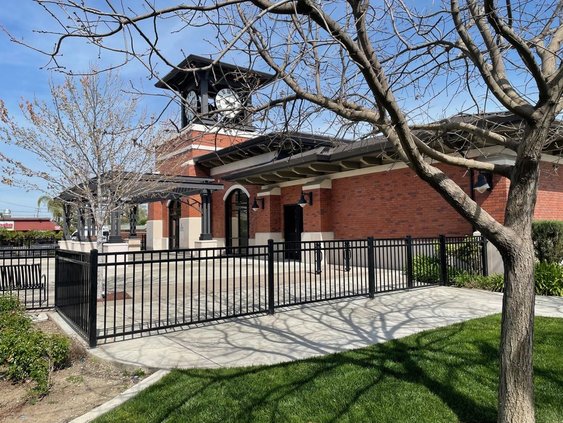
The $1.1 million American Legion Post 249 remodel in the 200 block of East Yosemite includes a hefty line item to secure the property with a 7-foot wrought iron fence from homeless access.
The homeless before the temporary cyclone fence for the construction work went up would routinely shelter overnight on the front steps to the hall.
No, the Legion is not being inhumane.
The homeless leave behind trash.
They also urinate and do the No. 2 that someone has to clean up.
And in the case of the Legion, they’ve been stung by super-sized PG&E bills in the past they discovered were the result of the homeless plugging everything from heaters and cooking appliances into outlets.
Being homeless isn’t a crime.
But the homeless commit crimes on a daily basis that cost property owners lots of time and money.
There are 238 or so homeless in Manteca based on the last point in time count conducted in January of 2024.
The emergency shelter at 555 Industrial Park Drive currently is housing 50 of them and providing services such as bathrooms.
That leaves 150 to 170 using Manteca as one big toilet.
Jeff Aksland on Monday came to work at his real estate office at the heart of Manteca on the northeast corner of Yosemite Avenue and Main Street.
Sleeping in front of his door was a homeless man.
In such cases when a business owner wants a sleeping homeless individual to wake up and move on, there is often an exchange of unpleasantries.
Then there is the mess they leave behind that often includes the No. 2 and areas where they urinated. All of that has to be cleaned up before a business can open.
Aksland, like many other business concerns downtown and elsewhere in Manteca, has been dealing with the impact of the homeless for years.
It got better after the city established the two 25-bed dorms for the homeless at 555 Industrial Park Drive last April.
Since then, it has been in a holding pattern of not being as bad.
That’s thanks in part to the stepped up pressure Manteca Police is applying.
And when a third 25-bed dorm is ready for occupancy in the coming weeks, it will be better.
That said, do the math.
The last point in time count put Manteca’s homeless population at 238.
If all 75 beds are filled, that still leaves 163 homeless out on the streets.
Taking an educated guess, the city’s efforts to get the homeless off the streets by reuniting them with families and other endeavors that help get them employed or deal with issues has likely reduced the homeless number on the streets and not in temporary shelters down to 100 to 120.
Again, that’s a guess but it does reflect the fact the city has made headway.
You can’t simply run the homeless out of town even with the most recent Supreme Court ruling.
And even if you did, it would just be moving the problem around.
There have always been homeless.
And it is clear they will likely be homeless at a stepped up level compared to 2010 given the billions of dollars California has thrown at the problem hasn’t made much of a dent.
It is why more and more entities are homeless proofing property.
Wrought iron fencing.
Secured trash enclosures.
Stepped up locks on outbuildings.
Cutting back landscaping that provides hiding places for illegal encampments.
Homeless proofing is not a cheap proposition.
It cost the city over $7,000 six years ago just to secure the library courtyard with wrought iron fencing.
Another $30,000 was spent securing an enclosure with solar power convertors at the Manteca Transit Center by adding a roof and other security measures.
Caltrans spent more than $160,000 on wrought iron fencing to secure right-of-way along the 120 Bypass that backs up to the Juniper Apartments, Tesoro Apartments, and Paseo Villas.
Dozens of businesses have spent between $7,000 to $12,000 to make trash enclosures homeless proof by adding roofs and wrought iron.
They did so not just because the homeless were scrounging through dumpsters looking for stuff they could use or food to eat and then leaving a mess.
More than a few businesses reported having homeless sleeping in enclosures and dumpsters and even have come across them doing drug deals.
As an aside, at least two homeless sleeping in dumpsters over the years have ended up in city solid waste trucks.
Even the school district, particularly with Manteca High, had to switch from cyclone fencing the homeless cut through to more bullet-proof wrought iron.
In recent years such measures easily have exceeded $600,000 in Manteca.
But that is just the tip of the iceberg.
The homeless cause property damage, increase trash bills, and cost hours of manpower cleaning up those daily messes.
The worst example was stripping copper wiring from the shuttered Alphatec building in the Manteca Industrial Park nearly two decades ago.
The damage they did to walls and ceilings in addition to the cost of the stolen copper wire was put at almost $600,000.
It is safe to say in the past 20 years, the homeless have easily cost property owners in Manteca well over $1.2 million just in property damage and steps taken to protect their property from being damaged.
Homeless crime costs.
The challenge the city now faces as it starts to get its navigation center model lined up and fully implemented at 555 Industrial Park Drive is what they are now doing isn’t enough.
They need to apply even more pressure on the homeless.
It is clear with each passing monthly “quality of life sweep” at night the Manteca Police conducted monthly along with their day-to-day efforts that a significant number of homeless do not want to get off the streets.
The reasons vary from not wanting to give up drugs to not wanting to follow rules.
Their decision not to take the city up on options they have been offered, has to come with a price.
And that price is 100 percent enforcement of anti-camping laws.
The city clearly will never be able to afford the manpower to keep such pressure on 24/7.
However, they need to turn up the current level of pressure as much as they can.
This column is the opinion of editor, Dennis Wyatt, and does not necessarily represent the opinions of The Bulletin or 209 Multimedia. He can be reached at dwyatt@mantecabulletin.com