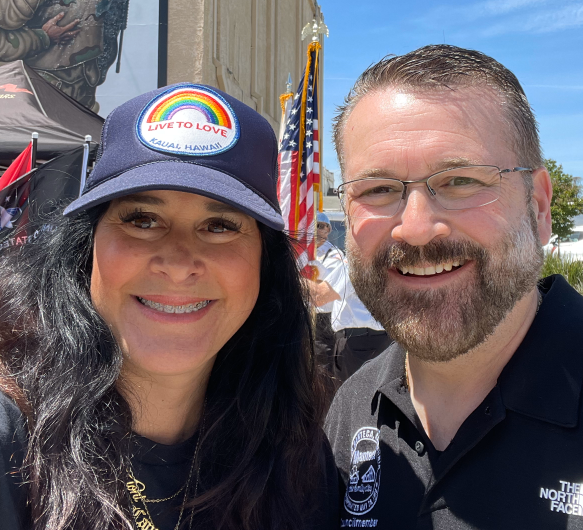
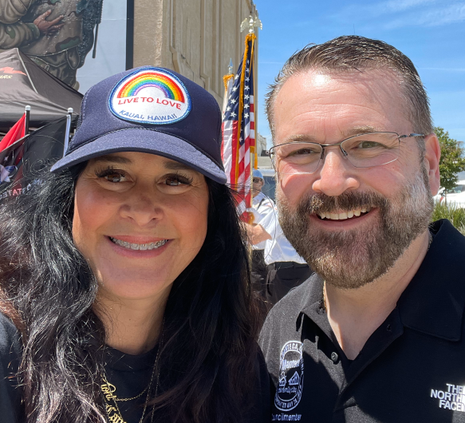
Mike Morowit is pumped.
And arguably if you are a Manteca resident you might be too.
Morowit is the District 4 councilman representing Manteca north of Louise Avenue minus the Diamond Oaks neighborhood east of Highway 99.
What has gotten Morowit — a pretty upbeat guy to begin with — excited is being able to decide how to spend $450,000 to improve Manteca.
Given he’s a councilman and - by an extension — an amateur political given one can’t make a living on a $600 a month stipend serving on the Manteca City Council, he doesn’t meet the definition of a professional politician.
In Morowit’s own words, “I’m a public servant, I serve the people.”
Unlike professional politicians with the California Legislature being a prime example, council members can rarely have a direct impact as one on how money entrusted to local government can be spent to benefit the community.
Do not misunderstand.
Morowit and his colleagues make collective decisions all the time to keep basic municipal necessities functioning.
Just like with most households, there is not much wiggle room for the city after basic day-to-day needs, long-range maintenance costs, and such are taken into account.
It’s always debatable about how any tax money is spent, but the reality is elected council members rarely have an opportunity to have as much of a direct impact on new initiatives that step up the effectiveness of existing services or to fund new amenities.
Things were a bit different on Wednesday.
The City Council as five separate individuals were able to divvy up $2.5 million in remaining COVID federal relief funds by earmarking them for specific projects.
Some were fully funded; others were partially covered with staff given the challenge of finding ways to cover the balance of the tab.
Keep in mind the fact the City of Manteca had “money” leftover from the more than $13 million the federal government shoveled their way to deal with pandemic related costs and general fund revenue cratering due to mandated public health shutdowns is a testament to municipal staff and elected leaders.
You may not like it, but the fact Manteca has positioned itself to capture residential growth with its strategic location in the Greater Bay Area meant the lockdown was not nearly as severe as it was in many cities.
That was also true in Lathrop and Tracy.
Say what you want about growth but it can cushion the overall hurt a community suffers when things slow down.
Equally important, prudent budgeting and fiscal management — the general ledger entry and affiliated sloppy accounting fiasco of a few years back aside — is built on conservative approaches to both expenditures and projected revenue.
That meant the COVID relief funds weren’t 100 percent consumed by overtime and other expenses the health emergency created plus incentive pay (or hazardous pay) for municipal workers to stay on the job when vaccines weren’t available.
Nor was it consumed backfilling lost revenue due to mandated pandemic closures of retailers.
The city already used several million dollars in remaining COVID funds to replace equipment they lacked funds to do so.
Included was buying street paving equipment so municipal crews could do pavement repairs the city otherwise had to contract with private firms to do.
The decision to split up the remaining $2.5 million — $450,000 for each of the four council members and $700,000 for the mayor — for elected officials to essentially earmark was ground breaking for Manteca.
It empowered not the staff or council collectively to direct spending but each of the council members who are not only the directly elected representatives of different Manteca district constituencies but arguably their ears are bent more than anyone else when it comes to the city’s business.
Morowit was able to advance a list of projects that reflected what he was hearing from the 22,000 or so Manteca residents that he directly represents.
At the same time, they were earmarks that benefited all of Manteca.
More importantly, by Morowit’s measure, it is allowing things to move forward in terms of amenities and enhancing the effectiveness of essential services that would have taken much longer to happen or not occur at all.
Here’s how Morowit earmarked the $450,000 he was allocated:
*A cricket field at Doxey Park.
*An inclusive sensory playground likely at Northgate Park.
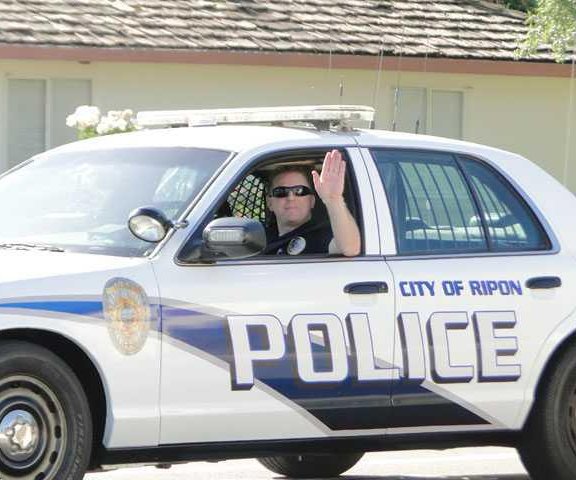
*Police drones.
*$50,000 toward sidewalk repairs within his district.
*Half the cost of “seed money” for infrastructure needed for a community garden adjacent to the Lathrop Road fire station.
*Funding toward citywide license plate readers.
All were needs that had been voiced as a high priority within his district. All will benefit and be accessible to the entire community.
Councilman Jose Nuno took a similar tact with solar lighting at Woodward Park. It’s more of an issue in his district but clearly much less in Morowit’s district, and is something the entire community can make use of after it is installed.
Councilman Charlie Halford put his entire allotment toward the license plate readers, aligning well with his lifetime commitment of finding better ways to increase the effectiveness of law enforcement when it comes to protecting and serving Manteca.
Mayor Gary Singh took a somewhat different approach.
He sought to use partial funding to jump start two endeavors that have been dead in the water for years — a splash pad for kids to use in a city park — plus the start of a second skatepark facility.
Ideally, as Singh hopes, the skate park facilities will be in a much more accessible, visible, and inviting location than the current one. Singh hopes that it could be adjacent to the Spreckels BMX course.
In the future, the city might be able to continue what they did Wednesday.
Given Great Wolf’s payback of development fees via the city’s share of the room tax split that is in effect for 25 years, is drawing down to the end, there is an opportunity to do what the City Council just did on a once-every-two year basis.
Just like the COVID relief money, the city’s share of the Great Wolf room tax flows into the general fund.
If $1.25 million was set aside for council allocation every two years from Great Wolf hotel room recipts, that would allow $225,000 for each council member to earmark and $325,000 for the mayor.
The exercise makes the council members look long and hard at what is needed and what would boost the quality of life.
It also gives staff a greater insight into council thinking in terms of the Manteca elected leaders envision.
This column is the opinion of editor, Dennis Wyatt, and does not necessarily represent the opinions of The Bulletin or 209 Multimedia. He can be reached at dwyatt@mantecabulletin.com