Grapes, not gold seekers, first came to San Joaquin County.
The year was 1848.
Amidst grasslands dotted with oak groves where the tule elk and California grizzly bears once roamed a man remembered only by his last name — Magley — reportedly planted the first grape vines in San Joaquin County near present-day Lodi.
Just like a much more famous Swiss immigrant 33 miles to the north by the name of John Sutter, he planted the seeds that helped define California to this day.
San Joaquin County’s role in the Gold Rush was initially being what some today might call “pass through” country.
Essentially, the county hosted wide spots in the road to reach the mines and to move supplies to the foothills.
It didn’t take long for miners and others to realize it was much more reliable to build wealth by supplying miners with food and more.
Much of the United States knows about how the California gold rush played out.
That said, if you mentioned California and the words “largest farm producing state in the union by a long shot” in the same sentence, they’d look at you as if you were daft.
California’s farm crop receipts in 2024 reached $61.2 billion.
That leaves its closest competitors — Iowa and Texas — in the dust by at least $20 billion.
But here’s another fun fact.
Probably not very many — including people in Manteca, Ripon, and Lathrop — know that San Joaquin County is the No. 7 farm producing county in California as well as the entire United States.
Agricultural crop production in San Joaquin County during 2024 reached $3.146 billion.
Ready for wine snobs in Pacific Heights in San Francisco to choke on their $50 glasses of Chardonnay?
The No. 3 wine grape producing county in California after Napa and Sonoma is San Joaquin County.
Not Monterey, not Calaveras, not San Luis Obispo — and not even grape producing heavyweight Fresno. None of those by a long shot.
Fresno is the king of grape production to the tune of $2.3 billion. But the bulk of that — as Carol Burnett fans know — are raisins as well as table grapes.
Raisins — were to the 1986 TV series spoof “Fresno” — as oil was to “Dallas” and wine was to “Falcon’s Crest” in the era of prime time soap operas.
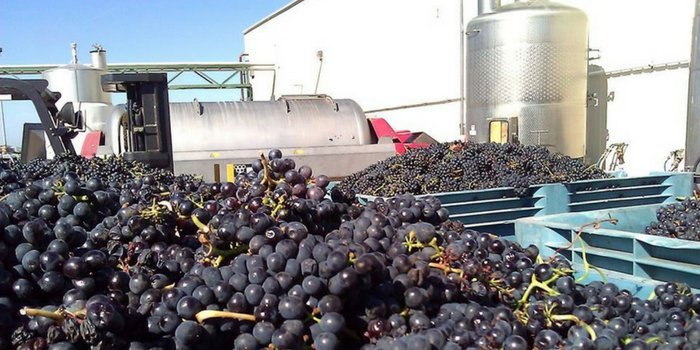
San Joaquin County in 2024 produced $319.3 million in wine grapes on 83,410 acres.
The dollar totals are $1.1 billion for Napa and $626.5 million for Sonoma.
In terms of producing acreage for wine grapes, San Joaquin at 83,410 acres blows the doors off of Sonoma at 57,200 acres and Napa at 45,967 acres.
San Joaquin is the No. 1 wine grape producing county in both California and the United States in terms of tonnage.
I know, I know.
Do the math. Napa and Sonoma produce higher dollar value wines than San Joaquin County.
But before you turn up your nose, three of the five largest wineries in the world are in San Joaquin County led by the proverbial 900-pound gorilla heavyweight E&J Gallo in Modesto, The Wine Group in Ripon at No. 2, and Delicato Wines in Manteca at No. 5 based on 2024 rankings.
Yes, the more expensive vintages are produced in Napa and Sonoma.
But that doesn’t translate into what comes from the vineyards in San Joaquin County being the equivalent of swill. Far from it.
There is no state secret that after the pandemic sent wine sales through the roof, since 2021 the number of wine cases shipped from California to the rest of the United States has declined by 15 percent.
That said, the wine industry is going through more than a rough spot thanks to trends swirling a health-conscious movement embracing alcohol-free “mocktails”, a growing demand for THC drinks and cannabis, while a surge in weight-loss drugs has helped reduce the alcohol consumption of some consumers.
But rest assured, it is far from a death spiral.
The history of Delicato’s survival, growth, and innovation since 1924 through a lot of thin and decent stretches of thick proves it isn’t.
America’s tastes are ever changing.
And keep in mind wine making, per se, has been around for 8,000 years or so.
There are 11,000 wineries in the United States.
San Joaquin County is home to 80 or so of those wineries.
They provide easily in excess of 2,000 primary winery jobs on top of affiliated employment in addition to those in the vineyards.
Then there is wine tourism primarily in the Lodi area. Tracy has its fair share of wine tasting rooms, Ripon a sprinkling, Delicato in Manteca, and even a new one on East Highway 120 between Manteca and Escalon east of French Camp Road.
All of this brings us to two points.
San Joaquin County has a viable and vibrant agricultural sector that needs and should be protected.
Food is a strategic resource.
It is key to a country’s security and survival.
Importing food beyond a certain point undermines the economic viability of farming.
And the ag economy should not be dismissed.
Yes, there are a lot of field level jobs that are back breaking and pay less than flipping burgers at a chain restaurant — especially in California.
But there are a lot more ag jobs that provide solid household incomes whether it is providing the means and materials to grow food, to harvest it and take it to market, and process it.
Many of those jobs are right here in San Joaquin County.
The other point is to keep growth in check.
It is clear growth in the Northern San Joaquin Valley — especially in South San Joaquin County — is far from being a flash in the pan.
It may not emulate San Jose or the blob-style sprawl on Modesto’s east side.
In fact, it shouldn’t be more of east Modesto et al.
Increased densities are a necessity of affordability. And it applies not just to the land but the proximity as well as ease of access to services, amenities, retail, dining, and jobs.
The close job connection that is the final and arguably the most important takes on a different tact being an exburb of the robust and more densely built Bay Area that has basically exhausted its ability to keep sprawling.
That is where ACE commuter trains and the coming Valley Link initially connecting Mountain House to BART come into play.
Valley Link, by the way, will eventually connect with Lathrop that will be reprising it’s 19th century role as a pivotal hub in regional passenger rail service.
Keeping farming viable by making sure we grow up a little more and grow out a little less will sustain not just jobs but also mold communities that are more livable and more walkable.
This column is the opinion of editor, Dennis Wyatt, and does not necessarily represent the opinions of The Bulletin or 209 Multimedia. He can be reached at dwyatt@mantecabulletin.com