Dave Breitenbucher is a 63 year-old “grandpa” who indulges his grandkids by bouncing around with them at Altitude Trampoline Park on Spreckels Avenue.
He also has what some view as a high risk habit — drinking Manteca tap water since he was a kid.
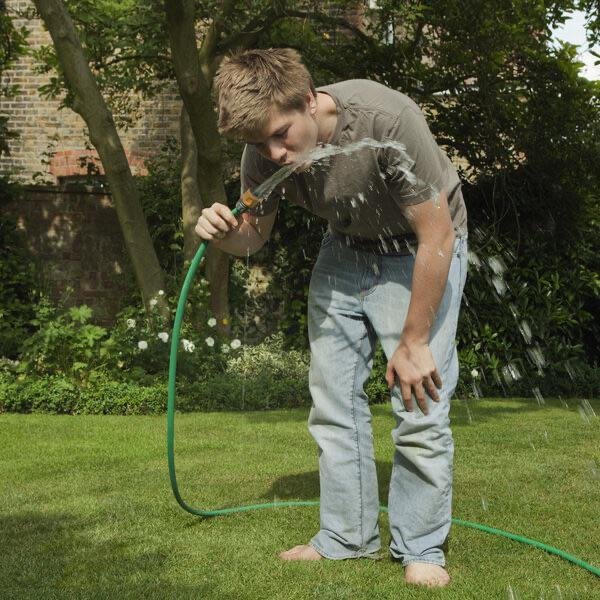
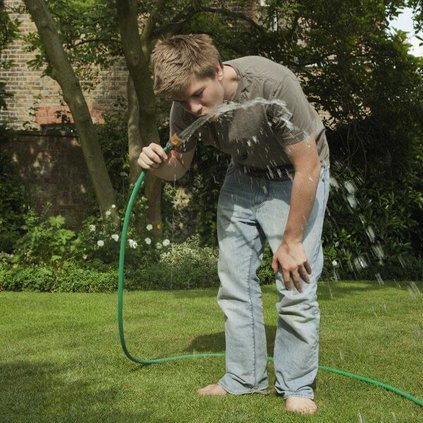
Breitenbucher has been known to double down on satisfying his thirst by drinking city water from a garden hose.
And it just wasn’t with the modern versions, but back in the 1960s when hoses were oozing with carcinogens.
Yet, the Manteca City councilman seems healthy.
He’s not growing and extra arm, a horn isn’t coming out of his head, nor is his skin turning green with fluorescent pink blotches.
Given how bad of a rap more than a few people give Manteca drinking water, Breitenbucher is a walking miracle.
Or else, the critics of drinking H20 flowing from taps hooked up to the Manteca municipal water system have been drinking the Kool-Aid served up by the likes of PepsiCo that make the gross national product of Brazil off the sale of bottled water like Aquafina.
What brings this up is the reaffirmation made Tuesday in a state-mandated Public Health Goals report based on solid science and not social media ranting that the water City of Manteca delivers to more than 30,000 households 24/7, 365 days a year is safe to drink.
This was not determined just on federal standards but State of California standards that some contend border on overkill at times due to having lower thresholds in what is acceptable in drinking water.
To gain a bit of a more level-headed perspective, go back the Dark Ages, say the 1970s.
Do you ever remember people carrying bottles of water with them wherever they went?
People back then made extensive use of quaint archaic contraptions known as public drinking fountains that a generation of some Americans fought to have the right to access all of them regardless of race.
Today, people take bottled water everywhere — when they’re driving, into stores, into meetings, into class, and even when they are walking down the street.
And I’d venture to say they are not putting tap water in reusable bottles.
Instead, they are spending a small fortune on bottled water.
But before we talk about how much this is costing, ask yourself one question: What is different about 1972 and 2026 that makes us think like camels?
Granted the extra water we carry around is external but the point is we weren’t water pack mules 54 years ago.
The drop off of public water fountains accelerated during the pandemic.
But even before COVID-19 entered the vernacular, there was a perception that drinking from a public water fountain is akin to mainlining viruses.
If that’s the case, why — given the explosion in bottled water consumption — aren’t there corresponding declines in a whole array of maladies from the common cold to strep throat?
Could it be we’ve bought into the subtle campaign that what comes out of our taps is not healthy?
Granted, there are aberrations in some municipal water systems with specific problems tied to specific aging pipe material and a specific mismanagement of the system.
But by and large people around the globe die every day because they don’t enjoy the high level of quality that Americans do when it comes to water flowing from our taps.
Wait, you say, there’s arsenic in our water. The City of Manteca sends out information saying that’s the case.
Here’s a new flash: Arsenic is naturally occurring in water and soil. Human bodies, as a result, will always have trace amounts. The issues start when arsenic consumption reaches a certain level.
The federal government — which mandates water providers such as the City of Manteca to inform customers of what’s in the water they consume — establishes a threshold that even if it is met or exceeded slightly still doesn’t pose danger to human life. That said, Manteca’s arsenic levels are significantly below the federal threshold.
You will notice there is no such breakdown on bottled water labels. So, you assume the water is “therefore” safer to consume than tap water.
Guess again.
All water bottlers are required to provide statements of water quality for consumers you can typically find on their websites. The bottom line of those reports is the same — they do not exceed the Federal Drug Administration’s maximum containment limits. That’s true also of Manteca’s municipal water.
The big difference is the federal government Environmental Protection Agency requires municipal water providers like Manteca to test and then send customers a recap of all minerals and such.
Imagine what it would do to bottled water sales if every place they are sold a large sign had to be posted with test results that show how many parts of various items are in the water you are buying including arsenic. It would probably put a severe dent in sales.
And there is a lot of sales to dent.
Bottled water sales in the United States exceeded $49 billion in 2024.
Ten years ago, when sales were at $14 billion, the International Bottled Water Association noted 17 major American cities including New York, Boston, Los Angeles, Las Vegas, and San Francisco had reached the point where water was the No. 1 selling packaged beverage in stores.
ConvergEx marketing used national averages to determine Americans pay $1.22 for a gallon of water bought in stores or delivered to their home. That’s 300 times more than what we would pay to drink the same water from a tap. But since two thirds of purchased bottled water is consumed from bottles consisting of 16.9 ounces or less, the real cost difference is almost 2,000 times higher.
As Americans we spend roughly $100 per capita each year for bottled water when we could easily spend less than $2 if we used reusable water bottled filled with tap water.
Yes, I buy bottled water, on average two cases a year to be precise. I take them as back up that I leave in my vehicle when I go on extended week-long hiking trips.
I use a water “bladder” in my hiking pack that’s filled with tap water.
Does the water taste funny?
No, and quite frankly even if it did, I’m not going to complain if I’m up in a canyon seven miles from where I left my car in Death Valley.
Has it gotten me sick? No.
The phobia we have with germs is amusing given exposure to an imperfect world helps our body build defenses. It is the entire rationale behind flu and polio vaccines among others.
I’m not dead yet even though for the past 69 years I’ve been drinking water from the tap and even — horror of horrors — from garden hoses just like Breitenbucher
As for the taste of Manteca water, Rick Martin — a former general manager for the South San Joaquin Irrigation District — noted in most cases it is due to chlorine that is a redundant measure after treating water through a myriad of other steps.
What he — and his wife Diane who was the city’s water engineer back in the 1990s — did when they lived in north Manteca was simple.
They’d fill an open glass pitcher with tap water and set it in the refrigerator.
After 24 hours, the chlorine gas would dissipate.
And, if they were in a hurry, they’d pour tap water into a blender.
It’s a lot cheaper and guess what — don’t have to worry about microplastics or thin plastic bottles leaching a soup of chemicals.
This column is the opinion of editor, Dennis Wyatt, and does not necessarily represent the opinions of The Bulletin or 209 Multimedia. He can be reached at dwyatt@mantecabulletin.com