Manteca, whether you like it or not, is a railroad town.
And trains, just like semi-trucks, are absolutely essentials to move goods and to keep the economy moving.
They can also be a pain in the tush.
Ask anyone who has gotten stuck during periods of heavy traffic trying to navigate downtown when a 120-car or so Union Pacific train is rambling ever so nonchalantly passes through the Yosemite Avenue and Main Street crossings.
Better yet, seek out someone that has been boxed in on Spreckels Avenue of Industrial Park Drive that can’t maneuver their way out of a 20-minute wait by going to another crossing when a train is parked on the Calla siding to let another train approaching in the opposite direction eventually pass.
That said, trains gave birth to Manteca and allowed it to take root and grow.
And between the Union Pacific intermodal facility that’s is a key to the region’s distribution and manufacturing growth as well as the growing importance of commuter rail service, the railroads will also keep Manteca’s economy healthy for years to come.
There is a downside.
Trains can be dangerous.
Most of the time it’s due to idiots playing Russian roulette in a 1.5-ton vehicle versus any train that can weigh up to 20,000 tons.
There are also a lot of derailments.
The Federal Railroad Administration indicates there were 793 derailments nationally in 2024. Most, or 76 percent, were slow moving affairs in railroad yards.
The majority of what remains were like what happened Monday in Manteca when six boxcars went off the tracks but reminded upright.
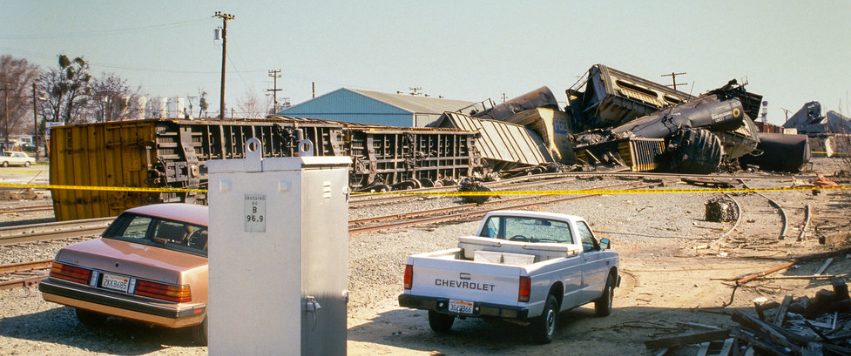
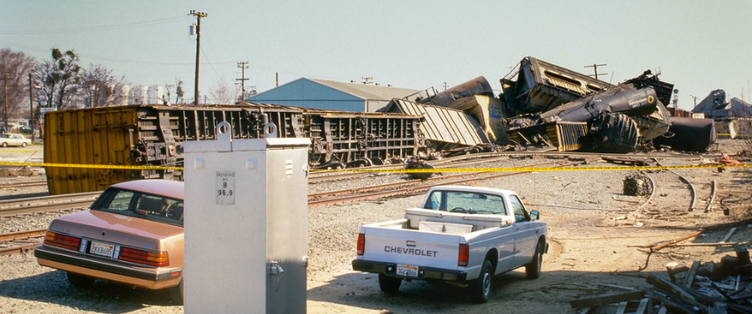
There are few major derailments such as the one that happened in the heart of Manteca at 5:55 a.m. on Feb. 20, 1989.
The 42 cars that derailed included “empty” tankers with residue of toxic chemicals they had been carrying.
There was a pile-up of derailed cars almost exactly where ground will be breaking in the next 18 months for an ACE commuter passenger platform just a short distance from the end of today’s Manteca Transit Center parking lot and barely a stone’s throw or two from the edge of the Manteca High campus.
Among the railcars that did not derail were four boxcars carrying artillery ammo.
Manteca Fire, when they responded in 1989, had no idea initially what they were dealing with in terms of cargo on the train.
Some 200 nearby residents were evacuated as a precaution until railroad and emergency officials determined there was no danger to people.
Given there are 30 to 45 trains passing through Manteca on any given day on two separate UP rail corridors, almost everything imaginable is passing through at 55 mph, give or take.
In the past 36 years, there have only been three derailments in Manteca. the other in the same stretch near the Austin Road crossing derailed 14 railcars and caused a small brush fire.
All things considered, that reflects a good safety record considering the number of trains and the tonnage transported during those 36 years.
Every four or so years like clockwork, someone who has moved to Manteca will go to the City Council and complain about the train noise and demand the City Council do something.
They keep hammering them until the City Council does something which is hire a consultant to look at options.
Every time the consultant gives a report that essentially offers no affordable solutions.
Quiet crossings that rely on enhanced crossings are approaching $2 million each.
All they do is give train engineers the option not to blow warning horns but doesn’t bar it.
In exchange for that, it relieves the railroad of any legal responsibility when a vehicle or pedestrian is struck and either injured or killed at a crossing.
One hundred percent of the financial liability in a lawsuit is shifted to the city.
With roughly an average of one fatality a year — mostly pedestrians who intentionally or in an intoxicated condition walk into the path of a train — that is a lot of risk exposure for the city to assume.
There are 14 at-grade crossings. There was 15, but the reopening of the new Austin Road interchange includes a bridge that clears both the railroad tracks and Moffat Boulevard eliminated one.
It will be Manteca’s first non-grade railroad crossing.
And it is being funded — except for $8 million or so to oversize the replacement bridge to four lanes in order to accommodate growth — on non-city dollars as part of the $153 million 120 Bypass/Highway 99 connector project.
It now costs north of $30 million each, excluding condemnation of houses and businesses, to replace existing at-grade crossings with underpasses overpasses.
As for a sunken trench where train tracks are lowered and vehicle traffic crosses above them in bridges, the price tag for just the Fresno line that slashes diagonally across Manteca, would approach $1 billion.
All “solutions” are exceedingly expensive.
Even more so when you consider Manteca’s long laundry list of needs and wants.
As chance would have it, I’ve resided for all but four of my 69 years within three-quarters of a mile of main railroad lines.
The last 17 years — plus my first 3 years in Manteca — was within roughly a block of the tracks.
You get used to the noise.
It took me a week for trains to become almost soothing background noises where I now live in Powers Tract east of Manteca High.
I never got used to the “coal train” that two of my three years at Park Place Apartments living at the end of the complex nearest Crom Street and not the tracks.
Each night like clockwork around 2:30 a.m. it would rumble through setting off car alarms throughout the complex.
It didn’t help that I slept on a traditional wooden futon at the time that was inches off the floor.
As such, the 80 or so empty hopper cars rumbling as the train speed through Manteca on a return trip to Utah would shake me awake.
You also learn what times trains are most likely needed to block the siding across Woodward Avenue and Industrial Park Drive and plan your driving and jogging routes accordingly
All in all, there are better uses of limited tax dollars given the vast majority of those living near train tracks come to view trains as background noise and blocked crossings as minor inconveniences.
Besides, learning to live with trains is certainly better than living without them.
This column is the opinion of editor, Dennis Wyatt, and does not necessarily represent the opinions of The Bulletin or 209 Multimedia. He can be reached at dwyatt@mantecabulletin.com