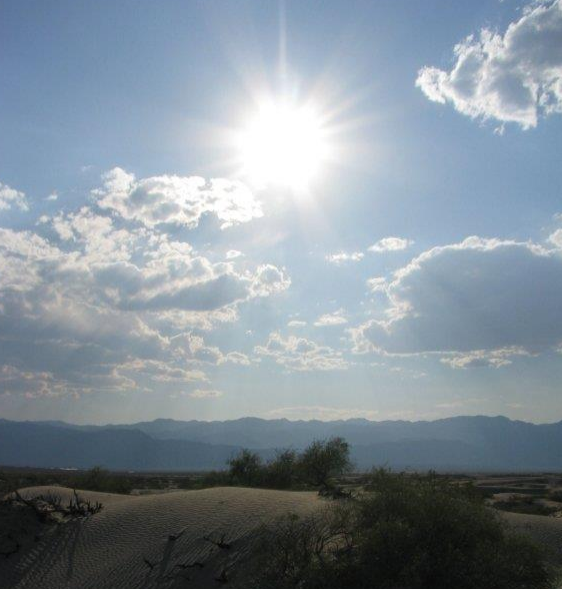
Death Valley is generally agreed to be the hottest place on earth.
It is where in 1911 — long before anyone strung the words “climate” and “change” together — the highest air temperature of 134 degrees was recorded at Furnace Creek.
It is where no rain was recorded in 1929 or 1953.
It is where in 1954 there were 100 days with 100 degree temperatures or higher.
It is where in 1927, 1959 and 1924 there were three days where the low did not drop below 100 degrees.
This information, and much more, was dutifully recorded and compiled by National Weather Service experts.
Death Valley is where those looking to rack up clicks for profit or to feed their egos turn in order to fan fears to trigger a stampede to policy decisions to use a specific agenda in dealing with the ever changing climate.
Climate has always been an issue for man.
Prolonged droughts, massive series of storms, hurricanes tornadoes, and such have been around long before Greta Thunberg was born.
There should be no debate they can get worse — or better — as climate is both cyclical and everchanging as the earth evolves.
No one should debate we need to adjust to it and change development and other policies accordingly.
But the solutions need to be forged not in an arena of fear whipped up by hyperbole, but by following the science and acknowledging history instead of giving lip service to both.
The latest example was the declaration that July 3 and July 4 by those more interested in clickbait on the Internet and ratings on cable TV were the hottest days ever on earth.
That might be a bit of news to life forms forged billions of years ago in the hellfire that scientists believe once encompassed much of the earth.
Experts were successful — to a degree — to get the hyperbole dialed back a bit, in noting that it was “recorded history”.
That means — at the longest stretch — the 17th century when instruments such as the barometer and thermometer were invented that allowed relatively reliable data to be collected.
Of course, there is a debate among scientists about the ability to make a proclamation that July 3 and 4 was even the hottest recorded days on earth given it is based on a global average using a mix of satellite temperature and computer-model based estimations to calculate temperature estimates.
There were no satellites 100 years ago, let alone 125,000 years ago.
This is not meant as a pun, but how data is presented or twisted can change to a large degree the course of actions needed to be taken.
It is just as fruitless and ineffective to take the wrong steps based on fear mongering than it is to do nothing at all.
And to be clear, whatever course of action taken requires the buy-in of rank and file people.
It is why former California Gov. Arnold Schwarzenegger a few months ago said the world would be better off if the words “climate change” were ditched and more precise labeling used that people can relate to without triggering hyperbole.
And this is coming from a man who is definitely green as in the environment and not as in the Incredible Hulk.
We need to address the climate issues and do so with perspective, not hyperbole.
Earlier this month, a 71-year-old man died hiking in Death Valley on a 121-degree day.
A year doesn’t go by that someone doesn’t die in Death Valley by pushing their luck.
It doesn’t typically rate more than a few words in print and perhaps a passing mention on TV et al.
But this month it wasn’t just wedded as a footnote with climate change coverage but it was given great prominence.
The death of a 71-year-old hiking in Death Valley is much more tantalizing than a 71-year-old dying from heat-related illness at home in Phoenix.
And for the record, an international study conducted by the London School of Hygiene & Tropical Medicine that analyzed 74 million deaths at 348 locations in 13 countries concluded people are 20 times more likely to die in cold weather than they are in hot weather.
The bottom line of that 2015 study — most weather-related deaths occurred on moderately hot or moderately cold days and not during periods of extreme temperatures.
Now ask yourself a question: Would the Jayhawkers of 1849 happily pay what a family in the Northern San Joaquin Valley will for turning on the air conditioning this month if they had just a tenth of the advantages we have today to deal with weather and climate issues?
The Jayhawkers ended up stuck in Death Valley near present day Furnace Creek on Christmas Eve in 1849.
They didn’t hop in their car and drive two or so hours to do a day hike in 121 degree temperatures that would end up killing them.
They were families that came to California looking for a better life.
By the time their ordeal was over, they had burned their wagons, their oxen had died, and one man perished before they walked out of Death Valley.
Reportedly, one woman turned back as the last view of the valley disappeared as they trudged up a a pass and said, “Good-Bye Death Valley.”
As stark of a situation the Jayhawkers dealt with, what is even more amazing is that late in the 19th century and the early part of the 20th century, upwards of 4,000 lived and mined in what is known as the greater Death Valley country that includes Furnace Creek.
Now think of 100-degree temperatures working as a miner.
Better yet, try sleeping when the overnight summer low rarely drops as low as 90 degrees.
Climate change — and extreme weather — has always been around.
The answer is not “reversing” it as that is way above our pay grade.
It is learning to adapt.
Climate history tells us that “civilizations” — including the Anasazi during the 13th century in what is now the southwestern United States — have collapsed due to climatic shifts.
That said, man certainly didn’t flee the North American continent or perish from the face of the earth.
They adjusted to the hand nature dealt them.
As for those self-anointed prophets that travel to Death Valley and hop out of their air conditioned cars for 10 minutes to take a selfie with a temperature sign reading 130 degrees, consider this: They are posting to the internet their firsthand experience of “climate change” as they head back to their air conditioned homes in a car that’s contributing to greenhouse gas levels.
Warning the world about climate change is hell. Thank heaven there are 7-Elevens on the way back to LA where you can buy chilled Serafina water imported from Italy.
This column is the opinion of editor, Dennis Wyatt, and does not necessarily represent the opinions of The Bulletin or 209 Multimedia. He can be reached at dwyatt@mantecabulletin.com