Call the City of Manteca crazy as in crazy like a fox.
Step by step they are turning a $34,333 investment to buy 56 acres in 1966 for future wastewater treatment plant spray fields into a $400 million cash cow.
The first step was the initial extension of Daniels Street west of Airport Way and the building of the Big League Dreams sports complex in 2008.
The second step was securing the 500-room Great Wolf Indoor Water Park Resort.
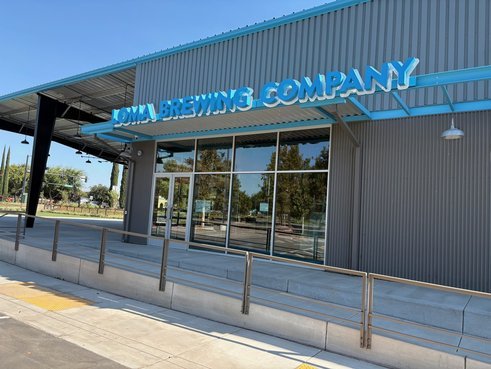
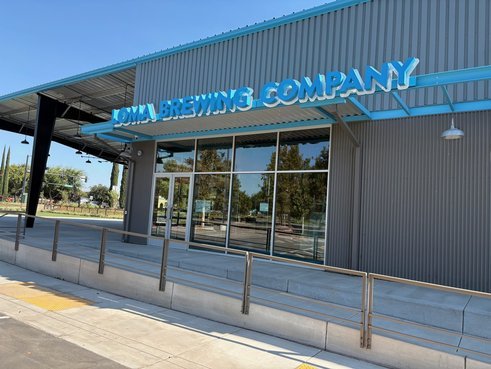
The third step, miniscule as it is in comparison, was landing the Loma Brewing Co. The brewery next to the BLD is opening this year once critical brewing equipment components caught up in chain supply delay issues arrives and is installed.
The fourth step was taking Daniels Street all the way to McKinley Avenue using redevelopment agency funds.
The fifth step was wedding remaining RDA money with other funds to build at interchange at the 120 Bypass and McKinley Avenue.
The next step is execution of the development of the 100-acre plus family entertainment zone bookended by Great Wolf and BLD.
Looking toward the future in 1966 as Manteca started growing, the city padded its land holdings for future treated wastewater spray field use by 56 acres at a cost of $34,333 or just under $700 an acre.
At the time plant smell and state disposal requirements made it a sound decision so the “new” treatment plant wouldn’t have its life shortened as the previous one did on Union Road.
That treatment plant eventually became the back 9 holes of the Manteca Municipal Golf Course.
The front 9 holes and the clubhouse, by the way, sit on the site of the former municipal dump.
Evolving technology eliminated plant odors and made treated wastewater clean enough to the point that it not only can be returned safely to the San Joaquin River but it is actually cleaner than the river water it is joining.
Twenty years ago, the city leadership resolved the push back against locating a BLD sports complex at Woodward Park by building it instead on land no longer needed for the wastewater treatment process.
That led to an epiphany of galactic proportions.
The city — between the 1966 purchase and land acquired beforehand for the treatment plant — realized it was sitting on a municipal Mother Lode.
They had more than 120 acres that were no longer critical to the operation and future growth of the treatment plant.
That was due to cutting edge technology they used in the last upgrade that allowed the city to be among the first in the region to meet extremely high state standards to return treated water to the river.
The land sat on top of an interchange — Airport Way — that had no development around plus freeway exposure to the heavily traveled 120 Bypass.
The city made two key decisions.
They parlayed the huge jump in RDA bonding capacity made possible by the conversion of the shuttered Spreckels sugar beet plant into a dynamic 362-acre multi-use development to build the $29 million BLD complex plus the initial extension of Daniels Street.
That not only provided access to the BLD complex but it opened up land to develop the Stadium Retail Center originally anchored by Mervyn’s and allowed the city to snare Costco.
They also hedged their bets by tapping the sewer fund to buy 220 acres some two miles to the south along Hays Road.
The purpose for the Hays Road acquisition was simple.
If the state’s ever-changing rules forced a return to even more robust land disposal of treated wastewater the city wouldn’t be caught flat-footed. All it would need to do would be to extend a pipeline.
The deal involving a 55-year land lease for 36,560 square feet — 7,060 square feet shy of an acre — with Loma Brewing Company to locate along Daniels Street near Milo Candini Drive is the end result of the city’s decision to buy 56 acres for less than $700 an acre back in 1966.
The land needed for the brewing company was appraised at $62,000.
The city was able to legally “discount” the land under state law due to a significant positive economic impact it would create to fund day-to-day municipal services as well as general overall economic benefit in the form of 40 to 70 jobs.
The $22,000 annual rent discount is being taken from projected sales tax.
It still leaves $40,000 a year in land lease payments flowing to the city. The overall $62,000 starting annual land lease payments will escalate every 10 years through the duration of the 55-year contract.
Based on annual sales tax projections the city would receive of $30,992, the city will net $8,992 after the “rebate”. When added to the $40,000 “net” from the land lease that comes to $48,992 flowing into the city’s general fund after the first year.
Taking the city’s share of sales tax projections on the fifth year of operations with the brewery up to 100 percent capacity, the city’s share of sales tax would hit $55,478. Delete the $22,000 rebate and that’s $33,478. Once you couple that with the $40,000 land lease net and the city will see a positive cash flow of $73,478 annually.
For ease of calculation, ignore the lease increases and inflation impacting prices and sales tax receipts. Over the course of the 55-year land lease the city will net $4,041,290 from an initial investment of less than $700 in 1966.
Assuming the remaining acres of city owned land within the family entertainment zone are all land lease deals, the FEZ concept could generate in excess of $300 million in city revenues over 55 years.
That does not include the impact on Manteca’s general fund from the 30 acres sold to Great Wolf to land the $180 million 500-room indoor waterpark resort.
Over the course of its first 30 years, the city will net $74.3 million or an average of $2.4 million a year.
And when the room tax sharing with Great Wolf goes away in the 31st year sending every penny on room tax collected at the resort to the city, Manteca could see a net of $90 million from Great Wolf.
That means a $35,383 land deal made 60 years ago could ultimately provide Manteca with a $390 million return.
Toss in the cost-avoidance in terms of maintenance and upkeep the city realized by leasing out the sports complex to BLD to the tune of $16.9 million for the first 35 years and the net positive impact on the City of Manteca soars past $400 million over 55 years.
That means 80 acres acquired in or before 1966 would have a $5 million return per acre over the next 55 years for land that cost $700 per acre.
This column is the opinion of editor, Dennis Wyatt, and does not necessarily represent the opinions of The Bulletin or 209 Multimedia. He can be reached at dwyatt@mantecabulletin.com