Manteca’s climate action plan update is, to put it bluntly, a waste of energy as well as money.
It was essentially an exercise in futility that in the end had to meet state expectations.
Rest assured the Manteca City Council, just like all other elected local leaders facing a mandate from Sacramento to put such plans in place and update them periodically, will give it their blessing in the coming weeks.
There may be politically correct platitudes uttered to show they care, which they likely do on some level.
But the odds are comments will be at a minimum unless they are naive newcomers to participating in the fraudulent exercise of local control as dictated by Sacramento.
It’s because at the end of the day there will be little, if anything, done to implement stated goals in the plan unless a decree on a specific area is handed down by the California Legislature.
With all due respect to the citizens that served on the advisory committee, in the end the climate action plan is long on sweeping gibberish and short on action.
Leonard Smith is one member who knows that all too well.
Yet to his credit, he keeps fighting the good fight.
Smith, when he was a member of the Manteca Planning Commission, could always be counted on to ask pressing questions about energy use of projects that were up for review. Almost all involved whether there was a solar energy component.
He would advocate that it be added or made more muscular.
Planning staff dutifully reminded Smith and other commissioners that they were there to make sure the project complied with city and state requirements.
And if they identified shortcomings, enhancing solar wasn’t in their wheelhouse.
Policy decisions are the purview of elected officials.
But here’s the problem with that.
It muzzles community input.
And it also assures the bare minimum is always done when it comes to climate policies aimed at obtaining climate goals that are stated by Sacramento and not California cities with the notable exceptions of places like Berkeley and Santa Cruz.
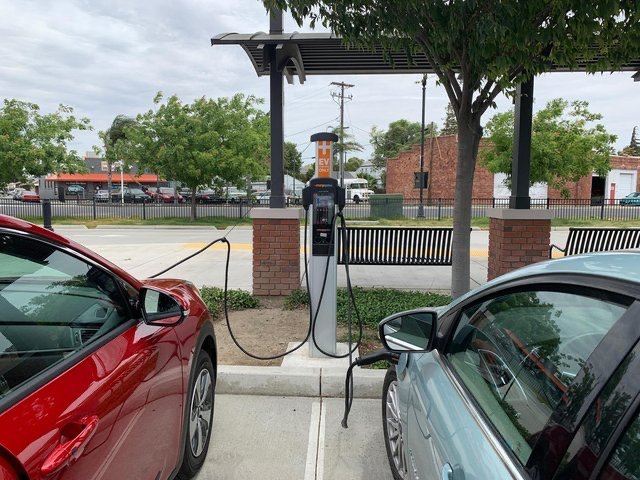
The climate plan update practically calls for EV chargers all over Manteca.
But here’s the kicker. Not one single policy regarding their actual installation is being advanced, or likely will be advanced, until the state mandates it.
Smith, and a small but growing number of others in Manteca, have an aversion to more gas stations being built.
That said, surely they’d agree that if more are built that they should have at least four EV charging stations included instead of possibly being plumbed so they can be added at a future date.
The same goes for retail developments.
Living Spaces, as an example, has 456 parking spaces of which 14 percent are plumbed for EV chargers per state law.
That is the equivalent of a possible 62 EV chargers.
There are zero EV chargers at Living Spaces.
Why can’t the city have an ordinance requiring at least 10 percent of the plumbed parking spaces required by the state in new developments must have EV chargers installed before a complex can open?
It would have been six chargers in the case of Living Spaces.
That would be an “action” and not just a plan.
Then there is the half-hearted effort that complies with the letter of state mandates and not the spirit.
We’re talking the use of trees to reduce urban islands and cut energy demand for cooling down buildings.
It’s based on the science that shows, on average, the area beneath a tree’s canopy is 10 degrees cooler than areas in the direct sun.
The City of Manteca has 16,000 plus street and park trees.
They are indeed trees.
But very few are what would legitimately be called shade trees.
A mature crepe myrtle isn’t a tree that will provide a large cooling canopy.
The ones that do in the hot Central Valley are sycamore trees and such.
Water them right and they create a massive cooling oasis such as at Library Park and Woodward Park, especially on the northeast corner near the storm retention basin.
Now take a look at 20 year-old subdivisions.
All were required to have trees in their front yards.
Few are shade trees in the truest sense.
They function more as ornamental trees.
As such, Manteca adheres to the state requirement of requiring trees to reduce energy consumption for cooling and to combat climate change, but they do so in a manner that is minimal in both execution and results.
Why not have a city ordinance requiring effective shade trees that are planted and watered right?
They would reduce the creation of urban heat islands, they would generate more oxygen and absorb more carbon dioxide, and they certainly would make Manteca more walkable especially at high noon in mid-August.
All three are goals in the climate action plan update.
All three were climate action plan goals before the work started on the update.
All three goals, and what minimal effort the city is doing, meets the letter of the state requirement but not the spirit.
Why not follow Leonard Smith’s lead and require solar on new commercial endeavors?
If it is an issue of penciling out and not wanting to make Manteca come across as anti-business, why not dangle an incentive in front of them like they did with Living Spaces, Costco, and the original developers of Orchard Valley?
Split the first three years of local sales tax collected from a new commercial center for the purpose of reducing the upfront costs of solar or battery storage packs.
Done right, it can earn Manteca a reputation of not just being green but also business friendly by helping make commercial endeavors less susceptible to PG&E power hikes.
In doing so, it would help improve energy reliability. That happens to be another goal of the climate action plan.
The bottom line is this: The climate action plan update the council adopts can either be basically preening or going through the motions.
Or they could take some elements already in motion and make sure they are significantly more effective than meeting the state’s minimum expectations.
And they can do so without costing businesses and the taxpayers a lot of green.
This column is the opinion of editor, Dennis Wyatt, and does not necessarily represent the opinions of The Bulletin or 209 Multimedia. He can be reached at dwyatt@mantecabulletin.com