Social media health influencers are busy doing what they do best which is churning out click bait to help line their pockets.
One of the latest is calling Diet Coke specifically, and diet soda generally, the millennial version of smoking a cigarette.
You can’t make this stuff up.
Diet Coke clearly isn’t a health drink. But it is also far from being categorized in the same breath as a cigarette.
One of the popular health influencers that pans diet soda as being as bad as smoking regularly videos herself drinking a grande Starbucks creation or sipping hyper caffeinated energy drinks.
Forget the fact that excessive use of anything with caffeine in it — diet/regular soda, energy drinks, coffee, and such — is addictive. And it can create health problems.
The bottom line is anything drank to the point of excess isn’t good for you, especially when done on a routine basis.
According to ambulance chaser sites, certain high caffeinated energy drinks chugged in excess during a short period of time have sent clients that into cardiac arrest and killed them.
Of course, deaths attributed solely to rapid, concentrated energy drink consumption are extremely rare and have centered around kids 10 and under.
Those that are older that excessive energy drink consumption was believed to have contributed to their deaths had underlying conditions.
If you pooh-pooh-pooh that anything drank in excess can kill you, it was 18 years ago that Sacramento radio station 107.9 KDND “The End” had a “Hold Your Wee for a Wii” contest.
There were 18 contestants entered who were trying to drink as much water as they could to win a Nintendo Wii going console.
Jennifer Strange, a 28 year-old mother of three drank nearly two gallons of water over a three-hour period on Jan. 12, 2007.
She ended up in second place with concert tickets.
Strange died hours later in her bathroom.
The Sacramento County coroner determined she died from water toxicity.
Quick fixes, fad diets, and such have always been the rage.
Coca-Cola appeared on the American scene in 1886 as a medicinal product that was touting as giving drinkers a pick me up. It had cocaine in it.
All traces of cocaine disappeared in the early years of the 20th century .
In the spirit of full disclosure, I am back to drinking one or less diet sodas a day.
This is after going close to 22 years rarely even drinking a soda.
I know it was 22 years because when I decided to go cold turkey after drinking the equivalent of three to four 16 ounce diet sodas a day for more than two decades I went through four days of caffeine withdrawal.
It included everything from non-stop headaches for three to four days, “the shakes”, and turning — I was told — “as white as a ghost.”
I am careful to drink diet sodas in moderation as I make a deliberate effort to keep my resting heart rate below 60.
That said, I love people that lecture me about the dangers of diet soda due to the caffeine content when they go around all day with a cup of coffee always within an arm’s length.
And to be clear, I am not a health expert, a scientist, or a medical professional. I know what works for me and I will share it but at no time do I have the delusion what I do will work for everyone else.
You had to know where this was going.
This brings us to Robert F. Kennedy Jr. and seemingly half the world having a cow over what they believe is his embracing “junk science” in his role as Secretary of Health & Human Services.
His most strident and dismissive critics like to imply he’s the first ever in his position to make what they term “crackpot decisions” about the nation’s health.
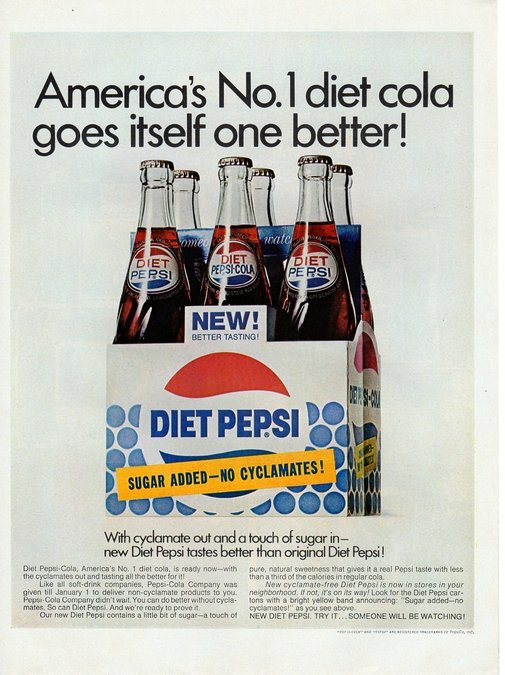
Let’s go back to Oct. 8, 1969 when then Secretary of Health, Education & Welfare Robert Finch banned the use of cyclamates that were prevalent in diet drinks and other products as an artificial sweetener.
The ban was done on the strength of one test that injected saccharine and cyclamates into the bladders of rats.
More specifically, it was the equivalent of the amount of cyclamates a human would consume in a day if they had 350 eight ounce cans of soda. Eight out of 240 rats in the Abbott Laboratories test developed bladder tumors
Most of the science community ripped the study and the ban to shreds.
The arguments ran the gamut that it was only one test and why was saccharine mixed with the cyclamates but only the finger pointed at cyclamates, to the same amount of sugar water injected into 240 rats would also cause several to develop cancer.
No scientist claimed cyclamates was a health additive and without side effects. But they did point to clinical studies confirming how the use of cyclamates were beneficial to people reducing impacts of excess sugar intake.
Canada — which a lot of people contend has a health care system that is better than in the United States — followed suit with a ban.
But guess what? After eventually subjecting cyclamates to rigorous scientific tests with animals, Canada reversed course.
Today, Canada as well as Mexico are among 100 plus countries where cyclamates are legal.
The 1989 ban was eventually seen as a textbook case of what can happen when public health decisions are driven by sloppy tests that shape an erroneous conclusion that is swallowed hook, line, and sinker.
There are health and medical experts today responding to the social media influencers by noting diet soda is not a health drink per se but that said comparing them to cigarettes is absolutely absurd.
But then again, who do you believe?
Scientists, a doctor or the modern-day version of rats being injected with the equivalent of 350 cans of soda a day better known as social media health influencers?
This column is the opinion of editor, Dennis Wyatt, and does not necessarily represent the opinions of The Bulletin or 209 Multimedia. He can be reached at dwyatt@mantecabulletin.com