Long before the word “homeless” became the talk of social media — and a good five to seven years before the Internet was commercialized — there were homeless in Manteca.
One of them was a single mom with a 5 year-old daughter who worked at the Bulletin when I was hired in 1991.
She would take advantage of camping at Caswell State Park that you were permitted to do for 30 days.
Sometimes friends allowed her and her daughter to couch surf between camping gigs. But when that wasn’t possible, they slept in her car.
Most of us wouldn’t have noticed the homeless that populated Manteca back then.
It’s because most of them had jobs and scrambled as the referenced co-worker did to find shelter when they could. There were few true “transients” that ended up sleeping in makeshift shelters that now would be called illegal homeless encampments.
Do not misunderstand. There were other transients, such as single migrant farm workers, that shared efficiency apartments that once flourished in much larger numbers on the second flood of downtown buildings.
Fast forward to 2000.
It’s about the time monikers such as Meth Manor, Heroin Heights, and Tweaker Towers started popping up in reference to some deteriorating second floor housing downtown,
The city used every option they could to counter the problem through building code and health code violations.
Then in 2008, a Marin County investor who opened and operated modern boarding houses in the Bay Area successfully, bought the building on the northeast corner of Sycamore and Yosemite avenues in downtown Manteca.
The two-story building with a 16-room efficiency apartment complex on the second floor had been dubbed Tweaker Towers for years.
When the building was renovated in 2008, the complex was lauded as an example of what solid investment and sound management could accomplish with second floor housing in downtown Manteca.
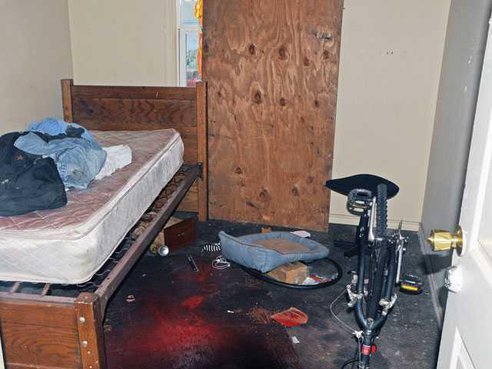
It had separate rooms equipped with a bed, dresser, and small refrigerator as well as two common bathrooms that were updated and even a computer for communal Internet access.
She also hired an on-site live-in manager to keep tabs on things at the complex rechristened as Sycamore Arms.
The rent for a small efficiency apartment was $600.
Back then you could secure a nice, clean, and somewhat older one bedroom apartment in Manteca for around $750 a month.
The efficiency apartments, though, did not require deposits or a credit check.
A single mom with an 8 year-old daughter was one of the first renters. She worked at Walmart.
She shared with the Bulletin, the room — that was barely 80 square feet — was a bit of heaven as the complex was not populated with druggies.
The woman and her daughter took turns between sleeping on the single bed and an air mattress on the floor.
She also had a 13 year-old son. But under the rules attributed apparently to how impulsive and restless most boys get at that age and the close quarters; Sycamore Arms did not allow any teen males.
The son was living with family friends as the father was somewhere in the wind.
The Walmart associate shared that the three of them had been living off and on in her car when they couldn’t afford one of the downtown efficiency apartments. Sometimes they were able to crash on someone’s couch, or in their garage, for a few days.
Then the Great Recession hit.
That, coupled without being able to keep a manager on site, saw Sycamore Arms go into foreclosure.
It was about this time that two aging trailer parks were cleared out — one in the 300 block of North Main Street and another on Moffat Boulevard.
Some of the tenants moved to Stockton. Some who had jobs took to living in their cars while trying to rent a room in a house.
And there were also those who may best be described as perennially unemployed with addiction issues.
All of that — the Great Recession, low-income efficiency apartments that addicts “took over” and the loss of the trailer parks — was just about when the homeless became more visible in Manteca.
And there were people who slept in cars and RVs.
The ones that were employed but not gainfully enough to secure an apartment or a room, would often park in areas around downtown. They were usually gone when the sun came up.
What brings this up is a need to remember not all homeless are addicts who prefer drugs over having to follow rules to stay in a safe shelter.
And there are those that struggle to stay off the streets that find out sometimes sleeping in their vehicles occasionally over extended periods of time is their only option.
It is why the city’s game plan for 555 Industrial Park Drive needs to include the ability for the homeless who have to resort to living in their vehicles and have no problem following the rules to park their vehicles in the secured parking lot.
Given the dorms and support services will ultimately be inside the former Qualex building once it is remodeled as a navigation center, there should be room for RVs and such in the parking lot.
That way they can access bathrooms, showers, and other services.
The Manteca Way Church already provides a safe haven on church property for the homeless living in three vehicles.
It goes without saying the homeless navigation center would be much more effective if they can be the go to place for people to avoid being homeless.
Those who are working, or are well to work, and want to stay off the streets need a resource center, so to speak.
And arguably one of the best resources might just be establishing a network where people who may offer rooms for rent and those needing to rent shelter and can afford to pay, can use as a clearing house.
But if the city does nothing more than having an option for homeless — providing certain conditions and rules are followed to park vehciles they sleep in — that would be a huge step.
The working poor who end up sleeping in their cars is often not due to addiction.
And it has been an issue hidden in clear sight in Manteca for decades.
This column is the opinion of editor, Dennis Wyatt, and does not necessarily represent the opinions of The Bulletin or 209 Multimedia. He can be reached at dwyatt@mantecabulletin.com