By allowing ads to appear on this site, you support the local businesses who, in turn, support great journalism.
Remember when there were drinking fountains and they actually worked?
PERSPECTIVE
WATER FOIUNTAIN
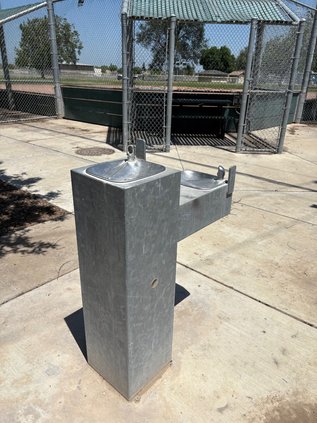
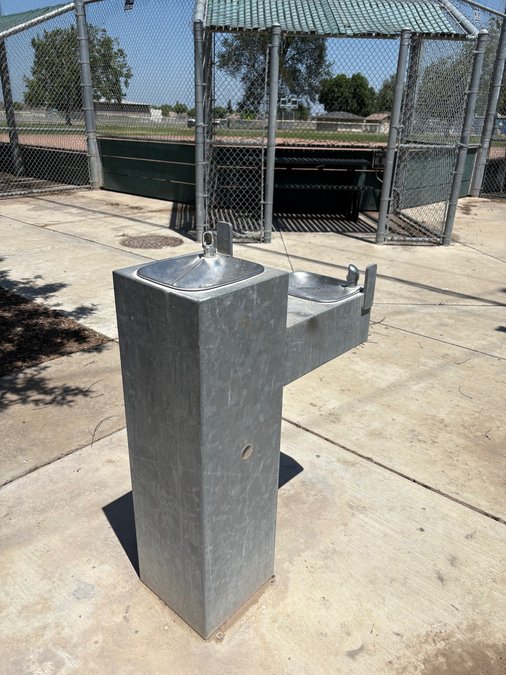
This drinking fountain at the lighted baseball field at Marion Elliott Park (formerly Lincoln Park) wasn’t working when this photo was taken.

Try to find a public drinking water fountain in Manteca.

The only thing harder to find is one that works.

Just 75 years or so ago, many were fighting for universal access to drinking fountains.

Now most avoid them like the plague which, by the way, killed astronomically more people than COVID.

That was due to the repertoire of healthy things they did not have that we take for granted today such as municipal drinking water, wastewater collection and treatment system, plus solid waste collection.

It’s more than ironic. It’s pathetic. And it plays into the big con that municipal, water is unsafe that allows companies like Coca-Cola and Pepsi to generate billions in bottled water sales.

Before he departed for what he believed was greener grass on the other side of the Altamont Hills in Livermore, former Manteca Public Works Director Carl Brown inserted exploring the placement of water bottle filling stations at various municipal venues on a list of proposed budget expenditures.

It got cut.

You’d think in a city that topped 100 degrees Friday that more attention would be given to a universal need, especially when kids and others access outdoor parks and such.

And given the bum rap city water gets, especially in terms of safety, you’d think the city would have water bottle stations/drinking fountains everywhere they could with signs boasting the fact it is some of the safest water on the planet.

The ultrafiltration membranes that cleanse surface water from the Stanislaus River watershed at the South San Joaquin Irrigation District treatment plant is the platinum standard.

The water the city blends from its roughly two dozen wells with the SSJID water also has state-of-the-art treatment.

Taste is another issue.

Sometimes it has to do with the condition of pipes that carry water the several dozen or so of the final feet to a home’s water faucet.

A lot of it has to do with the overkill treatment, if you will, of adding chlorine after all of the other more sophisticated treatment steps.

A funny thing about chlorine.

If you fill a water container and shake it aggressively — or simply let it sit a spell — the chlorine gas will dissipate.

It might shock you, but water kiosks in stores or parking lots don’t make the water you get measurably safer than the much more sophisticated treatment that the city and SSJID apply.

The water is still basically city water.

What they do address is taste issues, real and perceived.

The late Carlon Perry, who served as mayor, made it known he believed city water not to be unsafe but was hideously bad tasting.

He agreed to take part in a blind water taste test involving bottled water, city water, and water from a parking lot water kiosk.

Two other people were included. One drank tap water exclusively. The other used bottled water.

The outcome of the three taste testing three different water samples? Not one agreed the best tasting was the source they used. And in Perry’s case, he said the city water taste the best.

Public Works staff conceded the condition of pipelines, including on the city’s side of the meter, could negatively impact taste.

It should also be noted that most bottled water originates from municipal water treatment plants and not artisan or mountain springs.

It might surprise you to know Safeway Select bottled water is basically bottled City of Merced drinking water.

Municipal sources are the norm for most bottled water you now spend upwards of $2 for a bottle.

Manteca municipal drinking water is not going to kill you or make you sick.

But not having access to water when it’s hot can be a problem.

Our collective aversion to drinking fountains is the fact many people use them.

It is a real problem when the stream of water barely pops out.

Maintenance is the real issue, not safety.

There are a number of drinking fountains put in place that don’t work or, if they do, they are a dribble.

One would think that Manteca, which is buying into the walkable city planning strategy, would give some consideration to public access to drinking water.

The deployment of water bottle stations — or even in combo with drinking fountains — should be on the list of things that need to be fine-tuned when it comes to city parks and other municipal venues.

Drinking fountains are not part of a national health problem.

But they have inadvertently gained notoriety almost on par with toxic waste dumps.

Schools switching from drinking fountains to fillable water stations before students returned to class during the pandemic was done out of an abundance of caution due to protocols addressing how COVID is spread.

That said, clearly students carrying refillable water bottles had been a growing trend for years.

The same kids when they go to parks should be able to refill water bottles as well.

Refillable water stations in parks also dovetails into the growing trend of more and more adults doing “laps” walking around the perimeters.

If the city sees the need for restrooms in larger neighborhood parks to support walking and leisure activities, youth sports practice games and such then workable drinking water fountains should be on the list.

Better yet, the best option would be hybrid water bottle filling and water drinking stations.

The worst those that most who grew up and went to school in the Stone Age got from porcelain and iron drinking fountains was the cooties.

As for those that got half their drinking water or more in the summer from the end of a garden hose, it hasn’t prevented them from living long enough to collect Social Security.

Making water available for people to drink in city parks doesn’t avoid health problems.

Arguably, it’s the opposite.


This column is the opinion of editor, Dennis Wyatt, and does not necessarily represent the opinions of The Bulletin or 209 Multimedia. He can be reached at dwyatt@mantecabulletin.com