California is sinking.
Well, not all of it.
Some of it is rising.
The Long Valley Caldera that Highway 120 skirts the northern edge of when it passes through Mono County east of Yosemite National Park rose 33 inches between 1980 and 2013.
The caldera is one of California’s active volcanoes as identified by the United States Geological Survey.
Some of California is heading north.
The San Andreas Fault is moving the Pacific Plate at an annual rate of 0.8 to 1.4 inches past the North America Plate.
It is a neck-breaking speed that scientists have noted is roughly how much your fingernails grow in a year.
Much of it is shaking.
Every day there are dozens of earthquakes recorded in California with almost all too small for most to people to feel.
The rising, northward ho movement, and shaking are not manmade.
It’s Mother Nature’s way of reminding Californians we live on some of earth’s newest real estate.
The sinking, however, is almost all manmade.
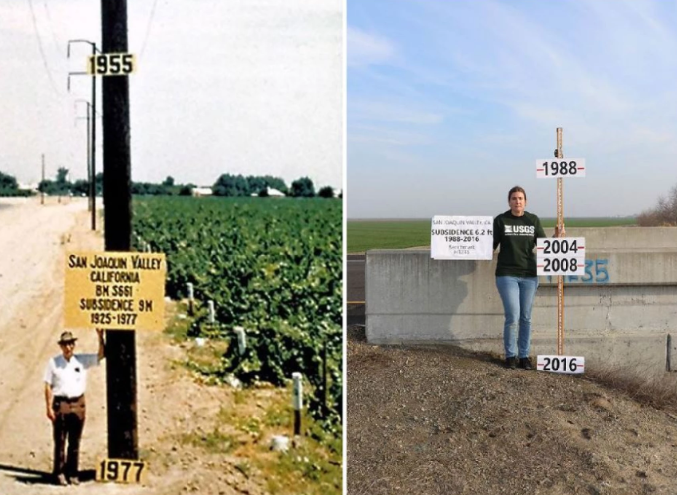
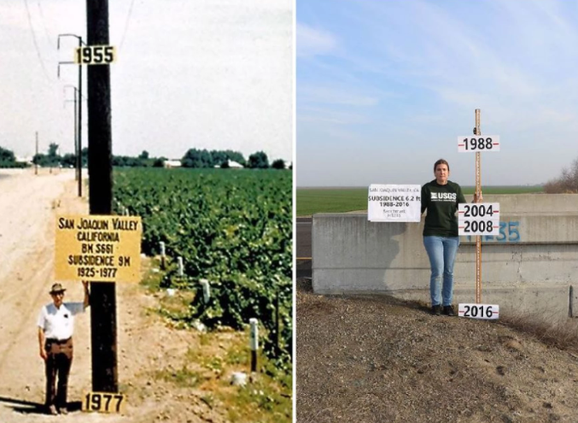
In the past 100 years, some parts of the state — especially near Mendota in the mid-San Joaquin Valley — has dropped 40 feet.
It has reduced the capacity of the California Aqueduct in several places
The aqueduct is the linchpin that conveys water to 27 million Californians and 750,000 acres of farmland.
And it’s all the land that is sinking — it’s called subsidence — is due to groundwater over drafting.
What makes it maddening is the aqueduct is part of the State Water Project advanced in the 1950s — with Lake Oroville being the main reservoir — that was supposed to stop subsidence from happening.
The Delta Tunnel is the “unfinished” piece of the 1950s era plan that was supposed to be a holistic approach to California’s water needs.
Had the tunnel in its earlier proposed form had been built as the Peripheral Canal that was resoundingly defeated by statewide voters in 1982, there would still be subsidence.
A Delta conveyance was seen as key back in the 1950s when there was 28 million less Californians.
Between decades of questionable flood-drought operating policies of the State Water Project, overcommitting water, and trying to inundate ecosystems with water instead of addressing underlying causes such as invasive species that has sent some fish species to the brink, subsidence is still happening.
The state mandate by the year 2040 limiting groundwater pumping to no more water than is replenished in a given year has a good chance of succeeding where the State Water Project has failed.
Prior to the 444-mile California Aqueduct’s construction in the mid-1960s, portions of the land it was built on has dropped 20 to 30 feet.
Subsidence stabilized for much of the first two decades the aqueduct was in operation. But then the 1976-1977 and 1986-1992 droughts hit. Increased pumping on nearby farmland has since significantly accelerated subsidence.
At one point from 2013 to 2016, sections of the aqueduct sunk nearly three feet.
Subsidence has reduced the capacity of segments of the aqueduct by 20 percent.
This has forced more water to be moved during peak energy times which only adds to California’s electricity woes.
A series of pumps are required to make it possible for 2.5 million acre feet of water each year to flow from the Delta to the Los Angeles Basin and beyond.
At the same, the Delta is protected by a mishmash of private and local reclamation districts.
They lack the financial resources to improve levees that date back to the 1880s and no longer meet Army Corps of Engineers standards.
The Delta Tunnel — now being pushed supposedly to assure water delivery reliability for 27 million Californians and not create an addition drop of water — does not address the levee issues.
Nor does it address subsidence that is a threat to water reliability south of the Delta.
What it does in reality is take Sacramento River water diverted south out of the Delta equation.
It is similar to what the City of San Francisco did by diverting Tuolumne River water into their Delta conveyance that carries the old-fashioned moniker of a “big pipeline” that passes beneath Modesto.
The water that ends up in the San Francisco pipeline isn’t impacted by court decisions or state edicts regarding fish flows in normal years and — more importantly — drought years.
San Francsico, as a result, has less at risk in a drought when it comes to water as it doesn’t flow through the Delta first.
Such a deal would make Los Angeles mighty happy.
The tunnel won’t increase water supply per se, but in drought years they would end up taking less of a hit.
Senate Bill 872 introduced in Sacramento on Wednesday addresses both levee integrity and aqueduct subsidence.
It directs $300 million annually from greenhouse gas reduction fees slapped on polluters for the next 20 years to protect the reliability of California’s primary water source for decades to come.
That includes:
*$150 million annually to the Delta Conservancy for levee improvements, including projects that restore habitat.
*$150 million annually to the Department of Water Resources for subsidence repairs along State Water Project canals
By addressing levee issues, it would strengthen water reliability for 27 million Californians and 750,000 acres of farmland and not destabilize the Delta ecological system as the tunnel project would.
Those points were underscored by San Joaquin County Board of Supervisors Chair Sonny Dhaliwal.
“Rather than investing billions in new conveyance infrastructure, state leaders should prioritize regional water resilience strategies such as conservation, groundwater recharge, and local storage including strengthening the levees that protect the Delta,” Dhaliwal said.
The basic premises driving the backers of SB 872 are:
*Subsidence of water infrastructure is one of the biggest threats to Californians' water security — more than 200 miles of the State Water Project have been impacted and require significant repairs as soon as possible, or else there is a risk of an 87% reduction in delivery capability.
*The Delta is the largest and most important estuary on the West Coast. It consists of 1,100 miles of levees that protect farms, ecosystems and freshwater from saltwater intrusion and provide essential flood protection for the region, including for more than 500,000 people, along with farms, businesses, and historic resources.
Repairs caused by subsidence are estimated to cost $3 billion over the next 20 years according to the State Water Project.
Sacramento’s tunnel vision is myopic at best.
The Delta Tunnel is a very expensive project that only address water delivery reliability
SB 872 is a true holistic approach with significantly more bang for the dollar.
It addresses reliability, flood control, subsidence, and the fragile Delta ecology.
This column is the opinion of editor, Dennis Wyatt, and does not necessarily represent the opinions of The Bulletin or 209 Multimedia. He can be reached at dwyatt@mantecabulletin.com