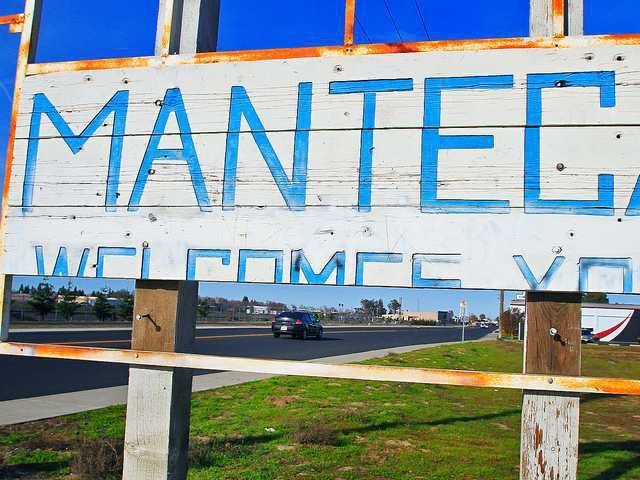
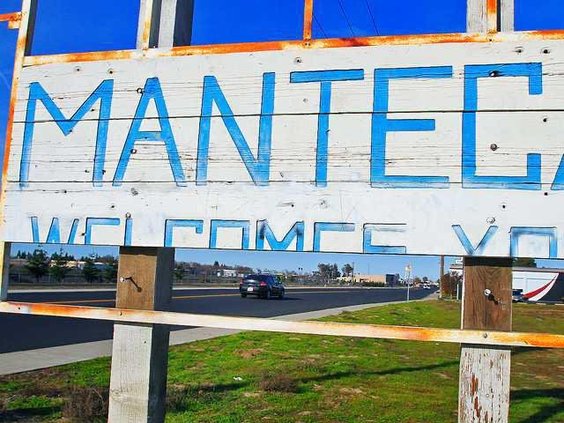
It’s back to the 1950s for Manteca.
It’s because, once again, the quickest way to reach downtown Manteca from Highway 99 will be via Moffat Boulevard.
Why does that matter?
It’s because the world, as far as downtown is concerned, is about to change.
The remake of the Austin Road interchange turns the clock back 70 plus years.
All of the pieces will be in place in four or so years.
Moffat Boulevard will again be the fastest “entrance” to downtown from the south.
If you doubt that, drive down to the end of Moffat as if you were going to get on the freeway heading for Ripon.
Make a U-turn before the on-ramp.
Drive west to where Moffat T-intersects onto Main Street. Time yourself as you do.
Next get onto Highway 99 at Lathrop Road and head south.
Take the Yosemite exit and head downtown.
Time yourself again once you turn onto a surface street.
Compare the two times you took to reach Main Street in downtown.
The quickest route — and the least congested — is Moffat.
That will even be true when the new signal is added at the new alignment of Woodward Avenue into Moffat.
There was a time when Moffat Boulevard was the only way into Manteca from the south.
It was before Highway 99 was built in 1955.
It was also prior to the 120 Bypass opening in the 1970s.
The quickest way into Manteca back then from the south wasn’t Austin Road.
Austin Road was out in the middle of nowhere. As bizarre as that might sound today, it was the equivalent of Siberia with a stench.
The reason was simple. It was southeast of what was once Manteca’s Achilles Heel in terms of housing development.
Actually, it was two Achilles Heels — the Moffat Feed Lot and Spreckels Sugar.
The area was downwind from the two. Prevailing winds blow to the southeast, most of the time, through the Delta.
Caltrans, in its infinite wisdom, decided in 1955 there was a need to put an exit almost on top of Austin. It was an exit only.
It was a Caltrans rarity. It was a left turn flyover exit.
The on-ramp that Moffat becomes for southbound Highway 99 was in place when the freeway was built in 1955.
You could get onto Moffat from Austin Road. But when you reached where the ramp connects with Moffat, you came to a stop sign. The road jogged a bit to the east. You had to turn left to continue down Moffat. The cross-traffic from the left lane off ramp whizzed by at 55 mph.
Moffat, by the way, was actually Highway 99 before the freeway was built.
Moffat/Highway 99, when it reached Main Street, had no stop sign.
Instead, traffic heading north on Main Street had a stop sign at Moffat.
From that point, Main Street turned into Highway 99 and headed through downtown toward French Camp and then Stockton.
And where Highway 99 (Main Street) crossed Highway 120 (Yosemite Avenue), was where Caltrans plopped down Manteca’s first traffic signal.
Now that the history lesson is out of the way, let’s talk about the future.
Moffat can be even bigger in terms of its impact on downtown than Old Highway 99 ever was.
And not just because it will be the quickest way to downtown from those wanting to get downtown from northbound Highway 99.
Caltrans is giving downtown, and the rest of Manteca, a big gift.
It’s the Austin Road reconfiguration project — along with the realignment Woodward Avenue — that also will also create a link to downtown Manteca’s future.
That link is a short, straightened out new alignment of Woodward between Atherton Drive and Moffat Boulevard with a new T-intersection complete was traffic signals.
Atherton Drive is the future of south Manteca. More specifically, southeast Manteca.
It is where the 1,080-acre Austin Road Business Park zoning is already in place.
And Atherton Drive is the main artery that ties the future south to the rest of Manteca.
There is other land in the path of development.
But Austin Road Business Park stands out for what it is.
It includes 350-acre employment center. It also includes commercial and high density residential.
And, it includes zoning for 4,198 single family homes.
They are the fuel that powers brick and mortar retail —-specialty and other wise — as well as dining out and entertainment dollars.
And Atherton Drive, with a slight jog to Moffat via Woodward, is about as a direct line as you can get to downtown.
That’s 13,000 future consumers with disposable dollars that single family housing growth has been bringing to south Manteca.
It is why the long game for downtown, and Manteca overall, needs to include a plan that makes Moffat Boulevard as part of its future.
Two mayors in a row — Ben Cantu and now Gary Singh — also have a strong sense of what Moffat Boulevard means to the future of downtown and Manteca.
Both see it as new entrance to downtown.
Actually, it gives beyond that.
They want to extend Moffat Boulevard across Main Street and tie into Yosemite Avenue near Library Park.
Their vision includes transforming Yosemite Avenue between Library Park and Fremont Avenue into more a low key “local downtown” street with a bustling street life — read that al fresco dining and such.
They also believe those businesses on the south side of Yosemite Avenue could have secondary entrances opening to parking lots and the extension of Moffat running along the tracks.
In doing so, it also creates a way to connect the current — and future — households in southeast Manteca not just to downtown but also the western commercial area of the city.
The bottom line is this: Moffat can be used to build stronger ties between the future and present Manteca.
Caltrans dropped a great gift of opportunity into Manteca’s lap.
The question is now whether Manteca builds on the opportunity or squanders it.
This column is the opinion of editor, Dennis Wyatt, and does not necessarily represent the opinions of The Bulletin or 209 Multimedia. He can be reached at dwyatt@mantecabulletin.com