The first time I saw an honest-to-goodness newspaper printing press I was hooked.
It was in the old Press-Tribune building on Judah Street in Roseville.
Gerry Winter, my eighth grade English teacher and advisor to the Glen Edwards School Panther Prints “newspaper” printed using the school’s mimeograph on green and pink paper for some reason, had arranged a field trip for students in her journalism class.
The last time I was at the newspaper office I was in the first grade.
My mom took me there to get rubber bands for my two brothers, Richard and Ronald, who delivered the afternoon Press-Tribune after school.
I don’t remember much about the visit except for three things: Carmela Martin, the publisher/editor, the news reporter (as there was just one besides the sports editor and social reporter) and the loud bell that sounded as a warning when the press was about to roll.
What followed that bell is hard to describe.
It’s rapid clicking. It’s humming. It’s metallic. It’s whirling. It’s incessant.
One thing is for sure, it’s loud. Strike that. It’s extremely loud.
As fate would have it, I ended up first being a high school stringer as a sophomore for the Press-Tribune and then a part-time reporter covering Rocklin City Council meetings. That also made me the back up for Jim Janssen, the reporter I met on the field trip, when he was unable to cover the weekly Roseville City Council meetings.
I ended up working full-time at The Press-Tribune for 16 years.
Carmela was the one who hired me.
By that time, The Press-Tribune had moved and bought a larger press.
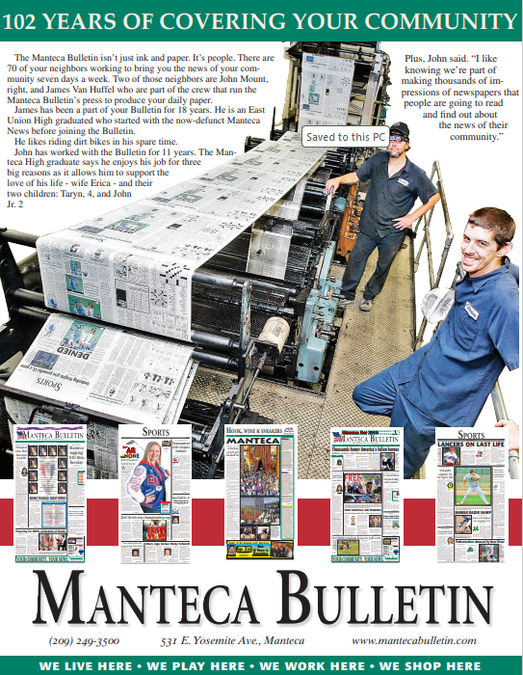
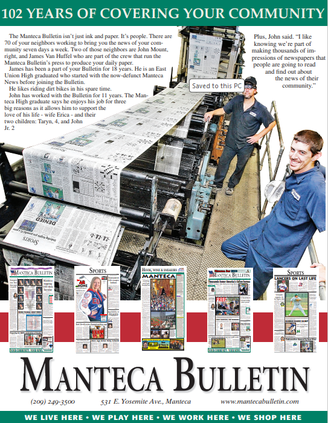
It’s a press that was the same model, type, and just a year newer than the press at the Manteca Bulletin when I was hired 35 years ago.
The press — or at least the iron bones— that were here in 1991 are still here.
Those iron bones were manufactured in the mid-1950s.
Stacks have been added, mechanic parts changed, and upgrades made over the years.
The biggest leaps in technology have been on how “copy”, photos and advertising get to the point they are imprinted onto a page.
Some have referred to publishing a newspaper as a “daily miracle.”
The hiccups of the past week dealing with aluminum plates reminded me of why there might be some truth to such a claim.
There was a time, of course, when newspapers were the proverbial dime a dozen and even small weeklies had their own printing presses.
Now printing presses are few and far between. It has resulted in a smaller market for suppliers of everything from newsprint to plates.
Toss in the supply chain and everyone trying not to get too much inventory and you can end up with problems.
But to be honest, the real challenges are often crazier.
To produce and paginate (package or layout) content we are the mercy of Comcast et al like everyone else. Internet outages — especially at night and into the early morning — have a tendency to stop progress in its tracks.
Power outages are another issue.
Everyone deals with that.
But when something goes wrong with the press or plate maker and the only on-call tech is in deep-sleep in Montreal, it can lead to all sorts of fun.
In the past 35 years, there easily have been at least a hundred times when the press crew put MacGyver to shame with some of the work arounds they devised when it looked as if we were dead in the water.
There is only one time in the past 35 years when we failed to print an edition on a day that we were scheduled to publish a newspaper.
It was because of a platemaker and our emergency 1 o’clock in the morning backups — the Tracy Press and Galt Herald — no longer had their own presses.
The paper that didn’t get delivered that day was printed and inserted inside the next day’s edition.
Power and press issues happen.
But the only thing that almost gave me a coronary in terms of a disaster happening was how pages were getting to the press for a six-week period in 1992.
That was from our old office in the 500 block of East Yosemite Avenue to the pressroom on Button Avenue.
The company’s delivery van had blown a gasket and the pick-up truck had died.
One of the press crew used his motorcycle to collect the pages when we got a number completed and take them to the pressroom.
You might be thinking what was the big deal.
Back then pages weren’t put together electronically on a computer screen.
Stories and headlines were fed into machines that printed them on thin photographic paper.
Type and art work for local ads were cut out and put together. “National” ads were sent as a Velox with all images and type photographic incorporated on a page.
Thin sheets of newspaper-sized page with six columns of light blue guidelines were attached to acrylic boards called “flats.”
Screened prints were made of photos.
Lines that appeared in print of various sizes between columns and to create a box for photos were in thin rolls that were sticky on one side.
Scissors were used for the first cut.
The items were then sent through a “waxer”. Blocks of wax were put in a metal reservoir that was then heated so the wax would melt.
The waxed items would then be applied to the page sheets that were taped to the flats using Xacto knives, pica poles (steel rulers with four different measuring systems), and a hand roller that best practices called for using with wax paper over the page.
That was so there was minimal chance that any wax on the roller would be smeared on top of copy.
It was critical not to do so as it would obscure letters when the press crew essentially shot a photo of the page with a big camera to create negatives to make the plates.
And if there was a typo, the corrected word was sent out, cut out, and then gingerly — and firmly — rolled down on top of the error.
They were then put inside Kodak full-size page negative boxes that were an inch thick.
Now imagine all of that being strapped to a rack on the back of a motorcycle with a bungee cord traveling down Yosemite Avenue at 35 mph to the pressroom.
What is a small miracle is that no edition of the Bulletin during that period ended up looking like a newspaper version of 52-card pickup.