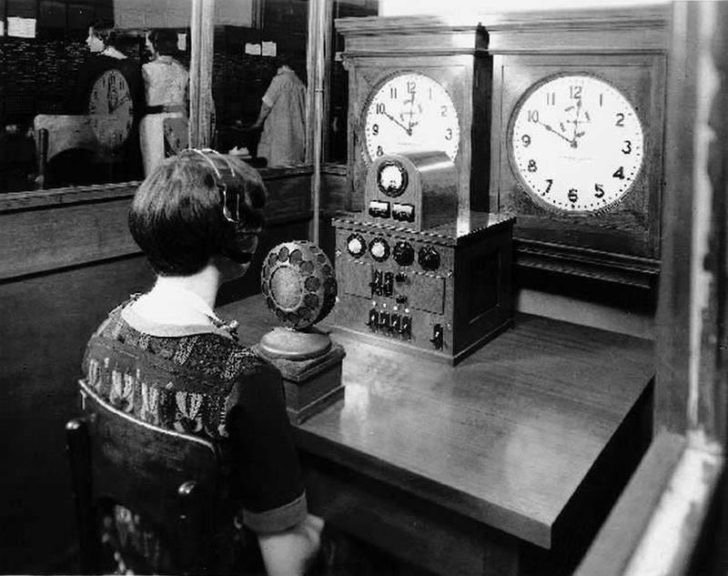
Back in the Dark Ages before people took a byte out of the Apple, if you didn’t have a watch or there wasn’t a wall clock around with a big hand and a small hand and you needed to know what time it was, you’d ask Ma.
That’s Ma as in Ma Bell.
And to talk with Ma Bell you had to find a device teetered to a plug in the wall that had an umbilical cord of about six feet attached to what today might be called a dumb phone.
Not only could you only use it to communicate with other people using your voice, instead of tapping numbers on a screen to reach them, you placed your finger in little holes above specific numbers in a metal circle and turned it.
To find out the time in many parts of Northern California and the rest of the country, you dialed the numbers with letters that corresponded to the word “POPCORN.”
In the 1950s, it was referred to in some parts of the USA as the talking clock.
It was actually the pre-recorded voice of a woman who also voiced such memorable lines as, “We’re sorry, the number you have reached is either disconnected or is no longer in service. If you need assistance, please hang-up and dial the operator. This is a recording.”
For the life of me, I never could understand why the phone company felt they had to tell you the obvious that you had reached a recording. It probably was an FTC requirement.
That said, the suggestion you should call the operator was the birth of the marketing premise for apps.
If you called an operator for information regarding a number listing more than three times a month, some phone companies dinged you a nickel for each time after you’ve run through the freebies.
Why was the POPCORN lady so popular?
It’s because she gave you the “exact” time and she didn’t hesitate to tell you so as in, “the time is now 12:15 and 20 seconds, exactly.”
Today, smartphone tells you the exact time anywhere in the world.
But it also assures that instead of dealing with a daily dump of junk mail once a day, Monday through Saturday, if you had residential postal service, you can get junk email and junk texts sent directly to you at any time, wherever you are.
And unlike a dumb phone that you could literally disconnect from the wall, you stay connected 24/7 with a smartphone.
It’s definitely convenient, but there is a price you pay for convenience.
You can shop at any time you want.
You can access your money any time you want.
And that is not necessarily a good thing.
Do not misunderstand.
It was maddening that banks only allowed you to access your cash Monday through Thursday from 10 a.m. to 3 p.m. — it was from 10 a.m. to 6 p.m. on Fridays that were typically pay days.
In a way, not being able to access your money easily made you put a lot more thought into how you spent your money. It may have not led to better results, but at least you thought about it more than just a second or so.
Back then a banker was more than an app. You built a relationship, a partnership, if you will.
That still happens but not with national chain banks and certainly not Internet banks.
It is why regional banks like Oak Valley Community Bank, F&M Bank, and Bank of Stockton are — to borrow a line from Douglass M. Eberhardt — withstanding the test of time.
At the end of the day, it is about relationships and service, not blindly riding the crest of disruptive innovation where algorithms drive decisions.
It is the mistake we make with our smartphones.
Instead of using technology at our fingertips to make our lives better, we have let it consume us.
Do we communicate better today because we can do it instantly?
Do we sacrifice living in the moment and soaking in what’s around us in favor of living in the virtual world of social media?
We no longer live for ourselves; we live to impress others.
The concept of a happy medium is lost in the whirlwind of clicks, spending impulsively, reaching out for the latest tech bauble, and expressing rage/passing judgment with strangers we counter on the so-called information highway.
The genie isn’t going back into the bottle.
But said genie isn’t going to magically change our world for the better.
And that is the lesson offered by stories where genies — or a woodcutter or some other mythical character — grants three wishes for some reason.
We have a tendency to wish for things in our idle moments.
But when opportunity presents itself, we often frivolously misuse it for short-term gain, myopically unable to see how a more prudent course of action might serve us better in the long run.
Such is the moral of such stories granting three wishes with a shiny lamp.
And such is the case with how we often use technology.
Smartphones are definitely an easier way to find out exactly what time it is, but to what end?
Are we using time more wisely today than back when you had to dial POPCORN to get the exact time?
Do we spend money more wisely because tech has made it easier to do so?
Are we better at communicating with others because it can be done instantaneously without the exercise of putting our thoughts on paper and then reflecting on what we’ve written before we tap “send?”
Technology never withstands the test of time as it always evolves.
What does are concepts like effective communication, delayed gratification, and valuing what matters.
The tech of time has come a long way from sundials and using a rotary phone to dial POPCORN to where it is today with a push of a side button on a personal computer that fits into our pocket and displays the time on big numbers on the home screen.
What never changes is the fact we have a finite amount of time, and that’s it.
The valuable thing is time, not tech.
Using tech to squander time — or the opportunity for far-reaching communication that could change hearts — is not disruptive innovation.
It’s destructive innovation.
This column is the opinion of editor, Dennis Wyatt, and does not necessarily represent the opinions of The Bulletin or 209 Multimedia. He can be reached at dwyatt@mantecabulletin.com