It’s a tad jarring to have read in USA Today’s Oct. 28 coverage that “a surprising 3.7 magnitude earthquake struck the San Francisco Bay Area.”
Nothing should be surprising about earthquakes in California, especially in the Bay Area.
Either the reporter has never lived in the Bay Area or they were looking for a way to make their lead paragraph have a bit of hyperbole even though the word “earthquake” is more than enough to grab the attention of any reader that has felt the earth rumble.
Seismometers monitored by Caltech recorded 237 earthquakes in California in the first 62 hours of November.
The closest was a 0.9 quake 15 miles southwest of Tracy 6:36:01 p.m. on Nov. 1.
The largest was a 3.9 quake 5 miles southeast of Ojai near Santa Barbara at 1:12:18 pm Nov. 3.
There were four in the Mammoth Lakes area, 160 miles to the east of Manteca.
The activity in the 62 hours Caltech dutifully posts to its website (scedc.caltech.edu/recent/Quakes/quakes0.html) reflects an average of 33,485 quakes during the course of a year’s time, That’s 3.8 quakes ever hour or 91.6 earthquakes every day.
There’s nothing “surprising” about quakes in California.
And since the “surprising” 3.7 quake centered near Millbrae struck on Oct. 27, there have been five seismic events between 3.0 and 4.2 in California as well as along its sooner just inside Nevada.
The 3.0 magnitude threshold on the Richter scale is when seismic activity is strong enough that people can feel them.
The others are detected almost exclusively by instrumentation.
What brings this up isn’t USA Today’s clickbait language but a supervolcano 6,310 miles from Manteca in Pozzuoli, Italy.
Supervolcanoes are the tag seismologists give to roughly 20 of the earth’s largest volcanoes.
The caldera-style volcano is question is dubbed Campi Fiegrei.
It is an 80 square mile depression home to 500,000 people with another 800,000 that live nearby.
Caldera volcanoes don’t rise up in a cone. Instead, they are created after the mountain blows apart and the magma chamber collapses.
Campi Foegrei is getting attention these days due to the area 8 miles west of Naples experiencing more than 2,500 earthquakes tremblors in the past three months.
It doesn’t necessarily mean it is a precursor to an eruption. The forces beneath the earth’s surface are ever moving.
But what it has done is focus a bit more attention on a supervolcano in Manteca’s own backyard — the Long Valley Caldera.
The United States Geological Survey notes there are 170 potentially active volcanoes in this country. Almost all are part of the Pacific Rim of Fire.
That list includes six in California.
The most active are Mount Shasta, Lassen Peak and Long Valley.
Keep in mind “active” is a relative term on a planet that is 4.543 billion years old.
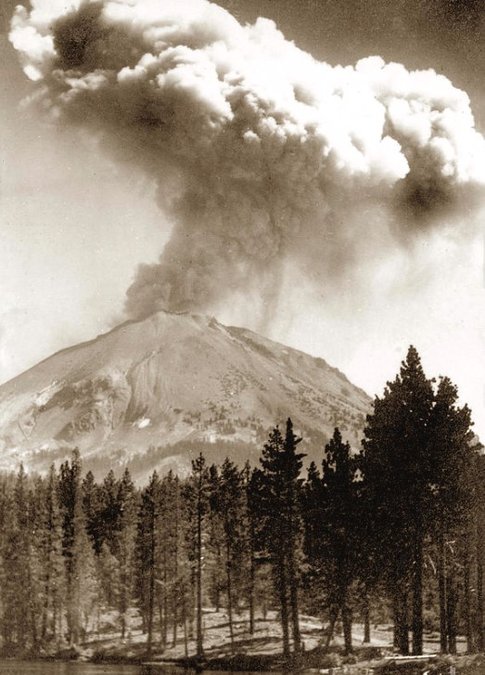
The last eruption of a volcano in California started on May 30, 1914. Mt. Lassen had various episodes of eruptions until the middle of 1917 when they ceased.
Long Valley had a super explosion 767,000 years ago.
You can actually take Highway 120 and drive by the northern edge of the Long Valley Caldera 160 miles east of Manteca.
Route 120 is probably the only California highway that passes between two volcanic fields — Long Valley on the south and Mono Craters to the north.
Mono Craters that draw from a separate magma chamber last erupted 600 years ago.
Caltech, over a 10-year period through 2020, noted there were more than 2,000 earthquakes at the Long Valley Caldera.
Before that in 1980, strong magma movement caused the floor — or ground — of the caldera that includes a segment of Highway 395 to rise 10 inches.
No one is sounding any alarms.
But it does underscore the earth is geologically active in a way that were are blissfully ignorant of.
In terms of forces that shape the earth, man is clearly inconsequential although we certainly don’t act like it.
We are “surprised” when a quake happens as if they are rare events.
In comparison, life as we know it is a surprise, compared to the long history of earthquakes, volcano explosions, and magma movements.
And while the Long Valley Caldera has been seismically stirring for decades, scientists say there are signs magma below is cooling reducing the chances of a major eruption in the foreseeable future.
The best vantage point to get a sense of the massive size of the Long Valley Caldera is to take a hike.
You don’t have to go too far to do the hike — just a little over 160 miles driving with one turn off of Highway 120 after leaving Manteca.
The hike is up Glass Mountain. Its perch is 3,179 feet above the Long Valley Caldera.
The hike itself is mercifully short covering 2.6 miles round trip. But you gain 1,865 feet in the 1.3 miles from trailhead to the 11,128-foot summit.
Along the way you will hike over and pass more Obsidian rock — basically volcanic glass created from lava as is cooled — than could fill hundreds of gravel trucks.
Glass Mountain is the highest point on the eastern rim of the Long Valley Caldera that covers 20 miles east-west and 11 miles north-south. The most prominent point on the western edge is Mammoth Mountain.
The caldera — a giant sunken bowl — is basically a sinkhole created in the most hellish conditions 767,000 years ago when molten lava erupting created a 3,000-foot deep bowl as the earth under it could no longer support the additional weight created from the magma pool pushing upward out of the earth.
The 1980 Mount St. Helens eruption in the State of Washington that killed 57 people, caused $1.1 billion in property damage and sent thick ash cloud into the Midwest was impressive. It wasn’t, however, in the same league as the Long Valley Caldera.
Volcanologists believe the last Long Valley Caldera explosion was 3,000 times more powerful than Mount St. Helens based on ash and lava output.
You certainly would have felt the shaking from that one if you had been in the Manteca area 767,000 years ago.
Experts say some form of volcanic eruption is expected every 100 years or so in California or about the same frequency of a 7.0 or higher quake along the San Andreas fault.
The last quake of that magnitude — the 1906 San Francisco quake — registered 7.9. By comparison, the last Lassen eruption was in 1915.
All in all, 190,000 people in California live in areas considered to be volcano zones.
Perhaps USA Today might find that little tidbit “surprising.”
To contact Dennis Wyatt, email dwyatt@mantecabulletin.com