My Uncle Chuck was always easy for my mom to buy for at Christmas.
She’d just buy a cartoon of Lucky Strikes.
It needed no wrapping, which was fine by Chuck.
The tobacco companies made sure a carton was a no brainer for a last-minute gift for smokers.
Back in 1965, the cartoon was decked out with festive holly art with the message “happy holidays.”
Lucky Strikes weren’t the only brand that sold cigarettes in a carton designed as a “gift box”.
That included Viceroys, Pall Malls, and Chesterfield, to name a few.
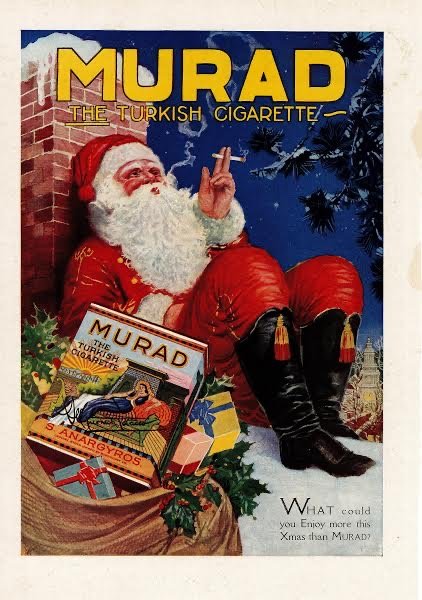
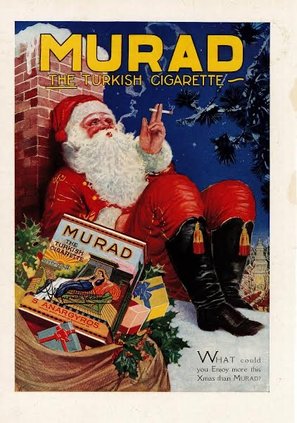
Magazine and newspaper ads had pictures of Santa hawking cigarettes in the 1940s, 1950s, and even early 1960s before the Surgeon General caught up with tobacco companies.
But they were tame compared to the 1920s where print ads actually showed the jolly old guy sitting atop a roof taking five from his appointed rounds leaning against a chimney as he puffed away.
I doubt my mom would be buying Uncle Chuck, if either were alive today, a cartoon of cigarettes.
To be honest, Chuck probably would not have given a rat’s behind about what the mountain of evidence the Surgeon General has linking smoking to cancer and more diseases than he could shake a stick out.
And it’s not that she necessarily would condemn her brother for smoking even though she was a two pack a day smoker when she quit cold turkey in 1968.
I seriously doubt she would be willing to spend the kind of dough needed today to buy a cartoon of cigarettes for a Christmas gift.
Depending upon the brand, a cartoon of cigarettes today in California will set you back $90 to $120.
Compare that to less than $9 a cartoon back in 1965.
Based on inflation since 1965, that cartoon of cigarettes should cost less than $50 today.
It doesn’t. Instead, it is more than double the rate of inflation.
That’s because federal and state governments have tried their best to tax it to death.
California, of course, tops the list of states for excise tax at a $2.87 a pack. That is on top of the federal excise tax of $1.01 a pack.
Then there are local taxes that places like San Francisco impose. In the case of The City, there is a $1.75 per pack litter abatement tax.
All of this is academic, right?
After all, cigarette smoking is slowly fading away.
Gallup surveys show 35 percent of those under 30 reported smoking recently in 2003 as opposed to 6 percent in 2024.
Overall, 11 percent of Americans last year reported they smoked a cigarette in the prior week.
But health experts are worried.
They fear cigarettes are again becoming glamorous.
They point to Hollywood.
Apparently, academia at the University of Chicago have determined tobacco products popped up in half the movies that debuted last year.
That reflects a 10 percent increase over the previous year.
Besides the obvious question about how you get a paid job watching movies to track the use of tobacco products, what’s the big concern?
Well, the experts don’t like the idea that more pop stars, social media, influencers, actors, and other celebrities are “unapologetically” smoking.
The concern is smoking is getting less taboo.
And there are numbers to suggest younger people are switching from vaping to cigarettes.
All of this is happening despite the landmark federal government’s settlement with Big Tobacco that basically set the stage for what they thought would be the beginning of the end for smoking.
That settlement led to Big Tobacco actively tracking movies and other entertainment media and sending cease and desist orders.
Reynolds, and other big tobacco firms, have ironclad policies barring the use of their products on TV or in movies. They enforce it by issuing cease and desist letters.
Firms like Altria and Reynolds have made it a corporate policy to not encourage people to start using tobacco products.
The fear that Joe Camel was going to create generations of new smokers led to the ban on all advertising by the federal government and promotions that looked like they were designed to appeal to young people.
The Marlboro Man was forced to ride into the sunset.
But the Surgeon General never dreamed of a world where a readily accessible Internet could influence more young people than TV, billboards, and such.
Tobacco companies may have been silenced from advertising or promoting cigarettes, but that doesn’t stop social media influencers et al.
The health impacts of even causal smoking are fairly clear.
That said, a two pack a day smoker is a long way from one who is one or two cigarettes a day.
It is obvious that the idea that the federal government can ever succeed at completely snuffing out smoking is, pardon the expression, a pipe dream.
Per capita consumption of cigarettes was down to 468 per capita last decade.
That is down from 2,738 cigarettes per capita in 1970.
To put that in perspective, a two-pack a day smoker consumes 14,600 cigarettes a year.
That translates, into $8,038 a year at today’s prices.
Not saying that cigarettes are a good thing, but it is unrealistic to think that somehow they are going to disappear from the face of the earth is pure fantasy.
There is no doubt there are health implications from cigarette smoking.
Anyone who believes otherwise is in an alternative universe.
Just like anyone today who wasn’t around 60 years ago can’t imagine buying someone a cartoon of 200 “cancer sticks” as a perfect Christmas gift.
Cigarettes today, among some social influencers, are seen as going retro.
They’re seen as chic.
To paraphrase the old Virginia Slims slogan, “maybe you haven’t come a long way, baby.”
This column is the opinion of editor, Dennis Wyatt, and does not necessarily represent the opinions of The Bulletin or 209 Multimedia. He can be reached at dwyatt@mantecabulletin.com