There’s still plenty of gold in California’s fertile dirt.
It lies dormant most of the year until the warm days of early spring force the natural bonanza to break through the soil and create dazzling clumps of lush, bluish green foliage accented with blooms of gold.
Given its rich and bold look basking in the Golden State’s sun as a precursor to earth’s bounty that will bless California through December, it is no wonder the Golden Poppy is the state flower.
They can be found on the edge of sandy dunes at sea level, throughout the fertile Central Valley, along the edge of the Mojave Desert, and populating the crevices in granite at 6,500 feet in John Muir’s beloved Range of Light — the Sierra.
Being partial to the Golden Poppy as a Californian is not the same as Nevadans’ partiality to sagebrush or Alabamans love of the camellia.
Unlike most state flowers, the foliage of the golden poppy dies away within months of blooming while its seeds are scattered to the four winds.
It’s a state flower whose beauty is elusive.
It is difficult to take it for granted.
Sagebrush survives the blistering high desert heat.
Camellias continue to grace gardens with their glossy wax green long after their petals have fallen.
The California Golden Poppy adds a rich luster to the countryside each spring and then disappears for another year.
Take a trip to see the hills
alive with Golden Poppies
Golden poppies have been blooming in gardens on the valley floor for several weeks.
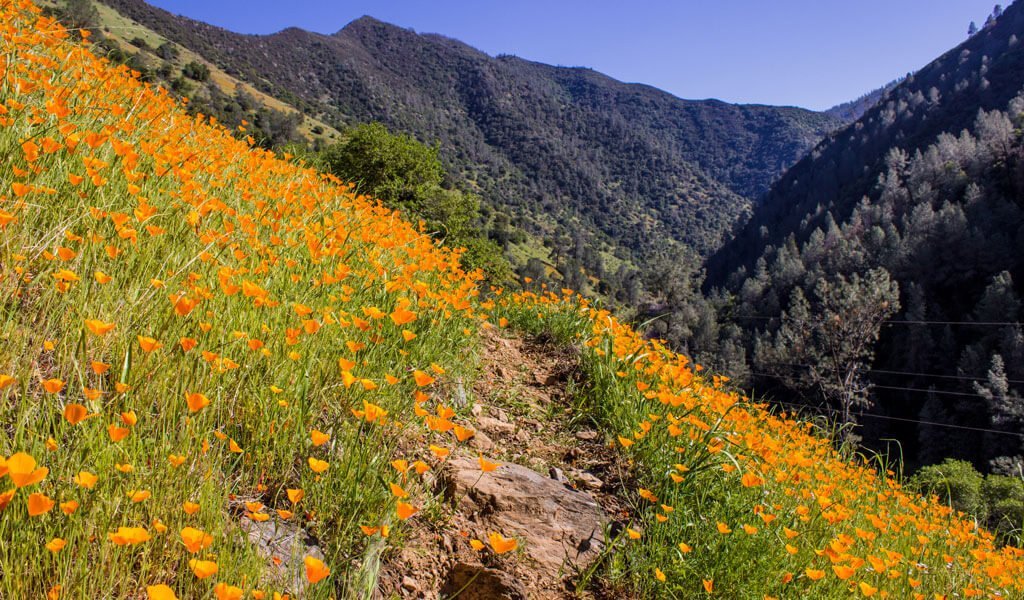
And while catching a glimpse of them when you are walking or driving by, nothing matches what awaits you for the next two to three weeks or so by taking an excursion in the 209’s backyard in Mariposa County.
It is where you will find one of the top 10 Golden Poppy areas in California and what most wildflower aficionados say is by far the best in Northern California.
Actually, it is two distinctive areas adjoining each other that have different accesses — Merced Valley and Hite Cove.
You can see the Merced Valley display from your car. It’s along Highway 140 heading out of Merced toward Yosemite National Park.
When the highway runs along the Merced River and as the valley becomes deeper, both sides of the river bank and ablaze in bright orange during the springtime.
Hite Cove is considered one of the of the five best spring hikes in Yosemite National Park as determined by the National Park Service even though it is outside the park boundaries.
The trailhead at 1,900 feet can be reached about 8.5 miles west of El Portal entrance gate to Yosemite Valley or 110 miles from Manteca and 80 miles from Turlock via Highway 99 and Highway 140.
The hike is deemed moderate as the 7.2 mile round trip has an elevation gain of only 100 feet but there is a lot of rolling terrain.
Keep in mind “net gain” is after you go up and down a lot.
Also, carry plenty of water.
It typically takes two to five hours based on fitness level.
If you opt to go all the way to Hite Cove, it is a 9 mile round trip. The reason to go the extra distance is to get a glimpse of where the south and central forks of the Merced River merge.
Typically, the prime time to hike is now through mid-May. It is dependent on how severe the winter has been. By mid-May, even with a wet winter, the flowers are pretty much dying off and it is a lot hotter.
The odds are this year the wildflowers will start loosing steam before May arrives.
Keep in mind a few things.
Cedar Lodge, that offers snacks and drinks, is three miles to the east of the trailhead that is located at the site of the historic Savage’s Trading Post.
The building no longer serves as a trading post but the sign is easy to spot. There is portable toilet across the highway from the trailhead where you will also find parking.
There is no fee but keep in mind the first 0.75 miles of the trail goes through private property.
If you slip off the trail there are spots you will get bruised if you fall. There are a few spots where the drop-off could prove deadly during a fall.
That said, it isn’t dangerous if you pay attention and remember to be careful when stepping aside to let other hikers pass on what is a one-track trail.
There are also lots of poison oak and a few mosquitoes. You can also come across ticks from time-to-time. And yes, there are rattlesnakes in the area but they don’t become an issue until spring wears on and the wildflowers are dead.
There is also a lot more to the hike than California Golden Poppies. You will find more than 60 varieties of wildflowers. The most brilliant palettes are typically now through early April.
More about the Golden Poppy
Golden Poppies can be found virtually everywhere in California during different times of the year. They pop up along sandy beaches, in fertile valleys, desert lands, rolling foothills and even in the lower elevations of mountains.
It is no wonder it was named the state flower in 1903 when then Gov. George Pardee signed legislation into law.
The reservoir bearing Pardee’s name that straddles the Alameda and Calaveras county lines 30 miles east of Stockton is just one of the endless places you can find the California Golden Poppy in bloom.
The California Golden Poppy is native primarily to California and extends into Oregon, Washington, Nevada and Arizona as well as Sonora and northwest Baja California in Mexico.
They have been introduced to other areas in the world with Mediterranean climates, most notably Chile. They also have been successfully imported to Australia, South Africa and Argentina.
They perennially grow between 5 and 60 inches tall featuring bluish-green foliage. The round lobed segments of flowers typically are in solitary stems with a slight feel of silk.
Each flower features four petals.
The petals close at night as well as in cold or windy weather.
Depending upon where you are in California, they bloom from February to September.
Wildflower experts indicate it is a potentially invasive species. That said, more invasive exotic species such as annual grasses and mustard plants have displaced the poppies in vast segments of Southern California.
It is, by the way, illegal to pick California Golden Poppies on state or federal land. But then again, it’s illegal to pick any wildflower on state or federal lands. Such a misdemeanor crime carries a maximum penalty of $1,000.
And for the record, it is illegal to harm plants on property owned by other people unless you have permission to do so.
California Golden Poppies are a flower that seems to do better with neglect.
As such, they are nature’s annual gift to California.
Nothing is more splendid that driving, hiking. or bicycling through the rolling Gold Country and to come across several acres of California Golden Poppies accenting wood rail fences.
It is true you can find the California Golden Poppy elsewhere.
The displays in other states and countries are not as dazzling or bold.
Perhaps it has to do with a bias toward California.
Or maybe it is the fact you can find them in all sorts of terrain in California from the base of snow covered volcanoes such as Mt. Shasta, the rugged Big Sur coast and even in the Owens Valley gateway to Death Valley.
The California Golden Poppy is a flower that defies convention just like the state it symbolizes.
It goes without saying — with apologizes to Joyce Kilmer — I’ll never see a poem as beautiful as a California Golden Poppy.
To contact Dennis Wyatt, email 209 dwyatt@mantecabulletin.com