The purchasing power of a penny — or at least three quarters of one — isn’t lost on Manteca’s frontline police and firefighter personnel.
Passage of the 20-year three-quarter cent sales tax measure in November of 2024 has given the City of Manteca financial breathing room to:
*authorize hiring three out-of-budget police officers to avoid excessive overtime that was putting stress on frontline officers due to a sizable number of officers out on long-term workmen’s compensation injuries.
*buy replacement fire engines and police cars for vehicles that were long past their useful life and were having constant breakdown issues.
*moving forward with a new police station that was first identified nearly a quarter of a century ago as a critical need.
*hire nine more firefighters to staff another engine company.
*make a sixth fire station to serve southwest Manteca a reality in the next few years.
City Manager Toni Lundgren, in the lead up to passage of Measure Q, repeatedly noted the tax would be the difference between Manteca “surviving and thriving” and using Band-Aid spending approaches to stay fiscally afloat.
The reason is simple.
It costs money for city services.
63% of public safety expenditure
go to cover overall personnel costs
And when it comes to the general fund, more than 63 percent of every dollar spent on public safety goes to personnel costs.
What Manteca spends in terms of a percentage of each public safety dollar for firefighters and police officers is in line with other cities throughout the Northern San Joaquin Valley region.
As of this month, Manteca spends:
*$214,833 on average for a police officer when it comes to fully loaded salaries and benefits that includes health insurance, worker’s compensation, and retirement.
*$146,111 in upfront costs per police officer including gear, equipment, and fully loaded vehicle.
*$195,312 on average for a firefighter when it comes to fully loaded salaries and benefits.
*$33,658 in upfront costs per firefighter for gear and equipment.
Those figures do not include overtime or potential cost of living adjustments.
When will Manteca’s nine new
firefighters be answering calls
The nine new firefighters Manteca has been able to hire with the help of Measure Q will likely start responding to emergency calls as a fourth firefighter on existing engine companies by the beginning of May.
Then, by mid-May, the new and existing personnel will be reassigned to existing companies as well as a sixth new company.
The new firefighters are now going through additional training with other department personnel. Then they will have roughly two weeks as ride-alongs on the existing five companies.
When the new company is formed, the tiller truck will be relocated from the Powers Avenue station from Union Road.
The ladder company (using the tiller truck) will be housed at the Union station with one of the city’s five engine companies.
The ladder company will not be the first dispatched out of the Union Road station.
They will roll on concurrent calls in the coverage area or to other areas in the city if needed when an emergency comes up and another engine company is already handling a call.
The tiller truck will respond to all “specialty” emergencies that it is equipped to handle such as major accidents on the 120 Bypass as well as whenever it is needed.
As a result, such a strategy will reduce the mileage somewhat that the $2 million tiller truck racks up as opposed to a $1.2 million fire engine.
The nine new firefighters reflect a mixture of those out of the academy and those with experience.
Three of them were previously Manteca reserve firefighters.
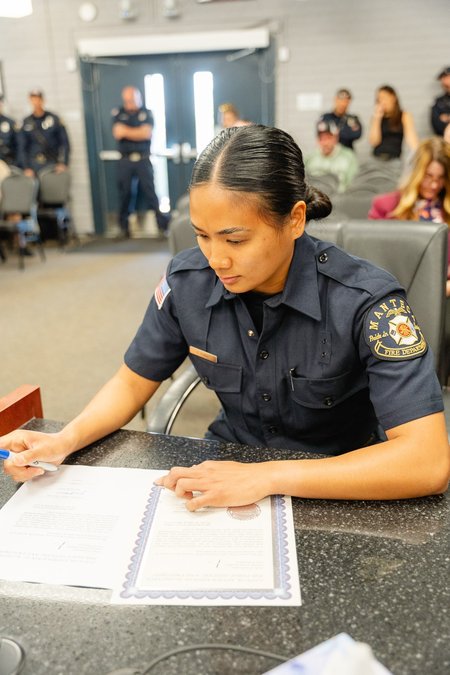
The nine includes the city’s first fulltime female firefighter although there have been female reserve firefighters.
There were 422 applicants for the nine positions.
Nine more firefighters needed
The nine new firefighter positions will be reassigned with an engine to the southwest fire station when it is completed sometime in the next two to four year horizon.
In doing so, best practices would call for an additional nine firefighters so the tiller truck wouldn’t again assume the 100 percent role of a first response engine.
Not only would that mean Manteca would function like many other departments with tiller trucks that play critical roles in structure fires from houses to distribution centers and multiple-story structure such as hotels, but the department would have optimum personnel on duty for structure fire calls.
“Most departments such as Tracy and Stockton with tiller trucks do not use them as frontline fire engines,” said Councilman Dave Breitenbucher who retired as a captain after 30 years with the Manteca Fire Department,
He noted tiller trucks — unlike fire engines — have capabilities for specific situations such as vehicle accidents, various rescue operations, specialty hazmat situations, and the ability to quickly ventilate structures that are on fire among other advantages.
Breitenbucher said ideally the city will be able to generate funding to hire nine additional firefighters for a dedicated ladder company by the time the sixth fire station opens.
He believes that can be done through various economic initiatives the city is pursuing to pump up sales tax revenue — as well as create more private sector jobs — by securing more retail in Manteca.
To contact Dennis Wyatt, email dwyatt@mantecabulletin.com