The spring storms blanketing the Sierra aren’t expected to break the back of the drought for much of California.
But it is a different story for the South San Joaquin Irrigation District.
The change of fortune has everything to do with the recent Sierra snowfall, a contract the SSJID hammered out in 1988 to protect its historic water rights on the Stanislaus River watershed, and an aggressive $14 million investment to conserve water with a state-of-the-art pressurized irrigation system for the southwestern end of the district.
The Bureau of Reclamation last week issued a water forecast based on the 1988 agreement that allowed the federal government to inundate the Melones Dam built by the SSJID along with Oakdale Irrigation District in 1925 with storage behind the New Melones Reservoir. That forecast translates into a 19 percent shortfall of the 300,000 acre feet the district has the rights to receive.
With tight oversight and conservation measures being put in place, the SSJID management now believes they will be able to meet all irrigation and domestic water needs for the rest of the year. Staff, however, cautions the Bureau’s number is only an estimate as the final figure won’t be issued until mid-April.
Even with the improved outlook, the SSJID will not likely be in a position to meet requests from other agencies this year to sell them water. During the past drought, a number of other districts counted on buying water from SSJID to avoid farmers having to tear out orchards and let field crops die elsewhere in the San Joaquin Valley.
The new water numbers will still make 2012 a tight water year. It also doesn’t address concerns relating to the possibility of a second dry winter in 2013.
There is an above average carry over from the 2010-11 water year in reservoirs throughout California. The dry winter, though, has severely cut into the outlook for water delivery even with the recent storms. The result is significant cutbacks in place for many water districts.
Working in SSJID’s favor is the $14 million investment to put in place a state-of-the-art pressurized water delivery system for 4,000 acres of farmland in Division 9 located south of Manteca and west of Ripon.
The project is expected to be completed in the coming weeks.
State-of-the-art irrigation system
The move to invest in state-of-the-art irrigation delivery systems aimed at protecting the environment, stretching water supplies, and increasing crop production efficiencies is part of a deliberate strategy by the SSJID board to maximum the benefits of the Tri Dam Project. Since the Great Recession started five years ago, the SSJID board has almost quadrupled annual investment in capital improvements to the irrigation and wholesale power system.
The district has invested more than $70 million in capital improvements since 2007. That includes increasing the power generation capacity of the Tri-Dam project as well as at SSJID’s Tulloch Reservoir. That, in turn, will generate millions of more dollars in revenue annually for the district.
Currently the SSJID’s share of Tri-Dam proceeds after system costs are met can range from $12 million to $18 million annually. That is the district’s 50 percent share with the rest going to Oakdale Irrigation District. Revenue for Tri-Dam shot up significantly after the original 50-year bonds were paid off. The district’s reserves even with the latest $14 million project are approaching $70 million.
The SSJID plans to use the Tri-Dam proceeds to also deliver on a promise to reduce retail power costs 15 percent across the board in Manteca, Ripon, and Escalon as well as the surrounding countryside by acquiring the retail delivery system from PG&E.
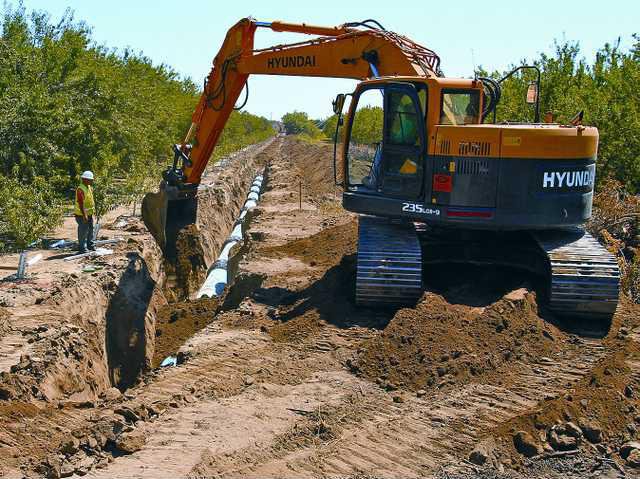
The Division 9 project involves installing more than 30 miles of pipeline installing meters than can be read remotely, and automation of water gates. When completed farmers south of Manteca will employ California’s most efficient irrigation methods.
Pressurized lines will replace open irrigation canals. All growers within Division 9 have signed to receive pressurized service. Several opted not to use the pressurized water system initially but have paid for service in anticipation of future needs. That means 78 landowners have signed on for valves to connect with the system representing 87 parcels.
In addition, a district wide grower’s survey indicated there is a high interest in other parts of the SSJID territory from farmers interested in pressurized lines to conserve water.
If results are successful, the pressurized systems may be extended to other areas of the district.
The pressurized system will reduce water waste through evaporation and will direct water where it is needed to the roots of plants and crops.
It also will help resolve an ongoing issue of salinity. The SSJID often had to augment water delivered to the farmers in the area as it is at the extreme end of the delivery system. They do that by pumping ground water and injecting it into irrigation lines. The only problem is the ground water has a growing salinity problem. When it is applied to crops it can slowly kill the roots.
Farmers need to be able to flush the soil with enough water to push the salts down and away from the roots. That sends it to the water table from where the SSJID does their supplemental pumping from. That in turns puts salt-laden water directly on the crops or tree roots.
A closed system would eliminate the need for pumping by sending water under pressure to the far reaches of the district.
The system will also eliminate pumping for ground water that in turn will reduce power bills for farmers.
In addition studies have shown water applied under pressure to where it is needed can substantially increase crop yields.